
AI Withdrawal Risk in Crypto
Explore AI withdrawal risk in crypto and how address whitelisting and zero trust models protect your assets from fast unauthorized transfers.
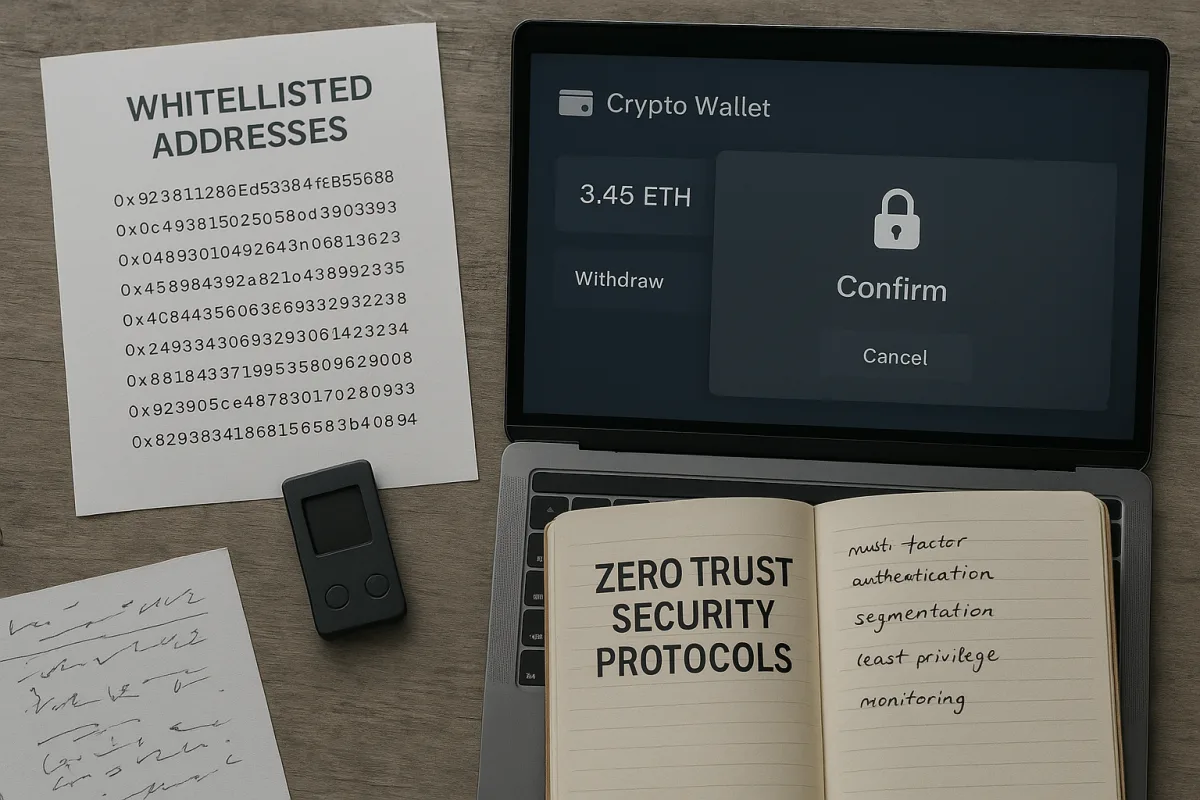
AI in Crypto: The Cost of Giving Software a Withdrawal Key
The expensive question is who can authorise a withdrawal
Crypto markets are incorporating AI in the places where money actually moves: trading interfaces, customer support, compliance screening, wallet monitoring and payment settlement. Visa Direct’s commercial deployment of USDC prefunding with Inyo Global, reported by The Block, is one example of stablecoins becoming payment infrastructure rather than a purely speculative asset.
The risk is that the same automation compresses the time between a compromised login and an irreversible transfer. In crypto, there is generally no card-network chargeback process once a transaction has been confirmed, and an agent with authority can be as dangerous as a stolen private key.
That is why the most useful concept in current crypto-security discussions is not an AI price target or a supposedly superior trading model. It is withdrawal authority: the system that determines who can send assets, where they can go, and how long a user has to intervene.
Crypto educator Crypto Casey frames this as part of a personal “zero trust” security model. The phrase is often used loosely, but its practical meaning is straightforward: possession of one credential should not automatically unlock a large transfer.
For an exchange customer, that can mean separating email accounts, using passkeys instead of SMS codes, restricting withdrawal addresses and requiring more than one approval for transfers. Each layer adds friction. That friction is not free, but it is often cheaper than giving a single compromised session unrestricted withdrawal rights.
How address whitelisting works
Address whitelisting, sometimes called withdrawal allowlisting, is an exchange setting that limits outbound transfers to a pre-approved list of blockchain addresses. If an account only permits withdrawals to two listed addresses, a thief cannot simply add a fresh wallet and empty the account immediately.
The mechanic is simple, but the outcome depends on the exchange’s implementation. A customer enters an address, completes any required authentication and waits through a security delay. Once activated, the address becomes an approved destination for a particular asset and network.
The intended protection is against an attacker who gains access to an exchange account but has not already manipulated the withdrawal list. The attacker may know the password, defeat a weak recovery process or take over an active browser session, yet still lack permission to send funds to their own wallet.
Crypto Casey cites a 48-hour cooling period used by Coinbase when a new withdrawal address is added. That is the key economic feature of allowlisting. It changes a theft from an instant event into a timed event, giving the actual account holder an opportunity to receive an alert and freeze access.
The delay is not an incidental inconvenience. It is the product. Crypto transfers can settle within minutes, and a fast-moving attacker may use bridges, swaps and multiple addresses to make tracing harder. A two-day hold creates time for detection, account recovery and exchange intervention.
That said, the 48-hour example should not be treated as an industry-wide rule. Exchanges set their own address-book procedures, cooling periods, authentication requirements and exceptions. A user needs to check the policy of the specific platform holding the assets, rather than assuming every venue offers the same protection.
What an attacker has to defeat
Whitelisting does not make an account invulnerable. It narrows the attacker’s routes. A criminal who controls the customer’s email account and exchange session may try to add a new address, disable alerts, wait out the hold and then complete the transfer.
A more serious failure occurs if the attacker has already added their address before the account holder notices, or if they persuade customer support to alter the address list. The protection is therefore strongest when account recovery, notifications and login verification are separated from ordinary consumer accounts.
This is where AI changes the operating environment. Generative systems can produce convincing phishing pages, automate conversations and tailor messages using breached personal data. Deepfake voice tools may also make telephone-based identity checks less reliable, particularly where mobile-phone numbers are used as the main recovery factor.
Crypto Casey argues that passkeys and authenticator applications are safer than SMS-based two-factor authentication, chiefly because SIM-swapping can redirect text-message codes. That is directionally sensible, but no single authentication method removes the need for device security and careful recovery controls.
Researchers have also documented device-level risks that are outside the exchange interface. TechRadar reported vulnerabilities affecting MediaTek Android devices that could expose PINs and wallet data even when affected phones are switched off. [10] A passkey stored on a compromised device is not equivalent to an independently secured signing device.
The practical lesson is that a whitelist protects an exchange withdrawal path, not every path to a loss. It does not secure a self-custody seed phrase, a malicious smart-contract approval, a compromised hardware wallet or an autonomous agent given authority to sign transactions.
Why “zero trust” is not a product feature
Zero trust is often marketed as though it were a product that can be bought in one step. In practice, it is an operating model based on continuous verification, limited permissions and the assumption that credentials, devices or networks may fail.
For an individual crypto user, the model has costs. Maintaining separate email identities, hardware keys, recovery procedures and device controls is more complex than using one password and a phone number. More complexity can itself create mistakes, including lost recovery material or inaccessible accounts.
The security case is strengthened by the size of recent losses. Crypto hacks and exploits exceeded $1 billion during the first half of 2026, according to Blockaid data reported by CoinMarketCap, with North Korean-linked groups accounting for nearly $600 million of that total. [2]
September alone produced roughly $768 million in reported losses, according to Gadgets360, making it the worst month of 2026 at that point. [3] The independent research brief identifies the Bitget exploit, at $387.5 million, and a Liquid Network exploit, at $318.7 million, as the largest single incidents.
Those figures matter because they put a price on operational weakness. They do not prove that AI caused every breach, and claims that AI agents are responsible for rising hack totals should be treated carefully unless a forensic report establishes the link.
A Business Standard report did attribute roughly $600 million in losses to AI-driven attacks on decentralised-finance platforms in April 2026. [7] Even then, “AI-driven” can encompass reconnaissance, social engineering, code generation or automated execution, rather than an autonomous system independently deciding to steal assets.
Autonomous agents create a delegation problem
An autonomous trading agent is not inherently a rogue system. It is software permitted to observe data, make decisions under set rules and execute actions such as placing orders, rebalancing collateral or moving stablecoins between venues.
The opportunity is obvious to trading firms and market makers. Software can monitor many markets continuously, respond to price dislocations and process operational tasks without waiting for a human desk. For cross-border payment businesses, tokenised dollars can also reduce prefunding and settlement friction.
The delegation problem begins when an agent receives broad permissions. An agent allowed only to read balances and suggest trades creates one category of risk. An agent holding an API key with unlimited withdrawal rights, a wallet signing key or authority to change allowlists creates another.
The correct control is therefore not simply asking whether the model is intelligent. It is defining the maximum loss it can create. A properly constrained system can have trading limits, approved venues, position caps, time-based permissions and a hard prohibition on changing withdrawal destinations.
That structure resembles address whitelisting. Both are forms of constrained authority. The agent may act, but only inside a predefined perimeter. If it is deceived by manipulated data, produces a poor trade or behaves unexpectedly, its access boundaries determine the financial damage.
The market case for fully automated crypto trading remains unproven. A September 2026 study of AI in equity and crypto markets found progress in modelling and execution, but limited evidence of sustained profitability from automated investing systems. [1] That finding is more useful than promotional claims about bots making money in rising and falling markets.
Security claims need to survive the supply chain
Self-custody shifts control away from exchanges, but it also shifts responsibility for device integrity and recovery procedures to the holder. That trade-off became more visible after reports of compromised hardware wallets sold through third-party channels.
Tom’s Hardware reported that store-bought hardware wallets had been fitted with covert chips that enabled theft of recovery phrases, with at least $93 million stolen in the reported attacks. [9] The failure was not a blockchain consensus failure. It was a supply-chain and credential-exposure failure.
Crypto Casey presents Tangem’s card-based wallet design, optional seedless mode and activation checks as mitigations against some seed-phrase and display-related attack paths. Those are product-design claims, not evidence that any wallet is immune to compromise or suitable for every custody arrangement.
Tangem’s growth does indicate commercial demand. The Block reported that the wallet maker’s 2025 revenue doubled to $61.3 million and monthly active users rose 50%, though public data does not establish comparative adoption or security outcomes against other wallet providers.
The wider evidence argues against treating an audit, a hardware wallet or an AI monitoring product as a complete solution. CoinGecko found that about 60% of exploited crypto platforms had passed independent audits, illustrating that an audit measures a review at a point in time rather than guaranteeing future resilience. [11]
Regulation is starting to focus on the interface
Regulators are also converging on the point where software meets financial authority. The SEC’s April 2026 no-action position created a path for some self-custodial crypto trading interfaces to avoid broker-dealer registration, subject to specific conditions. [5]
That matters for AI-enabled products because a company may describe itself as providing software while still influencing execution, custody, customer disclosures or access controls. The legal treatment depends on what the system actually does, not only on whether it uses blockchain or artificial intelligence.
The SEC and CFTC issued joint guidance in March 2026 on crypto-asset classification under federal securities laws. [6] Separately, the SEC proposed its “Regulation Crypto Assets” framework in August, with crypto-specific disclosure requirements. [4]
For market participants, the near-term implication is operational rather than ideological. AI can make a crypto service faster and cheaper to run, but it can also concentrate decision-making, obscure accountability and turn a minor authentication failure into a large, rapid loss.
The useful question is not whether AI will transform crypto. It already has roles in security, execution and payment workflows. The more immediate question is whether each system has a defined financial perimeter, a human escalation path and enough delay to stop a bad instruction before it becomes an irreversible transaction.
Frequently Asked Questions
What is AI withdrawal risk in cryptocurrency?
AI withdrawal risk refers to the danger that AI-powered tools, such as trading bots or wallet apps, can move crypto assets faster than human review processes. If an account or device is compromised, AI automation can accelerate unauthorized transfers, making it harder to stop thefts before irreversible blockchain transactions occur.
How does address whitelisting protect crypto withdrawals?
Address whitelisting limits withdrawals to a pre-approved list of blockchain addresses, preventing attackers from immediately sending funds to new, unauthorized wallets. Its effectiveness depends on features like cooling periods (e.g., a 48-hour delay), alert settings, and whether the attacker already controls an approved address.
Why is zero trust important for AI in crypto withdrawals?
Zero trust means no single credential should automatically authorize large transfers. Applying zero trust principles helps ensure that possession of one login or key does not grant unrestricted withdrawal rights, adding layers of authentication and friction to reduce the risk of AI-enabled or automated unauthorized withdrawals.
Can AI trading bots cause faster unauthorized crypto withdrawals?
Yes. AI trading bots or automated systems can compress the time between a compromised login and an irreversible transfer, enabling attackers to move funds more quickly than manual processes would allow. This speed increases the risk of losses before detection or intervention.
What security measures limit AI-related withdrawal risks in crypto?
Security measures include address whitelisting with cooling periods, separating recovery and notification accounts, using passkeys or authenticator apps instead of SMS-based two-factor authentication, and implementing zero trust models. Device security and careful recovery controls are also critical since compromised devices can expose credentials despite strong exchange protections.
How we researched this
This article was assembled from 1 video source, 1 published article, 11 cited references.
Nothing here is based on hands-on testing. Where a figure or finding appears, it belongs to the source cited beside it, and the writing says so rather than implying otherwise. Every source is listed below so you can check it.
Sources
Crypto Security 2027: 7 Layers to Protect Your Bitcoin & Crypto from AI, Wallet Hacks, & More... — Crypto Casey
Visa Direct moves USDC prefunding into commercial production with Inyo Global — The Block
Crypto Hack Losses Passed $1B in H1 2026, Blockaid Reports | CoinMarketCap
Crypto Hack Losses Reach $768 Million in September, Marking 2026’s Worst Month | Technology News
SEC Proposes “Regulation Crypto Assets” Rulemaking | White & Case LLP
SEC carves out path for some crypto interfaces to bypass broker registration | The Block
BTC, ETH, SOL, XRP extend losses as AI scare trade unsettles risk markets
Watch AI and Crypto: Risks and Opportunities on Youtube
Related Articles

AI Impact on Crypto Security: Risks and Defenses Explained
Explore how AI affects crypto security, from autonomous exploits to defense challenges in blockchain and smart contracts.

Tokenization and Institutional Crypto Adoption
Explore tokenization and institutional crypto adoption with insights on SEC rules, trading limits, and challenges in regulated tokenized securities.

Crypto Regulatory and Political Developments Shaping 2026
Explore key crypto regulatory and political developments in 2026, including the Clarity Act, EU MiCA, and industry election spending impacts.

Crypto Scam Infrastructure Seizures
Explore how crypto scam infrastructure seizures disrupt fraud networks and what this means for victims and recovery efforts.