
Crypto Regulatory and Political Developments Shaping 2026
Explore key crypto regulatory and political developments in 2026, including the Clarity Act, EU MiCA, and industry election spending impacts.
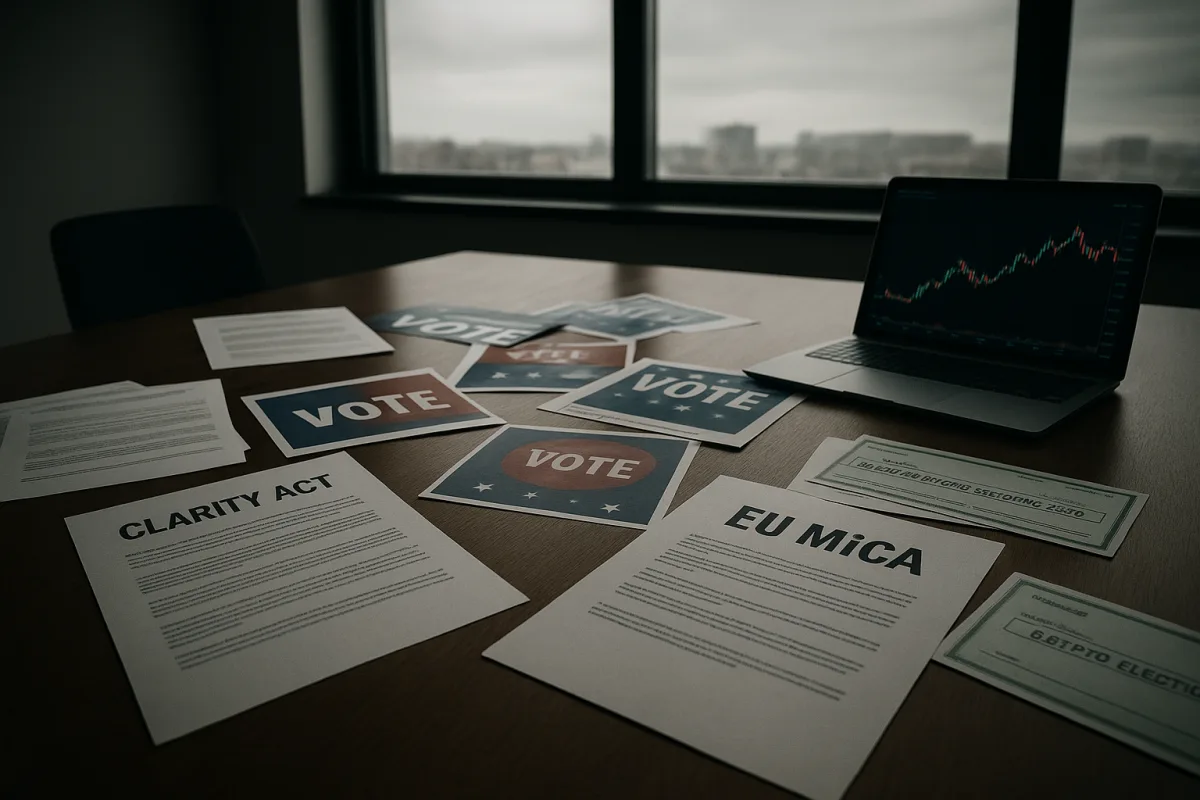
The quick list
- Best overall: Europe’s MiCA-and-Pontes route, for regulated institutions that value defined market rules and central-bank settlement over fast, lightly supervised expansion.
- Best value: U.S. agency-led rulemaking, for firms needing near-term operational guidance without waiting for Congress, but willing to accept policy-reversal risk.
- Best for political access: Crypto PAC spending, for the industry’s largest companies seeking influence over future lawmakers, with high reputational and regulatory-capture risk.
- Best for legislative certainty: A revived U.S. Clarity Act, for exchanges, token issuers and brokers that need durable jurisdictional rules, though its timing and final text remain uncertain.
What markets are deciding now
The practical question for crypto market participants is not whether Washington or Brussels is “pro-crypto.” It is which regulatory route offers the most usable rules, at what political cost, and how quickly those rules can support products, listings and institutional capital.
The immediate risk is that traders mistake a short-lived price rebound for resolution. The U.S. Senate’s failure to advance the Clarity Act left the underlying legal question unresolved, while Europe’s clearer framework comes with stricter licensing and enforcement demands.
Bitcoin initially reflected that uncertainty. After the Senate cloture vote failed 49-50 on September 15, short of the 60 votes required, bitcoin fell 4.28% to roughly $75,370 and ether dropped to around $2,400. [1][14]
A Federal Reserve rate increase compounded the move the following day. The Fed lifted rates by 25 basis points to a 3.75%-4.00% range, its first increase since 2023, before bitcoin recovered to about $80,822 by September 18. [10][11]
That rebound matters, but it should not be overread. It shows that the Clarity vote was one input among rates, leverage, liquidity and broader risk appetite. It does not prove that regulation has become irrelevant to crypto valuations.
Crypto Casey, a market commentary channel, described the post-vote decline as a short-term leverage flush and argued that the market had absorbed bad news. That is an interpretation, not a demonstrated causal forecast, particularly given the simultaneous rate decision and substantial liquidations.
Comparison table: four routes shaping crypto regulation
| Regulatory route | Size and price signal | Layout | Main benefit | Main trade-off | What remains uncertain |
|---|---|---|---|---|---|
| U.S. Clarity Act | Bitcoin fell 4.28% to about $75,370 after the failed vote. [1] | Statutory division between CFTC spot-market oversight and SEC securities oversight. [[2]](https://www.bit.com/knowledge-hub/clarity-act?utm_source=openai "CLARITY Act Explained: US Crypto Market Structure Bill | BIT")[[3]](https://coinunited.io/en/research/crypto/crypto-clarity-act-sec-rules-traders-guide-2026?utm_source=openai "Crypto Clarity Act & SEC Rules: A Trader's Complete Guide 2026 | CoinUnited.io Research") | Potentially durable federal market-structure rules |
| U.S. agency rulemaking | No direct price tag, but the cost is compliance adaptation under rules that may change | SEC, CFTC and bank-regulator guidance without new legislation | Faster operational clarity for firms | Future administrations can revise policy | How far agencies can go without Congress |
| Crypto PAC spending | $189 million industry spending in 2026, Fairshake’s $30 million anti-Brown commitment. [[5]](https://www.theblock.co/news/regulation/2026-09-21-clarity-act-fallout-cryptos-fairshake-pac-commits-30-million-against-sherrod-brown-415962?utm_source=openai "Clarity Act fallout: crypto's Fairshake PAC commits $30 million against Sherrod Brown | The Block")[[6]](https://www.kucoin.com/news/flash/crypto-firms-spend-189m-on-2026-midterm-elections-per-public-citizen-report?utm_source=openai "Crypto firms spent $189 million on the 2026 midterm elections, according to a Public Citizen report. | KuCoin") | Independent expenditure campaigns, often outside candidate committees | Can reshape the congressional coalition over time |
| EU MiCA and Pontes | No public purchase size disclosed for the ECB’s proposed tokenised-securities activity | Licensing and conduct rules under MiCA, with central-bank-money settlement infrastructure | More integrated institutional market plumbing | Tougher enforcement and slower permissioned entry | MiCA review outcomes and final operational details |
The Clarity Act: lowest sticker price for traders, highest cost for U.S. firms
The Clarity Act was designed to establish a market-structure framework rather than directly support token prices. Its central proposed trade-off was a division of responsibility: the CFTC would oversee spot markets for qualifying digital commodities, while the SEC would retain authority over securities-related tokens. [2][3]
The bill’s decentralisation test would have treated networks as commodities where no single party controlled more than 20% of supply or voting power. That kind of threshold is commercially important because it could affect exchange listings, disclosures, custody arrangements and tax treatment. [2][3]
But the bill was not a simple deregulatory package. Its stablecoin yield prohibition would have limited interest-like payments, aligning stablecoins more closely with traditional banking rules. That provision was contentious because yield is part of the commercial case for some dollar-token products.
Another difficult provision was Section 604, which raised potential liability questions for DeFi developers. The disagreement illustrates the problem facing any successor bill: even if lawmakers agree that token markets need a statutory framework, they remain divided over who bears compliance responsibility.
The political split was also more complicated than a standard Republican-versus-Democrat narrative. Three Republican senators, Susan Collins, Josh Hawley and Jerry Moran, opposed the measure, while Democratic opposition included concerns over safeguards and President Donald Trump’s crypto-related financial interests. [1]
For markets, the failed vote removed a near-term policy catalyst rather than existing regulation. That distinction helps explain why the initial sell-off reversed. The legislation did not pass, but neither did it impose an immediate new restriction on trading, custody or token issuance.
Coinbase policy chief Faryar Shirzad told Bitcoin Magazine that regulation can still advance through agency action, while acknowledging that legislation offers greater predictability. That is the essential comparison: agency guidance is quicker, but congressional statutes are harder for a later administration to unwind.
PAC spending: a $189 million effort to reduce legislative risk
The industry’s alternative to waiting for consensus is electoral spending. Crypto companies have spent about $189 million on the 2026 midterms, exceeding the reported $170 million spent in the 2024 cycle. [6][9]
Fairshake is the most visible vehicle. The super PAC reportedly raised around $137.4 million and spent roughly $88.7 million by September 21, leaving it with a financial scale that exceeds most single-issue campaigns in congressional races. [4]
Its $30 million commitment against former Ohio senator Sherrod Brown is the largest known individual commitment in the current cycle. Fairshake previously spent $12 million in Ohio supporting Republican Bernie Moreno, who defeated Brown in 2024. [5]
The price is straightforward in dollar terms but more complicated politically. Election spending may improve the odds of electing lawmakers receptive to market-structure legislation, yet it cannot guarantee votes, especially when a bill includes contentious stablecoin, ethics or DeFi provisions.
Fairshake’s spending also does not map neatly onto party labels. The PAC has supported candidates from both parties, and The Block reported that it backed Democratic senators Ruben Gallego and Elissa Slotkin, both of whom ultimately voted against the Clarity Act. [5]
That is a useful warning against simplistic assumptions about political spending. Supporting a candidate who accepts crypto as an economic sector is not the same as securing support for every bill, every issuer regime or every developer-liability clause.
The broader trade-off is credibility. The industry has argued that it needs representation commensurate with an asset class held by millions of Americans. Critics see the same spending as evidence of regulatory capture, particularly when advertisements do not disclose crypto policy as their purpose.
No complete public breakdown identifies every race, donor or targeted policy outcome. That lack of transparency makes it difficult to calculate a clean return on the industry’s $189 million spending figure, or to attribute any future legislation to PAC activity alone.
Europe: clearer infrastructure, stricter gatekeeping
Europe is taking a materially different approach. Rather than awaiting a single congressional bargain, the European Union has built its regime around MiCA, licensing, supervisory expectations and an institutional market infrastructure designed for tokenised financial assets. [12]
The ECB’s Pontes initiative is the infrastructure side of that approach. CoinDesk reported that the platform will enable wholesale settlement of tokenised transactions in central bank money, linking the Eurosystem’s payment rails with blockchain-based finance.
The ECB plans to test tokenised securities investments using its own funds, focusing initially on euro-denominated securities from governments, agencies and European supranational institutions. The size and timing of those purchases have not been disclosed, which limits any claim about immediate market impact.
Pontes sits within the ECB’s Appia roadmap, which aims to expand European tokenised-finance capabilities through 2028. For banks and securities firms, the attraction is not token-price appreciation. It is settlement finality in central bank money and more integrated post-trade infrastructure.
The cost is a narrower path to entry. Europe’s approach seeks to accommodate tokenisation within regulated finance, not create a lightly supervised alternative to it. That distinction matters for exchanges, stablecoin issuers and offshore platforms seeking access to EU customers.
Reports that ECB President Christine Lagarde blocked Binance’s EU entry underline the enforcement side of the framework. [7] The message is not that Europe rejects blockchain-based finance, but that access to the market depends on meeting supervisory standards.
The European Commission’s MiCA review consultation closed on August 31, and no final amendments have been published. [12] Firms therefore have a clearer starting framework than in the United States, but still face evolving requirements rather than a finished rulebook.
Price signals are not policy verdicts
Treasury-company buying has helped create a more constructive market backdrop, but it should not be confused with a referendum on regulation. Strategy bought 950 bitcoin for $75.7 million, taking holdings to 846,000 BTC, according to its SEC filing. [11]
Bitmine Immersion Technologies bought 27,562 ether worth about $75 million, raising its holdings to nearly 5.98 million ETH, or roughly 4.9% of ether’s supply. The company says it is approaching a 5% ownership target. [11]
Those purchases illustrate concentrated corporate demand, not a broad regulatory settlement. Bitmine chairman Tom Lee’s view that institutions are underweight crypto and will increase allocations is a market thesis, and should be treated as such rather than a price prediction. [11]
The more concrete policy signal is stablecoin regulation. Treasury Secretary Scott Bessent has promoted dollar-backed stablecoins as part of U.S. dollar infrastructure, noting that the dollar is on one side of 89.2% of foreign-exchange transactions. [11]
That creates a strategic contrast with Europe. Washington is still debating the legal perimeter for crypto markets while presenting dollar stablecoins as a tool of monetary influence. Europe is building tokenised settlement infrastructure while applying stricter access controls to private-sector platforms.
Who each option suits
A revived Clarity Act suits U.S. exchanges, brokers, token issuers and institutional service providers that need durable answers on whether an asset is a commodity or security. Its advantage is statutory predictability, but its final form may include restrictions that parts of the industry dislike.
Agency-led U.S. regulation suits firms with immediate operational needs such as custody providers, registered brokerages and banks. Guidance can arrive faster than legislation, but it carries the risk that future regulators reinterpret or replace today’s approach.
Crypto PAC spending suits large companies with the balance sheets to treat political influence as a long-term operating expense. It may change the composition of Congress, but it is expensive, outcomes are uncertain and scrutiny over donor transparency is likely to increase.
The European MiCA-and-Pontes route suits regulated financial institutions and tokenised-securities businesses that prioritise formal market infrastructure. It is less suited to businesses relying on regulatory ambiguity, fast retail expansion or lightly supervised cross-border exchange models.
Frequently Asked Questions
How did the Senate's rejection of the Clarity Act affect crypto markets?
Bitcoin fell 4.28% to about $75,370 immediately after the Senate failed to advance the Clarity Act, reflecting market disappointment. However, prices recovered above $80,000 within days, indicating that while the vote influenced short-term price moves, it did not settle the market’s overall direction.
What are the main regulatory routes shaping cryptocurrency in 2026?
There are four main routes: the U.S. Clarity Act, which aims for durable statutory jurisdiction between the SEC and CFTC; U.S. agency rulemaking, offering faster but potentially reversible guidance; crypto PAC political spending, which seeks to influence lawmakers; and Europe’s MiCA framework, providing a structured but stricter regulatory environment.
How does crypto industry political spending influence regulation?
Crypto firms spent $189 million in the 2026 midterms, with major PACs like Fairshake committing large sums against specific politicians. This spending gives the industry significant political access but raises concerns about reputational risks, regulatory capture, and transparency in donor disclosure.
What are the differences between US and EU crypto regulatory approaches?
The U.S. relies on a mix of legislative efforts like the Clarity Act and agency rulemaking, which can be faster but less stable. Europe offers a clearer, more structured framework under MiCA, emphasizing strict licensing and enforcement, as seen in resistance to Binance’s EU expansion.
What uncertainties remain after recent crypto regulatory developments?
Without the Clarity Act, firms face ongoing uncertainty over the boundary between SEC and CFTC oversight, and agency policies remain subject to change by future administrations. In Europe, stricter rules create compliance challenges, and the timing or content of any revived U.S. legislation remains unclear.
How we researched this
This article was assembled from 2 video sources across 2 channels, 8 published articles, 14 cited references.
Nothing here is based on hands-on testing. Where a figure or finding appears, it belongs to the source cited beside it, and the writing says so rather than implying otherwise. Every source is listed below so you can check it.
Sources
Bitcoin Absorbed Clarity Act Setback & Fed Rate Hike — Here’s What Happens Next (Bull Run Starting!) — Crypto Casey
Coinbase Policy Chief Shirzad: Why Congress Will Become More Pro-Bitcoin — Bitcoin Magazine
Clarity Act fallout: crypto’s Fairshake PAC commits $30 million against Sherrod Brown — The Block
Crypto's Fairshake repeats history with $30 million to oppose Sherrod Brown Senate bid — CoinDesk
Tom Lee's Bitmine Adds $74M in Ethereum, Declares a Crypto Bull Market 'Underway' — Decrypt
Strive adds 1,355 bitcoin, picks up pace toward year-end second-place treasury goal — The Block
ECB plans to buy tokenized bonds with its own funds — CoinDesk
Strategy's Bitcoin Pile Nears June Record After $76M Purchase — Decrypt
Bitmine bought $75 million ether as Tom Lee says institutions are still underweight crypto — CoinDesk
Treasury Secretary Scott Bessent champions dollar dominance across global markets and stablecoins — CoinDesk
CLARITY Act Explained: US Crypto Market Structure Bill | BIT
Crypto Clarity Act & SEC Rules: A Trader's Complete Guide 2026 | CoinUnited.io Research
Fairshake (C00835959): Super PAC 2026 Spending, Filings and Profile | The Political Group
Clarity Act fallout: crypto's Fairshake PAC commits $30 million against Sherrod Brown | The Block
Lagarde blocks Binance's EU entry, toughens crypto regulation | EUBizNews
The Global Crypto Regulatory Landscape: A Comprehensive Guide for 2026
Bitcoin Reclaims $80K as Crypto Markets Recover From CLARITY Act Blow
What next as bitcoin weathers Fed hike and Clarity Act setback?
Ethereum Falls to $2,400 as the CLARITY Act Fails in the Senate
Watch Regulatory and Political Developments Affecting Crypto on Youtube
Also from the sources
Related Articles

AI Impact on Cryptocurrency Development and Market Dynamics
Explore how AI affects cryptocurrency development, mining, and market risks amid calls for slower AI progress in crypto infrastructure.

Crypto Regulatory Developments
Explore key crypto regulatory developments, legal challenges for prediction markets, and stablecoin compliance in the US, EU, and beyond.

Bitcoin Market Outlook 2026: Price Predictions and Trends
Explore the Bitcoin market outlook 2026 with price predictions, institutional demand, and regulatory impacts shaping its future.

Crypto Regulatory Challenges
Explore crypto regulatory challenges, legal risks, and compliance costs shaping stablecoins, blockchain records, and cross-border crypto markets.