
Solana vs Ethereum Layer 1 Comparison
Compare Solana and Ethereum Layer 1 blockchains on speed, fees, liquidity, and reliability to choose the best platform for your application.
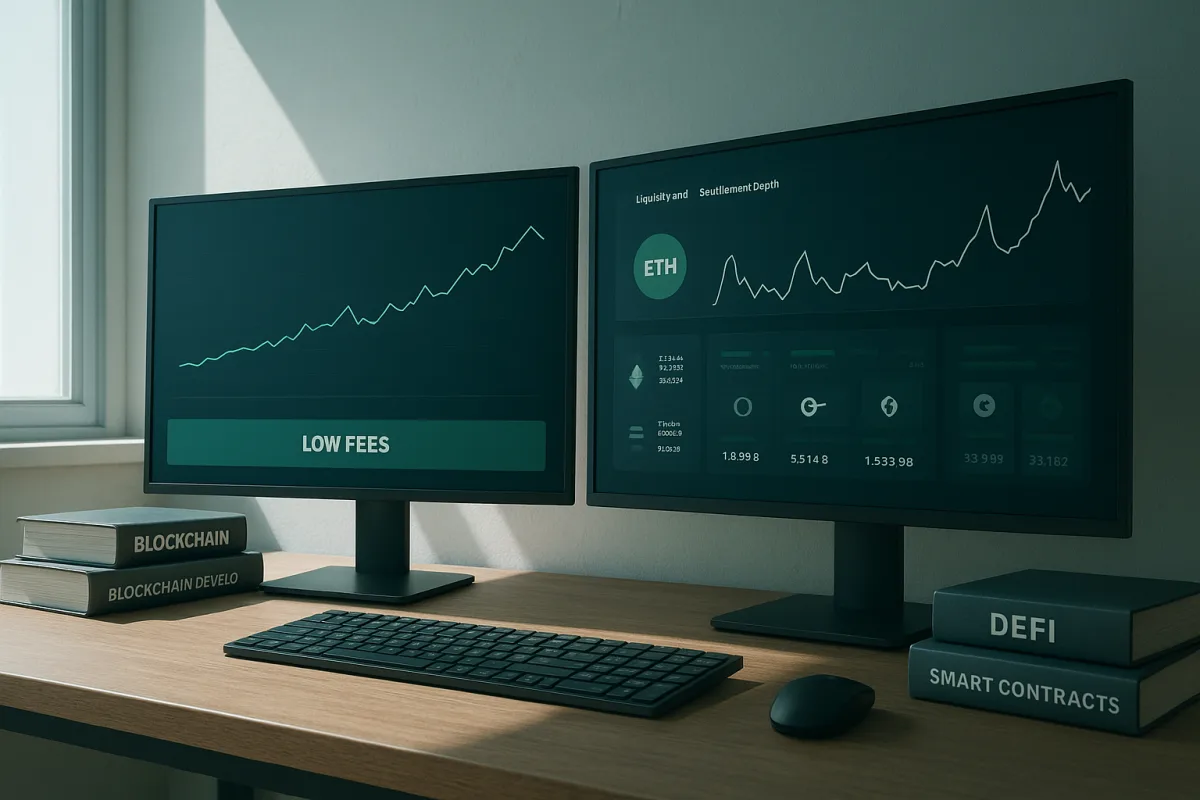
Solana vs Ethereum: the Layer 1 decision is speed versus settlement depth
The decision: Solana or Ethereum
The practical Layer 1 decision is not whether Solana or Ethereum is “better” in the abstract. It is whether an application needs one fast, low-cost execution environment now, or access to Ethereum’s deeper capital base and more established settlement network.
Solana is the choice for a high-frequency retail application. Ethereum is the choice for a protocol handling substantial on-chain capital, regulated counterparties or assets that need the widest established DeFi distribution. The gap is real, although it narrows materially once Ethereum Layer 2s are included.
The cost of getting this wrong is not principally a token-price move. It is building an application around the wrong liquidity pool, confirmation model, wallet flow and regulatory exposure, then paying to migrate users and assets later.
The risk is that Solana’s speed and low fees come with a documented reliability record, while Ethereum’s security and liquidity advantages can impose fragmented user journeys across Layer 2s. Neither trade-off disappears because a network reports strong transaction figures.
Solana’s reported Q1 2026 average of 112.6 million daily non-vote transactions, up 50% quarter on quarter, demonstrates substantial throughput demand.[17] Yet transaction counts do not tell an investor or builder whether activity is durable, profitable, organic or predominantly speculative.
Ethereum’s position is different. CoinLaw estimates that Ethereum held about $55.6 billion in DeFi total value locked in April 2026, roughly 68% of the global market.[3] That is a capital-distribution advantage, not proof that every Ethereum application has better economics.
Solana and Ethereum against the same criteria
| Criterion | Solana | Ethereum | Decision |
|---|---|---|---|
| Transaction speed | Estimated real-world throughput of 3,000 to 5,000 TPS, with roughly 400-millisecond blocks.[11] | Base layer handles roughly 15 to 30 TPS, while Layer 2 aggregate capacity can exceed 5,000 TPS.[[12]](https://eco.com/support/en/articles/15182157-solana-vs-ethereum-compared?utm_source=openai "Solana vs Ethereum: Fees, TPS, and DeFi Compared | Support") |
| User cost | Simple transfers are estimated around $0.00025, with typical fees below $0.01.[11] | Mainnet fees are estimated at $1 to $5, while Layer 2 fees are roughly $0.01 to $0.10.[[12]](https://eco.com/support/en/articles/15182157-solana-vs-ethereum-compared?utm_source=openai "Solana vs Ethereum: Fees, TPS, and DeFi Compared | Support") |
| Settlement and liquidity | TVL was about $6.22 billion on Oct. 11, according to SolDataLab.[2] | About $55.6 billion in DeFi TVL as of April, according to CoinLaw.[3] | Ethereum for deep DeFi liquidity and established capital. |
| Network structure | One primary execution environment, reducing bridge and chain-selection friction. | A base layer plus many Layer 2s, offering scale but adding network selection and bridging complexity. | Solana for retail onboarding, Ethereum for modular deployment. |
| Reliability history | At least eight major and ten partial outages were documented through February 2024.[[14]](https://www.coingecko.com/learn/what-is-solana-sol-and-how-does-it-work?utm_source=openai "What Is Solana (SOL) and How Does It Work? | CoinGecko") | No comparable outage record is cited in the supplied research. |
| Finality | Reported finality is about 12.8 seconds.[11] | Layer 1 finality is estimated around 13 minutes, although Layer 2 soft finality can be under one second.[[12]](https://eco.com/support/en/articles/15182157-solana-vs-ethereum-compared?utm_source=openai "Solana vs Ethereum: Fees, TPS, and DeFi Compared | Support") |
| Regulatory and institutional fit | Expanding developer activity, but China-related event disruption shows policy sensitivity.[4] | Larger DeFi footprint and deeper institutional integration, though no regulatory outcome is guaranteed. | Ethereum for conservative institutional deployment. |
| Main weakness | Reliability history, speculative activity concentration and uncertain regulatory conditions in some markets. | Higher costs on mainnet and fragmented execution across Layer 2s. | The right choice depends on the application, not a universal winner. |
Criterion one: speed and transaction cost
Solana’s advantage starts with execution. Current benchmarking cited in the research places real-world throughput between 3,000 and 5,000 transactions per second, against a theoretical maximum of 65,000, with block times near 400 milliseconds.[11]
That makes a meaningful commercial difference for trading interfaces, gaming, consumer rewards, machine-to-machine payments and other products where users will not tolerate paying dollars to complete a low-value action. A simple Solana transfer is estimated at roughly $0.00025.[11]
Ethereum mainnet cannot compete directly on that criterion. Estimates in the research put its base-layer capacity at 15 to 30 TPS and typical fees between $1 and $5, although costs vary sharply with demand.[12]
Ethereum’s answer is its Layer 2 ecosystem. Aggregate Layer 2 throughput can exceed 5,000 TPS, with transaction fees estimated between $0.01 and $0.10.[12] That can be sufficiently cheap for many applications, but requires users to understand which network holds their funds.
Solana therefore wins this criterion for applications that want a single native environment and negligible transaction costs. Ethereum remains credible when a team accepts Layer 2 architecture in exchange for access to its wider capital base.
Criterion two: liquidity and settlement depth
Ethereum wins decisively on currently documented DeFi capital. The $55.6 billion TVL estimate cited by CoinLaw is almost nine times Solana’s reported $6.22 billion TVL in October.[2][3]
TVL is an imperfect measure. It can include staked, rehypothecated or inactive assets, and it does not equate to revenue, users or trading volume. Still, for a lending market, stablecoin issuer or collateral-intensive protocol, available capital matters.
Solana’s lower TVL does not mean low usage. Its Q1 average of 112.6 million daily non-vote transactions indicates a network built around high-frequency interaction rather than simply locked collateral.[17] The key question is whether that interaction remains after speculative demand recedes.
For an issuer needing deep liquidity, established lending markets and a broad set of counterparties, Ethereum is the stronger base. For a product monetising volume, quick settlement and low-value user actions, Solana’s lower cost base may matter more.
Neither conclusion is a token-price forecast. The view that Solana activity must close any valuation gap with Ethereum is speculation, because token holders do not automatically receive application revenue and network usage can reverse quickly.
Criterion three: resilience and operational risk
Solana’s resilience is the central qualification to its performance case. CoinGecko’s documented history includes at least eight major and ten partial outages through February 2024, including a five-hour interruption on Feb. 6, 2024.[14]
There is no supplied evidence of later outages, but absence of later data is not evidence that the risk has been eliminated. A builder choosing Solana should treat operational redundancy, user communication and fallback trading procedures as design requirements.
Ethereum’s slower base layer is partly the price of a more conservative architecture. Its large validator base and longer operating history make it the lower-risk operational choice for applications where a service interruption could produce legal, collateral or reputational consequences.
Solana supporters can fairly argue that its network has continued handling significant activity since the 2024 incidents. That is evidence of resilience in the ordinary sense. It is not a guarantee that peak-load, software or validator problems cannot recur.
The decision here is straightforward. A consumer trading product can tolerate more infrastructure risk in exchange for cost and speed. A settlement venue, collateral system or regulated asset platform generally has less room to do so.
Criterion four: regulatory and geographic execution
Solana’s planned China activity illustrates a separate form of resilience risk. The Solana Foundation postponed its Shanghai Accelerate event after registrations reportedly quadrupled overnight and exceeded the local attendance limit.[4]
The official explanation was capacity compliance, but reports also described police presence and access problems at the venue.[5] Subsequent tour registrations for Hangzhou, Shenzhen and Beijing were closed, leaving their operational status uncertain.[6]
That mattered because Solana had just opened a Shanghai office in Pudong focused on developer infrastructure, AI and robotics through its Builder Station initiative.[9] The initiative was positioned away from direct crypto promotion, reflecting the constraints of the Chinese market.
China reinforced restrictions in February 2026, including limits on offshore tokenisation of domestic assets and on internet companies facilitating crypto or real-world-asset activity.[8] A local developer office is not equivalent to a freely operating token business.
Ethereum is not immune to regulation, but Solana’s China episode shows why ecosystem-event announcements should not be treated as adoption metrics. The postponement does not prove failure, yet it exposes execution risk in a strategically important market.
Where Sui and Starknet fit
Sui is the more relevant emerging competitor to Solana because it targets high-throughput application design. PipeFlare cites throughput of up to 5,000 certificates per second and sub-second finality for simple transfers.[13]
That makes Sui suitable for teams that want consumer-scale responsiveness but are willing to accept a younger ecosystem with less verified comparative market data. The supplied research provides no current Sui market capitalisation, daily transactions or transaction-fee figure.
Starknet occupies a different position. It is an Ethereum-aligned scaling system rather than a direct single-chain substitute for Solana, and the available research gives it a market capitalisation of about $482.2 million and 24-hour trading volume of $109.4 million.
Starknet suits teams that want Ethereum’s settlement environment while pursuing a scaling-oriented execution stack. It falls down as a clean head-to-head infrastructure choice here because the supplied research lacks comparable figures for its throughput, finality and fees.
Neither Sui nor Starknet has a verified token price in the supplied research, so presenting either as a price-based alternative would be misleading. The same caution applies to market-cap comparisons, because current comparable Solana and Ethereum market-cap figures were not provided.
Solana’s published roadmap activity includes research around Accord, an arbitration oracle designed to support composable dispute resolution on the network.[1] That is promising technical work, but an academic paper is not evidence of deployed adoption or future revenue.
Breakpoint 2026 has also been announced as a Solana ecosystem event, although a date was not specified in the available report.[7] Builders should regard it as a potential catalyst for partnerships and product launches, not as a measurable economic result.
Who each option suits
Solana suits consumer-facing trading venues, payment products, games, marketplaces and automated applications where transaction frequency is high and individual transaction value may be low. Its advantage is the combination of low fees, fast blocks and a single primary execution environment.
Solana falls down for teams that cannot tolerate another major interruption, require the deepest existing DeFi collateral base or operate in jurisdictions where developer events and crypto-facing business activity can be abruptly constrained. The Shanghai postponement is a reminder that ecosystem momentum is not the same as regulatory permission.[4][5]
Ethereum suits lending systems, stablecoin infrastructure, tokenised-asset programmes and protocols that need deep on-chain liquidity, established integrations and conservative settlement assumptions. Its mainnet costs can be justified where transaction size is large enough.
Ethereum falls down for products that need frictionless microtransactions or cannot ask users to manage bridges, multiple networks and Layer 2 balances. Layer 2s reduce the cost problem, but they do not remove architectural fragmentation.
Sui suits early-stage teams optimising for high-speed consumer experiences and willing to accept thinner available market evidence. Starknet suits teams that explicitly want Ethereum alignment and can work within its scaling architecture. Neither has enough comparable data in the supplied research to replace the Solana-versus-Ethereum decision.
Frequently Asked Questions
What are the main differences between Solana and Ethereum as Layer 1 blockchains?
Solana offers a single, high-throughput execution environment with fast confirmation times and low fees, making it suitable for consumer applications requiring speed and cost efficiency. Ethereum, by contrast, has a base layer with lower throughput but supports many Layer 2 networks that increase capacity, offering deeper liquidity and a larger DeFi ecosystem. The choice depends on whether an application prioritizes native speed and simplicity (Solana) or capital distribution and established settlement (Ethereum).
Which blockchain is faster, Solana or Ethereum?
Solana processes an estimated 3,000 to 5,000 transactions per second (TPS) with approximately 400-millisecond block times, providing quick base-layer finality around 12.8 seconds. Ethereum’s base layer handles about 15 to 30 TPS, but Layer 2 solutions can exceed 5,000 TPS with soft finality under one second. Solana is faster natively, while Ethereum achieves comparable speed through Layer 2s.
How do Solana and Ethereum compare in transaction fees?
Solana’s transaction fees are very low, with simple transfers costing around $0.00025 and typical fees below $0.01, making it economical for frequent, small-value transactions. Ethereum’s mainnet fees range from $1 to $5, but Layer 2 fees are lower, roughly $0.01 to $0.10. Thus, Solana is generally cheaper for high-frequency activity, while Ethereum’s fees vary by network layer.
What are the reliability risks of using Solana?
Solana has experienced at least eight major outages and ten partial outages documented through early 2024, which represents a significant operational risk. Although its resilience has improved since the 2024 outages, this history remains a material consideration for developers prioritizing network continuity. Ethereum has no comparable outage record cited in the available research.
When should developers choose Solana over Ethereum for dApps?
Developers should choose Solana for applications that require fast, low-cost execution with simple user onboarding, such as high-frequency retail trading, payments, or consumer apps where sub-cent fees and quick confirmation are critical. Ethereum is preferable for projects needing deep DeFi liquidity, institutional integration, or regulatory alignment, especially when handling substantial on-chain capital or tokenized assets.
How we researched this
This article was assembled from 1 video source, 8 published articles, 18 cited references.
Nothing here is based on hands-on testing. Where a figure or finding appears, it belongs to the source cited beside it, and the writing says so rather than implying otherwise. Every source is listed below so you can check it.
Sources
Solana Versus Ethereum Data Breakdown Reveals Something Shocking — Lark Davis
Traders will soon be able to bet on whether Coinbase, Robinhood and Marathon will hit their targets — CoinDesk
Solana’s Liu says Shanghai event postponed over registration surge — Cointelegraph
Circle targets 40 new markets as stablecoin demand grows globally — CoinDesk
Quantum Alliance forms amid warnings 6.4 million bitcoin face future quantum threat — CoinDesk
Tokenized Tesla surges as Elon Musk unveils SpaceX-powered flying Roadster prototype — CoinDesk
Altcoins outpace bitcoin as celestia jumps 16%, Warsh silent on interest-rate plans — CoinDesk
Scammer gets scammed in Ledger spy-chip exploit, loses almost $5 million in bitcoin — CoinDesk
Live updates: Bitcoin steady near $82,000 after Fed Chair Warsh's comments — CoinDesk
Accord: Schelling-Point Arbitration as a Composable Solana Primitive
Solana’s Liu Says Shanghai Event Postponed After Registration Surge
Solana Postpones Shanghai Event Amid Police Response, Registration Closes | CoinArticle
Solana Announces Breakpoint 2026 Event for Ecosystem Innovation | TokenPost
CZ Questions Solana’s Grasp of China Rules After Police Halt Shanghai Event
Solana vs Ethereum in 2026: Speed, Decentralization & ETF Battle - CrypTech Today
Is Solana Quantum Safe? What SOL Holders Need to Know | QuanChain
Solana Foundation says the network is secure against quantum threats
Solana vs Ethereum 2026: Which Blockchain Should You Use? CoinCreate Web3 Resources
Watch Solana and Layer 1 Developments on Youtube
Related Articles

XRP Surges to $340: Catalysts for Future Growth in 2025
XRP's potential shines as it reaches an all-time high of $340 in 2025. Regulatory clarity, institutional adoption, tokenization, and retail interest fuel optimism for XRP's future growth. Exciting times ahead for this crypto powerhouse.

Crypto Regulatory Challenges
Explore crypto regulatory challenges, legal risks, and compliance costs shaping stablecoins, blockchain records, and cross-border crypto markets.
XRP Resilience: Potential US Reserve Inclusion Sparks Price Surge
Discover how XRP defies the crypto market crash, with potential US strategic reserve inclusion. Ripple's partnerships and strategic moves hint at a bullish future for XRP's price.
XRP Resurgence: Ripple's Legal Win & Future Amid Pro-Crypto Wave
Discover how XRP surged back with regulatory changes, Ripple's legal victory, and the future of crypto post-Washington's pro-crypto shift. #XRP #Ripple #cryptocurrency