
Tokenized Treasury Markets
Explore tokenized treasury markets and institutional adoption trends, including risks, growth, and regulatory frameworks in 2026.
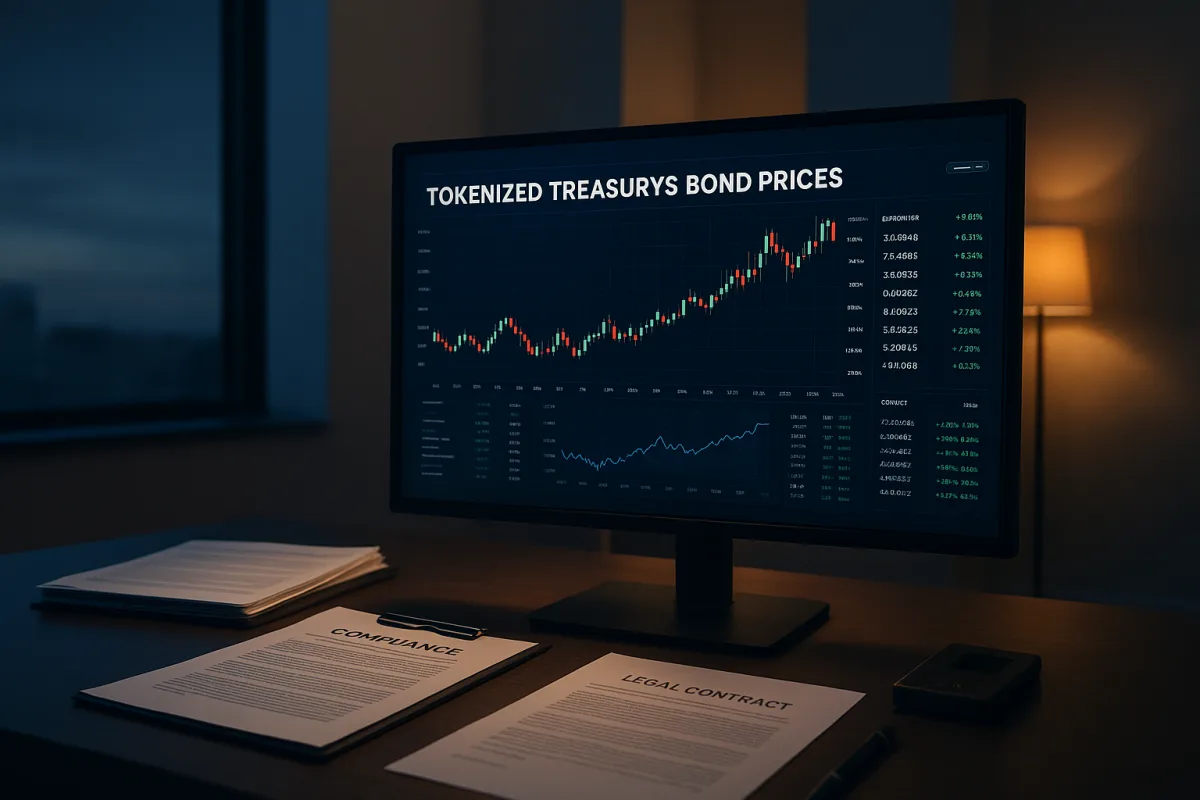
The institutional shift is real, but narrow
Major financial institutions are no longer treating tokenization solely as a research topic. They are building regulated rails for tokenized cash, funds, securities and settlement, while exchanges and payment companies are testing how those assets trade and move.
The immediate risk is that institutional interest can be mistaken for a functioning market. The IMF has warned that tokenized markets remain small, illiquid and more volatile than their conventional equivalents, with tokenized US stocks showing roughly 1.5 times the volatility of traditional shares. [1]
The evidence for a shift is strongest in low-risk financial assets, particularly US Treasuries and cash-like instruments. Research cited by Crowdfund Insider put tokenized real-world asset capitalization at $19.3 billion by the first quarter of 2026, up from $5.42 billion in early 2025. [8]
That is rapid growth from a small base, and the asset mix matters. Tokenized US Treasuries represented 67.2% of the market, or roughly $10 billion by the end of March, according to the same research. [8]
This is not yet a wholesale migration of public markets onto blockchains. It is a concentrated effort to place short-duration, yield-bearing instruments on programmable settlement rails, where issuers can test demand without immediately confronting the complexities of tokenized equities.
JPMorgan’s Kinexys platform is one indicator that the activity is extending beyond crypto-native firms. McKinsey reported that the platform processes more than $1 trillion of tokenized deposit transfers annually, showing that institutions see commercial use in moving regulated money, not just issuing digital representations of funds. [3]
The US Securities and Exchange Commission’s five-year tokenized-stock pilot provides another signal, although it is also a reminder that regulators are proceeding cautiously. The framework permits public-blockchain trading with safeguards for shareholder rights and restrictions on synthetic derivatives. [2]
Meanwhile, Stellar’s tokenized-asset market rose more than 360% during 2026 to nearly $4 billion, according to Terminalcraft. The reported growth spans tokenized Treasuries, credit instruments and non-US government securities, a broader mix than the earliest Treasury-focused products. [4]
Those are separate institutions and networks pursuing similar commercial goals: faster settlement, continuous transferability, collateral mobility and lower reconciliation costs. That convergence is more meaningful than any single tokenized-fund launch or trading-platform announcement.
Why the timing has changed
The practical case for tokenization has improved because key components are now available at the same time. Stablecoins provide an onchain cash leg, custody providers have developed institutional offerings, and regulated entities have clearer, though still incomplete, paths to issuance and distribution.
CoinDesk’s reporting on research firm Citrini argues that the central opportunity is not simply trading a stock at midnight. It is making financial assets usable across applications, as collateral, lending inventory or settlement assets, without rebuilding custody and transfer systems for each venue.
That is the operational argument institutions understand. A tokenized fund share or Treasury instrument may settle faster, move outside local market hours and be used in a collateral workflow, provided its legal ownership, transfer restrictions and redemption process remain enforceable.
Payments firms are moving in the same direction. CoinDesk reported that Polygon Labs acquired regulated crypto-payments provider Coinme, seeking to control conversion between cryptoassets, stablecoins and conventional money rather than operating only the underlying blockchain.
Polygon’s strategy is commercially intelligible, but it is early. Its chief executive told CoinDesk that the company expects its regulated payments business to become profitable in 2027, while its unified integration remained in technical preview rather than general availability.
The comparison with established payment networks is sobering. Visa processed more than $12.3 trillion in payments volume during fiscal 2025 and Stripe processed $1.9 trillion, according to CoinDesk. A blockchain-based payments business does not gain scale merely by acquiring regulated access.
Traditional firms are also not waiting for crypto infrastructure companies to capture the market. CoinDesk noted that Visa has expanded stablecoin settlement, Stripe has built stablecoin-payment capabilities, and Swift is developing blockchain infrastructure with major banks.
For a project builder, this changes the competitive question. The task is no longer to prove that blockchain settlement is technically possible. It is to identify where an existing financial workflow is expensive, slow or poorly interoperable, and show why the proposed structure is better.
Treasury products lead because the risks are easier to contain
Treasury tokenization has become the leading use case because the underlying asset is familiar, the yield is observable and the redemption proposition is comparatively straightforward. It is far easier to sell institutions a digitized claim on short-term government debt than a novel tokenized private asset.
That does not mean tokenized Treasuries are risk-free. Investors still face issuer, custody, smart-contract, transfer-agent, counterparty and liquidity risks that may sit alongside, rather than replace, the credit risk of the underlying government instrument.
The market’s concentration in Treasuries also limits what can be inferred from headline growth. A rapidly expanding cash-management category does not prove that tokenized equities, real estate, private credit or commodities will develop equally deep secondary markets.
BlackRock’s tokenized BUIDL fund is frequently cited as evidence of institutional adoption, but the figures circulating in market coverage are inconsistent. The research brief cites both $10 billion in April 2026 and $2.1 billion in assets under management in June 2026, so neither figure should be treated as reliable here.
What can be said with more confidence is that large asset managers are willing to issue regulated fund products onchain. The harder question is whether secondary trading, collateral reuse and cross-platform distribution become sufficiently valuable to justify the additional operating complexity.
CoinDesk’s tokenization analysis makes the distinction clearly. Jeff Dorman of investment firm Arca told the publication that issuance itself could become commoditized, while the more durable economics may arise after issuance, when assets trade, are lent or are pledged as collateral.
That is a more useful framework than assuming the tokenization layer captures all the value. Distribution platforms, custodians, market makers, payment processors, compliance vendors and networks may each take a share, and the eventual allocation remains uncertain.
Securities trading remains the harder test
Tokenized shares are a more consequential but less proven application. The SEC pilot is significant because it creates a defined route for blockchain-based stock trading, but its investor-protection provisions show that tokenized securities cannot simply be treated as unrestricted cryptoassets. [2]
The requirement to preserve shareholder rights matters. A tokenized stock that does not deliver voting rights, dividends, corporate-action treatment and enforceable ownership claims equivalent to the underlying security may be a derivative or contractual exposure, not the share investors assume they own.
There is already evidence of issuer unease. The Block reported that CoreWeave, Broadcom, Verizon and other companies objected to tokenized trading of their shares on OKXICE, while Applied Optoelectronics told The Wall Street Journal it was uncertain about effects on price, liquidity and volatility.
Those objections are not proof that tokenized equities will fail. They are proof that issuers, exchanges and regulators are still negotiating who controls the product, what investors own and whether tokenized venues fragment liquidity from established markets.
The IMF’s comparison of tokenized and traditional share volatility reinforces that concern. A market open around the clock can offer more trading windows, but it can also expose thinner order books to abrupt moves when conventional exchanges and market makers are closed. [1]
Tokenized repo provides another useful reality check. Research cited by CoinMarketCap put tokenized repo volume at roughly $300 billion to $350 billion daily, substantial in isolation but far below the roughly $13 trillion traditional US repo market. [1]
Institutional experiments are therefore not the same as institutional migration. The products are being built, but the deepest pools of securities financing, liquidity provision and post-trade infrastructure remain largely within conventional market architecture.
Infrastructure is the constraint, not chain capacity
The next bottleneck is operational readiness. Blockchain.News reported that only 15% of custody infrastructure is production-ready, despite banks increasing tokenized-asset activity. [5] That gap is important because custody is where technological convenience meets legal finality.
A viable institutional system must control wallet permissions, key management, asset issuance, burns, freezes, redemptions, transfer restrictions, audit trails and recovery processes. Each feature can improve compliance, but each can also add operational dependencies and new failure points.
The research brief flags unauthorized issuance and dilution among the custody and governance risks. A token that can be created incorrectly, transferred to an ineligible holder or frozen without a clear contractual process is not ready for institutional balance sheets. [6]
Legal classification remains equally important. The Blockchain Council’s review of tokenization risks notes that ambiguous treatment can create enforcement, onboarding and compliance problems, particularly where different jurisdictions disagree over whether a token is a security, deposit, fund interest or derivative. [6]
The IMF has also cautioned that tokenization’s reported $65 billion market expansion is moving faster than regulatory development. [7] That does not invalidate the market, but it increases the value of conservative structures, legal opinions and clear investor disclosures.
This is where claims of seamless global liquidity should be treated carefully. Tokenization can make transfer technically easier, but regulated assets still carry eligibility rules, sanctions screening, tax reporting, securities-law obligations and local settlement requirements.
What a new project should build first
A project considering tokenization should begin with the legal claim, not the token standard. It needs to establish precisely what the holder owns, how that right is evidenced, who maintains the register and how redemption or insolvency is handled.
Swiss regulation illustrates the distinction. In a Bitcoin Magazine interview, Swiss alternative-investment manager Richard Byworth said Swiss banks faced limits on their digital-asset expansion. The available research does not support that characterization as a general 2026 FINMA policy.
FINMA’s current approach centers on custody, prudential supervision and investor protection, including bankruptcy-proof custody arrangements, rather than explicit portfolio holding caps or growth ceilings. Switzerland’s DLT Act also strengthens insolvency protection for custody assets without setting quantitative digital-asset limits.
That correction matters because regulatory constraints are often misstated in project pitches. Builders should map the actual rules in every relevant jurisdiction, including issuance, custody, transfer, taxation, marketing and secondary trading, before relying on broad claims of regulatory openness.
The second requirement is distribution. A tokenized fund or credit product without a regulated investor channel, banking access, redemption mechanism and credible liquidity provider may be technically sound but commercially irrelevant. Issuance does not solve customer acquisition.
The third requirement is a reason for the asset to be onchain after issuance. CoinDesk’s reporting identifies collateral use, lending and settlement as possible sources of value. A project that offers only a parallel record of an already digitized security should be explicit that the benefit may be administrative rather than transformative.
Price speculation should also be separated from infrastructure analysis. Cointelegraph’s report on CryptoQuant’s Bitcoin moving-average signals is a market-forecast story, not evidence that tokenization is succeeding. Technical indicators can describe historical price patterns, but they do not validate institutional adoption.
Similarly, Bitcoin Magazine’s discussion of Bitcoin-collateralized credit and yields is relevant to the broader search for alternative financial products, but it is not evidence of regulated asset tokenization at bank scale. Yield claims remain strategy-specific and carry market, counterparty and liquidation risks.
The measurable trend is that regulated institutions are building tokenized-money, fund and securities infrastructure at the same time. The unproven part is whether that infrastructure consolidates liquidity, lowers total costs and produces sustainable economics for the companies operating it.
Frequently Asked Questions
What are tokenized treasury markets and how do they work?
Tokenized treasury markets involve issuing digital representations of US Treasury securities on blockchain platforms. These tokenized assets enable faster settlement, continuous transferability, and use as collateral across applications, leveraging programmable settlement rails. Institutions can trade and move these assets outside traditional market hours while maintaining regulatory compliance.
Why are tokenized US Treasuries leading institutional adoption?
Tokenized US Treasuries represent a low-risk, yield-bearing asset class that suits institutional needs for programmable settlement and collateral mobility. They accounted for about 67.2% of the tokenized real-world asset market, roughly $10 billion by early 2026, reflecting rapid growth and strong demand for cash-like instruments with faster settlement capabilities.
What risks affect tokenized treasury and securities markets?
Key risks include thin liquidity, fragmented trading venues, higher observed volatility (tokenized US stocks show about 1.5 times the volatility of traditional shares), and potential custody or legal failures. These factors can undermine confidence in tokenized products despite regulatory safeguards and technological advances.
How do regulated custody and legal frameworks impact tokenized assets?
Regulated custody ensures bankruptcy-proof solutions by requiring custody at prudentially supervised institutions or equivalent jurisdictions. Legal frameworks like the SEC’s five-year tokenized-stock pilot provide safeguards such as maintaining shareholder rights and restricting synthetic derivatives, enabling cautious institutional adoption while managing enforcement and onboarding risks.
What is the current size and growth trend of tokenized real-world assets?
Tokenized real-world assets are projected to grow rapidly from $5.42 billion in early 2025 to $19.3 billion by the first quarter of 2026. This surge is driven by institutional momentum, especially in tokenized US Treasuries, credit instruments, and non-US government securities, reflecting a shift from pilot projects to regulated market infrastructure.
How we researched this
This article was assembled from 1 video source, 4 published articles, 11 cited references.
Nothing here is based on hands-on testing. Where a figure or finding appears, it belongs to the source cited beside it, and the writing says so rather than implying otherwise. Every source is listed below so you can check it.
Sources
Richard Byworth: Bitcoin Credit is Coming for the $300T Debt Market — Bitcoin Magazine
CoreWeave, Broadcom, Verizon among nine companies objecting to tokenized trading of their shares on OKXICE — The Block
Citrini sees a tokenization boom. The harder question is who profits — CoinDesk
Bitcoin may seek 20-month trend line reclaim before new record highs: CryptoQuant — Cointelegraph
Polygon sees Coinme acquisition as entry to payments sector dominated by Visa, Stripe — CoinDesk
IMF Says Tokenized Markets Remain Small, Illiquid and More Volatile | CoinMarketCap
SEC Paves the Way for Blockchain Stock Trading in Landmark Shift
Banks Bet on Tokenized Assets, But Only 15% Are Production-Ready - Blockchain.News
Tokenized Assets Hit $65B, but Adoption Barriers Persist: IMF
Huge Predicted Growth in Tokenized Equity Market | InvestorIdeas
IMF Warns $65 Billion Tokenization Market Has a Dangerous Catch
The Evolution of Financial Market Infrastructures Evolution in a Tokenized Economy
Watch Tokenization and Institutional Adoption Trends on Youtube
Related Articles
Tokenization and Institutional Crypto Adoption
Explore tokenization and institutional crypto adoption with insights on SEC rules, trading limits, and challenges in regulated tokenized securities.

South Korea Tokenized Securities Roadmap
Explore South Korea's tokenized securities roadmap, phases, eligible assets, and regulatory changes starting in 2027.

Stablecoin and Tokenized Securities Developments Explained
Explore stablecoin reserve models, ECB's Pontes system, and tokenized securities infrastructure in the latest regulatory and market developments.

Crypto Market Infrastructure and New Financial Products
Explore crypto market infrastructure and new financial products like volatility futures and tokenized settlements with key risks and usage insights.