
XRP and Altcoin Market Developments and Challenges in 2026
Explore XRP and altcoin market developments, comparing tokenization, payments, and challenges in 2026’s crypto landscape.
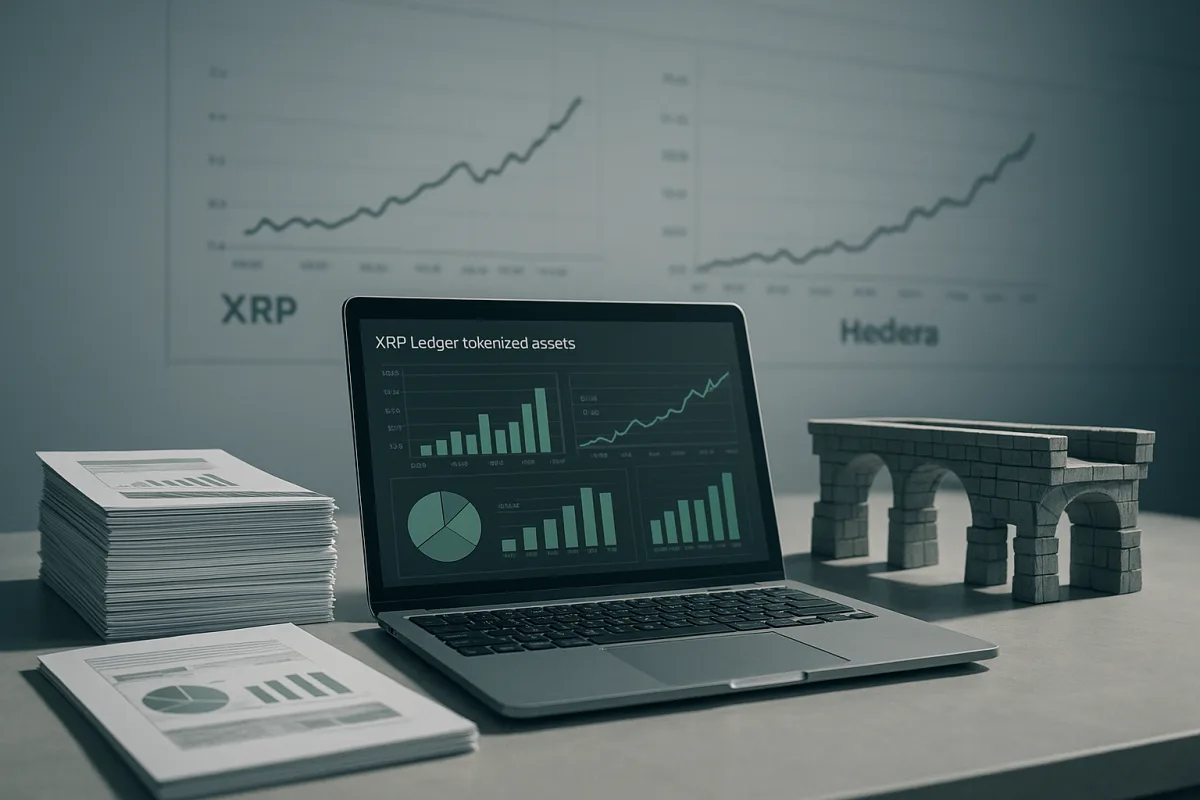
The decision: XRP or Hedera for the payments-and-tokenization trade?
XRP and Hedera’s HBAR token are competing, indirectly, for attention from market participants looking for exposure to blockchain-based payments and real-world asset tokenization. XRP traded near $1.31 on October 16, carrying an $82.65 billion market capitalisation and ranking fifth among cryptocurrencies. [3]
The risk is that neither token necessarily captures the economics of the businesses built on its network. XRP faces token supply, liquidity, adoption and consensus-security questions, while Hedera faces the familiar challenge of proving that corporate announcements become recurring on-chain activity rather than pilot programmes.
The more defensible choice depends on the use case being evaluated, not a forecast for either token’s price. XRP is the stronger candidate for readers who want a liquid, established cryptoasset tied to cross-border payments. Hedera is the more coherent candidate for those assessing enterprise tokenization infrastructure, although the evidence supplied here is thinner.
That is not a call to buy either asset. It is a comparison of two different ways the market is attempting to price the same broad theme: financial assets and payment flows moving onto shared ledgers.
Criterion one: market scale and price risk
XRP wins on scale. Its October market value of about $82.65 billion gives it a much deeper market profile than most competing payment-oriented altcoins, and its fifth-place ranking makes it easier for institutions and exchanges to treat it as a major cryptoasset. [3]
Scale has not made XRP stable. Coinucation’s 2026 history shows XRP opened the year at $1.84, touched $2.35 on January 6, then fell to $0.9927 on August 17 before recovering toward the low-$1 range in October. [2]
That decline matters more than a daily quote. XRP remained about 59% below its $3.65 all-time high reached on July 17, 2025, according to the research brief, showing that broad recognition and legal clarity have not removed the token’s exposure to speculative crypto-market cycles.
Hedera does not win this criterion because the supplied sources provide no comparable October 2026 price, market-capitalisation or trading-liquidity figure for HBAR. The Modern Investor channel highlighted reports of Deutsche Bank using Hedera staking and tokenization through Taurus, but that claim is not independently quantified in the supplied research.
The absence of comparable market data is not evidence against Hedera’s technology. It does, however, limit any attempt to present HBAR as a like-for-like, lower-risk alternative to XRP. A network partnership and a liquid investment market are separate things.
| Criterion | XRP | Hedera, HBAR |
|---|---|---|
| Market scale and available pricing | XRP was $1.31 with an $82.65 billion market capitalisation on October 16, ranking fifth in crypto. [3] | The supplied materials contain no equivalent current price, market-capitalisation or liquidity data. |
| Payments proposition | Long-standing cross-border payments narrative, but reported bridge-currency adoption remains limited and stablecoins are strong competitors. [[8]](https://www.webopedia.com/crypto/learn/criticisms-xrp/?utm_source=openai "6 Major Criticisms of XRP - Some Experts Just Aren't Buying It | Webopedia") |
| RWA tokenization | XRPL tokenized assets rose to $4.38 billion by August, but liquidity is limited and concentration is a concern. [1] [7] | The Modern Investor channel cited tokenization activity through Taurus, but the independent brief provides no comparable RWA total or liquidity figure. |
| Tokenomics and governance | Fixed 100 billion supply, with about 31.40 billion in escrow and roughly one billion released monthly, mostly re-escrowed. [9] | No comparable tokenomics detail was supplied, so a supply-based judgement cannot be made here. |
| Regulatory and operational risk | SEC resolution in August 2025 improved clarity, but compliance design, centralization criticism and consensus-security questions remain. [[8]](https://www.webopedia.com/crypto/learn/criticisms-xrp/?utm_source=openai "6 Major Criticisms of XRP - Some Experts Just Aren't Buying It | Webopedia") |
| Main weakness | A large market capitalisation does not prove XRP demand from payments or tokenization activity. | Corporate integration claims do not yet demonstrate comparable market depth or token-value capture. |
| Better suited to | Readers evaluating established, liquid large-cap exposure to the payments narrative. | Readers researching enterprise tokenization infrastructure and willing to accept less comparable market evidence. |
Criterion two: cross-border payments and stablecoin competition
XRP’s original market case was straightforward: use a fast-settling digital asset as a bridge between currencies in cross-border transfers. That premise helped establish the token’s place in earlier crypto cycles, but the economics have become harder to separate from stablecoin-based payments.
A company paying an overseas supplier usually wants the transferred value to remain stable between initiation and receipt. Dollar-linked stablecoins can offer that property, whereas XRP’s price fluctuates continuously, creating a foreign-exchange risk that must be managed if XRP is used as an intermediary.
The EllioTrades channel made this criticism directly, arguing that many Ripple partnerships involved RippleNet technology rather than necessary on-chain use of XRP. That distinction is central: commercial adoption of a company’s software does not automatically establish demand for its associated token.
The independent research brief reaches a similar conclusion more cautiously. XRP’s actual use as a bridge currency remains limited despite partnerships, while leading 2026 payment and tokenization competitors include Ethereum, Canton, Plume, Hedera, Stellar and Ondo Finance. [4] [5]
Hedera’s appeal here is different. It is presented less as a universal bridge asset and more as enterprise infrastructure that can support tokenized assets, permissions and institutional workflows. The Modern Investor channel cited reports involving Deutsche Bank and Taurus, but did not provide transaction volumes, asset balances or revenue data.
On the available evidence, XRP wins for readers specifically assessing a traded payment token with a long history and substantial liquidity. Hedera is more appropriate for readers examining institutional infrastructure claims, but it falls down because those claims are not yet supported here with comparable adoption metrics.
Criterion three: real-world asset tokenization
Tokenization is the sharper competitive test. XRP Ledger’s tokenized-asset value rose from about $897 million at the start of 2026 to $4.38 billion by August 1, a rapid increase that establishes real momentum rather than a purely theoretical ambition. [7]
Still, headline asset value can overstate economic activity. Research on tokenized real-world asset markets finds that tokenization does not automatically create liquidity, particularly where assets have restricted distribution, fragmented venues, limited holders or unclear redemption mechanisms. [1]
That caveat applies directly to XRP Ledger. The research brief says XRPL’s tokenized-asset growth has been substantial, but secondary-market liquidity remains limited. In practical terms, an on-chain representation of an asset may exist without becoming an easily tradable instrument.
Crypto Market Lens also flagged concentration risk in XRPL’s tokenized asset totals, reporting that a single token represented roughly half the ledger’s RWA value. [6] Concentration does not invalidate the total, but it weakens claims that broad-based tokenized-market activity has already emerged.
Ethereum remains the benchmark for breadth, while networks such as Canton, Stellar, Hedera and Plume are also positioned in the institutional-tokenization competition. FinanceFeeds’ 2026 comparison places those networks among the leading options, illustrating that XRP is pursuing a crowded market rather than an uncontested niche. [4]
Hedera’s enterprise framing may fit regulated issuers that value governance and controlled deployment. Yet the supplied research does not provide a verified HBAR-chain RWA total, asset distribution data or secondary-market liquidity statistics. XRP therefore wins narrowly on measurable tokenization activity, even though its liquidity remains the key qualification.
Criterion four: tokenomics, governance and value capture
XRP has unusually visible tokenomics. Its total supply is capped at 100 billion tokens, with around 68.59 billion circulating and roughly 31.40 billion held in escrow. About one billion XRP is released from escrow monthly, with most reportedly returned to escrow. [9]
The structure reduces uncertainty about an unlimited future supply, but it does not remove dilution concerns. Scheduled releases are part of the market’s supply outlook, and Ripple Labs’ influence over escrowed holdings is a persistent reason critics question how decentralised XRP is in practice. [8]
This issue is not merely ideological. Governance concentration can affect market confidence if participants believe a related corporate entity retains material influence over supply, validator ecosystems or strategic network development. The long-term significance of that influence remains contested, rather than settled fact.
Hedera cannot be declared superior on this criterion from the supplied record. There is no comparable token-supply, treasury-control or validator-governance detail in the materials. Its corporate orientation may reassure some institutions, but it may concern participants seeking censorship resistance or looser governance.
XRP loses this criterion because the available evidence identifies specific, material centralization criticism. Hedera does not win it, however, because insufficient comparative evidence is not a positive finding. For governance-sensitive analysis, the honest answer is that the supplied information is incomplete.
Criterion five: regulation and technological risk
The August 2025 resolution of XRP’s SEC dispute improved regulatory clarity and contributed to institutional interest, according to the independent research brief. That is an advantage over periods when the legal status of XRP was a direct barrier for US market participants.
Clarity is not the same as completed compliance. Proposed regulatory-compliance protocols for tokenized assets on XRP Ledger were still evolving in June 2026, and their adoption is uncertain. A tokenized bond or fund also needs issuer approval, transfer controls, investor checks and enforceable legal claims.
XRP additionally faces reported questions around the resilience of its consensus mechanism. A 2026 study identified potential conditions that could affect safety or liveness, although the practical real-world impact remains unresolved, according to the research brief. That is a risk to monitor, not proof of failure.
Hedera shares the broader market’s exposure to regulation, technical problems and changing institutional requirements. Its enterprise orientation does not exempt it from these risks. Nor does a bank-related announcement establish that regulators, custodians and asset issuers will standardise on its network.
Neither option wins convincingly on risk. XRP has more legal history and clearer recent regulatory progress, but also more visible disputes around centralization, bridge usage and consensus design. Hedera has a potentially relevant institutional posture, but less quantified evidence in the supplied material.
What speculative claims should be treated cautiously?
The Modern Investor channel argued that crypto could enter an extended bull market and floated an XRP price of $16 in a broader discussion of upside scenarios. That is speculation, not an analyst consensus, and it is particularly difficult to reconcile with XRP’s 2026 drawdown from $2.35 in January to $0.9927 in August. [2]
EllioTrades similarly framed tokenization as XRP’s possible route back to relevance, while warning that competing networks may capture the opportunity first. That is a reasonable competitive thesis, but it should not be confused with evidence that tokenization volumes will translate into XRP token demand.
Predictions that tokenized real-world assets will reach trillions of dollars by 2030 are often repeated in crypto markets. Even if the aggregate market expands, the distribution of value remains uncertain: stablecoin issuers, regulated custodians, asset managers, exchanges and application providers may capture much of it.
The key analytical mistake is assuming that a successful network application automatically benefits the network token proportionally. XRP’s history illustrates the point. Ripple’s commercial partnerships and XRP’s market performance have not always moved together, particularly where products do not require XRP settlement.
Who each option suits
XRP suits readers evaluating the established, liquid large-cap version of the cross-border payments and tokenization thesis. It has measurable market scale, a defined supply schedule and demonstrable growth in XRPL tokenized assets. It falls down where holders assume payments partnerships necessarily create XRP demand, or where escrow concentration and limited RWA liquidity are treated as minor details.
Hedera suits readers researching enterprise-oriented tokenization infrastructure rather than established crypto-market liquidity. The bank and Taurus-related claims highlighted by The Modern Investor channel point toward the kind of institutional integrations that could matter if they produce sustained issuance and settlement activity. It falls down because the supplied evidence does not quantify HBAR’s current market scale, RWA assets, liquidity or token-value capture.
For a reader forced to choose between the two on currently available evidence, XRP is the more measurable option, not necessarily the better outcome. Hedera is the more speculative infrastructure option because its institutional narrative is plausible but less substantiated here. The gap is narrower in technology positioning than in available market evidence.
Frequently Asked Questions
What are the main challenges facing XRP in the altcoin market?
XRP faces several challenges including token supply constraints, limited liquidity, adoption hurdles, and questions about consensus security. Despite regulatory clarity following the SEC resolution in August 2025, compliance design and centralization criticisms persist. Additionally, XRP’s price remains volatile and significantly below its all-time high, reflecting ongoing speculative risks.
How does XRP compare to Hedera for enterprise tokenization?
XRP has a larger market capitalization and a more developed payment narrative, making it suitable for those prioritizing scale and established payments. Hedera, however, is considered a cleaner alternative focused on enterprise tokenization infrastructure, though evidence of durable network demand from corporate integrations is limited. The choice depends on whether the priority is market depth or enterprise-led infrastructure claims.
What limits XRP’s use as a bridge currency in payments?
Reported adoption of XRP as a bridge currency remains limited, and stablecoins present strong competition in this role. Despite partnerships and a long-standing cross-border payments narrative, XRP has not achieved widespread real-world use as an intermediary currency, which constrains its payments proposition.
How liquid are tokenized assets on the XRP Ledger?
Although tokenized assets on the XRP Ledger reached $4.38 billion by August 2026, liquidity remains limited. The value of tokenized assets does not directly translate into active secondary-market trading, and concentration concerns further restrict market fluidity.
What factors influence XRP’s market scale and price risk?
XRP’s market scale is supported by its $82.65 billion market capitalization and ranking as the fifth-largest cryptocurrency as of October 2026. However, its price is affected by volatility, regulatory uncertainties, centralization issues, and speculative market cycles. These factors contribute to significant price risk despite XRP’s established market presence.
How we researched this
This article was assembled from 2 video sources across 2 channels, 13 cited references.
Nothing here is based on hands-on testing. Where a figure or finding appears, it belongs to the source cited beside it, and the writing says so rather than implying otherwise. Every source is listed below so you can check it.
Sources
XRP Will FAIL If It Doesn't Do This — EllioTrades
XRP And HBAR Get A Major Boost Bitcoin & Crypto Are Taking Over The World And No One Notices — The Modern Investor
Tokenized but Illiquid? Evidence from Real-World Asset Markets
XRP price history 2026: open, close, high, low and monthly returns | Coinucation
XRP price stands at 1.31 USD on October 16, 2026 as market cap ranks fifth
Best Blockchains for Real-World Asset Tokenization in 2026 - FinanceFeeds
XRP Ledger Tokenized Assets: One Bet Is Half the Total — Crypto Market Lens
XRP's RWA Tokenization Surged 2,200% in 2025—Can It 10x Again in 2026? - 24/7 Wall St.
6 Major Criticisms of XRP - Some Experts Just Aren't Buying It | Webopedia
XRP in 2026: Ripple's Buyback, Escrow, and the Activity Decline Explained
XRP has failed to make holders rich like bitcoin and ether. Here’s why
Watch XRP and Altcoin Market Developments and Challenges on Youtube
Also from the sources
Related Articles

Crypto Regulatory Challenges
Explore crypto regulatory challenges, legal risks, and compliance costs shaping stablecoins, blockchain records, and cross-border crypto markets.

Crypto Regulatory Developments
Explore key crypto regulatory developments, legal challenges for prediction markets, and stablecoin compliance in the US, EU, and beyond.
Tokenized Treasury Markets
Explore tokenized treasury markets and institutional adoption trends, including risks, growth, and regulatory frameworks in 2026.
Tokenization and Institutional Crypto Adoption
Explore tokenization and institutional crypto adoption with insights on SEC rules, trading limits, and challenges in regulated tokenized securities.