
Dogecoin Ecosystem Expansion
Explore Dogecoin ecosystem expansion as Dogecoin Labs unites MyDoge wallet, DogeOS, and Such App to boost commercial use and developer tools.
A meme asset is being organised like a commercial platform
Dogecoin’s ecosystem is shifting from a loose collection of wallet, payments and application projects into a consolidated commercial operation. Dogecoin Labs now brings MyDoge, DogeOS and Such App under one company, alongside the Dogecoin Foundation and House of Doge. [3][6]
The risk is that consolidation can make a roadmap easier to present without making the products more secure, useful or widely adopted. DogeOS is still early, merchant adoption is unquantified, and Dogecoin Labs has disclosed neither funding amounts nor a long-term revenue model. [3][8]
That distinction matters because DOGE has long had liquidity, name recognition and a large holder base, but relatively limited consumer and developer infrastructure compared with its market profile. The Labs launch is an attempt to turn recognition into repeat use.
The evidence of a real strategic change is stronger than a single press release. The Dogecoin Foundation is separating its open-source stewardship and advocacy work from commercial product development, while House of Doge is contributing operations in exchange for an equity stake. [8][9]
This is the familiar structure of a protocol ecosystem seeking to reduce fragmentation. A foundation can preserve a public-interest role around the underlying network, while a company can own product decisions, hiring, integrations and commercial partnerships.
The three-product stack is the central change
The MyDoge wallet is the consumer entry point. It has surpassed 500,000 total users without paid acquisition, according to CoinDesk, and its V3 release connects users to applications being developed on DogeOS. [3]
That user number should be handled carefully. MyDoge has not published verified active-user data, retention figures, transaction frequency, balances, or the number of customers using its application connections. Total downloads or registrations are not the same as an engaged payments audience.
MyDoge has no publicly disclosed price in the available reporting and appears designed for DOGE holders who want wallet access and, eventually, an application discovery layer. For a project builder, its value is potential distribution, not a demonstrated acquisition channel.
DogeOS is the development layer. Its public testnet opened on September 30, offering an Ethereum-compatible environment where developers can experiment with lending, exchanges, games and other applications using test DOGE. [3]
DogeOS has no publicly disclosed pricing, fee schedule or speed benchmarks. It suits developers who want to test DOGE-denominated applications, but it is not yet evidence that a production DeFi market exists around Dogecoin.
Such App is the merchant-facing component, positioned for invoices and in-person QR-code payments. CoinDesk reported that its beta supports those functions, although the planned link between Such App and DogeOS remains unfinished. [3]
Such App also has no public price list, processing-fee schedule or transaction-speed benchmark in the material supplied. It is intended for merchants accepting DOGE payments, but a beta payment tool is not the same thing as a scaled acquiring network.
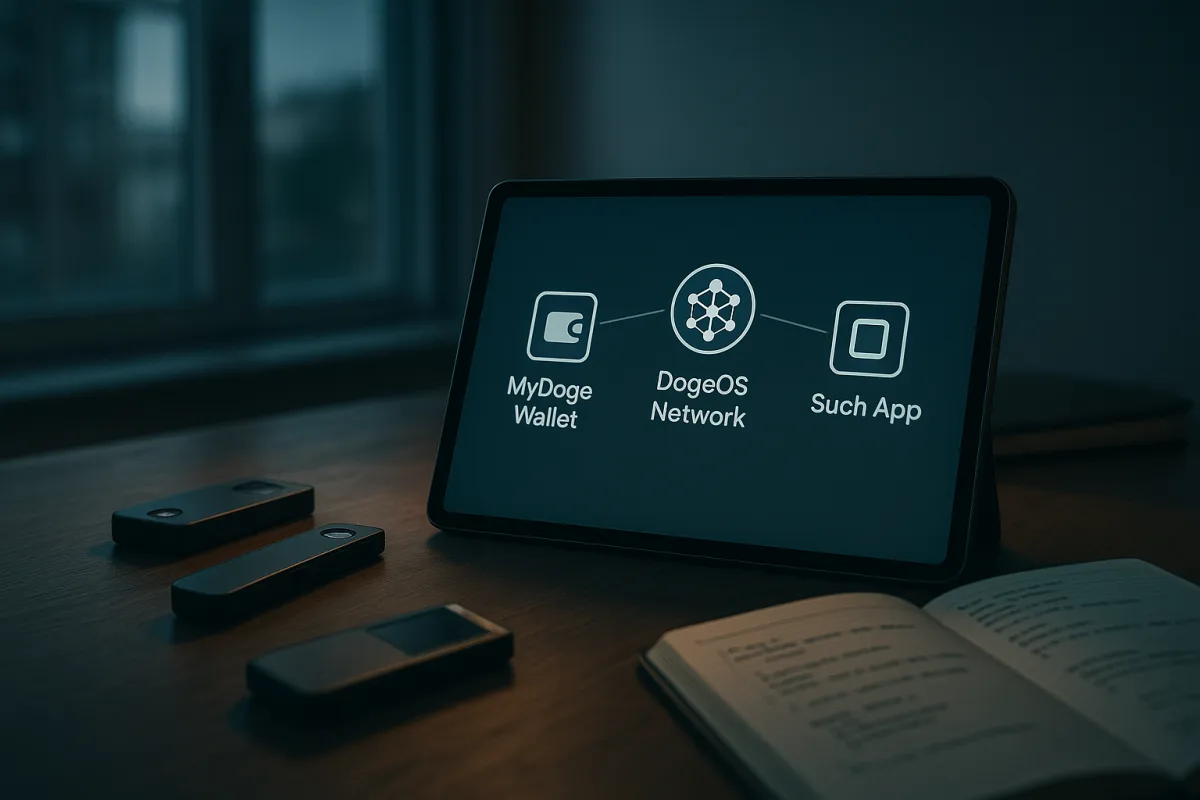
Taken together, the logic is straightforward: developers build through DogeOS, consumers discover and use applications through MyDoge, and merchants accept DOGE through Such App. That design resembles a conventional platform strategy rather than a token-only promotion exercise.
The missing information is equally important. There is no public measure of how many merchants use Such App, how many developers are building on DogeOS, or how many MyDoge customers have actually tried an integrated application.
Why this is happening now
The timing reflects a practical problem for mature crypto assets. Dogecoin was created in 2013 as a joke, yet it remains among the better-known digital assets. Recognition has not automatically translated into services that generate regular economic activity. [3]
DOGE was trading around $0.082 when CoinDesk reported the consolidation, after gaining 3.9% over 24 hours. That short move says little about the success of Dogecoin Labs, particularly because the products remain early and key usage metrics are absent. [3]
A more useful reading is that the ecosystem needs a route beyond cyclical attention. Meme-led assets can experience sharp bursts of trading interest, but consumer payments, merchant tools and developer applications require longer implementation cycles and operational spending.
The proposed organisation also arrives as crypto payment infrastructure is becoming less exotic. Stablecoin payment products, wallet integrations and merchant settlement services have created more competition for any token seeking a place at checkout or in online commerce.
That does not mean DOGE payments will compete directly with stablecoins. Stablecoins are usually designed to limit price volatility, while DOGE’s market price can change materially. For a merchant, the relevant issue is conversion, settlement and accounting rather than community sentiment.
The regulatory environment is another reason to consolidate. In the European Union, MiCA has established an authorisation framework for crypto service providers, while the United Kingdom is working toward a new framework scheduled for 2027. [4]
Merchants often do not need a dedicated crypto licence merely for accepting a payment, but payment providers can carry licensing and compliance obligations. Requirements remain jurisdiction-specific, and merchants still face tax reporting, consumer disclosure and record-keeping duties. [5]
For Dogecoin Labs, a centralised product organisation may make integrations, compliance processes and support more manageable than a scattered group of independent teams. It also creates a clearer counterparty for merchants and developers, though that does not remove regulatory responsibility.
The technical claim remains unproven
DogeOS is attempting to extend Dogecoin’s utility without changing the base chain into a general-purpose smart-contract platform. DOGE transfers remain on Dogecoin, while lending, exchange and gaming functions would operate on a separate system. [3]
That architecture carries a security trade-off. DogeOS wants the Dogecoin network to verify mathematical proofs that its applications executed correctly, but the rule change needed for that connection remains a draft, according to CoinDesk. [3]
Until that link exists, users would depend on DogeOS-selected operators and hardware to validate application activity. That is a meaningful departure from simply relying on Dogecoin’s established proof-of-work network for ordinary coin transfers.
There is no public technical risk assessment for the integration of MyDoge, DogeOS and Such App. There are also no disclosed vulnerability reports, service-level targets, custody details or incident-response commitments in the supplied reporting.
That absence does not prove a flaw. It means prospective developers and commercial partners cannot yet independently assess some of the issues that determine whether payment and DeFi infrastructure is usable at scale.
Likewise, low-cost claims should be treated cautiously. DOGE can have low base-layer network fees, but no specific DogeOS or Such App costs have been publicly documented, and an application-layer design can introduce separate fees or operational costs.
What the consolidation means for builders
A developer planning a DOGE-based project now has a more legible route to market. DogeOS offers a stated development environment, MyDoge offers a possible wallet-distribution surface, and Such App could provide a merchant-payment endpoint. [3]
That is more useful than building against an undefined ecosystem. But it does not eliminate the standard platform risk: the same company now controls the most visible wallet, application and payments routes, potentially making builders dependent on its product priorities.
Projects should therefore distinguish between technical compatibility and commercial distribution. Building an Ethereum-style application on a DogeOS testnet may be feasible, but customer acquisition, liquidity, security review, compliance and customer support remain separate costs.
The lack of active-user data is particularly relevant. A builder cannot reasonably estimate conversion from MyDoge’s 500,000-plus total users when the wallet has not disclosed how many customers are currently active or using connected applications. [3]
Payments projects face a different question. Such App’s invoice and QR-payment features may be appropriate for small merchants testing DOGE acceptance, but businesses need clarity on settlement, refunds, volatility handling, support, reporting and local compliance before relying on it.
Builders should also avoid designing a business model around assumed near-zero costs. Public benchmarks for DogeOS transaction speed and fees are unavailable, and the final cost to users may depend on application architecture, liquidity arrangements and payment-provider services.
The sensible signal to watch is not token price or social-media activity. It is whether Dogecoin Labs publishes measurable data: active wallet users, merchant locations, processed payment volume, developer activity, application usage, fees, security audits and uptime.
A commercial strategy, not yet a proven economy
Dogecoin Labs gives the Dogecoin ecosystem something it previously lacked: a single commercial operator with control over a wallet, an application layer and merchant-payment tooling. That is a meaningful organisational change, not merely a rebrand. [6][7]
It may also make the ecosystem easier to evaluate. Investors, developers and merchants can ask one organisation for product plans, integration standards and operating data, rather than attempting to assemble an ecosystem picture from disconnected projects.
Still, the evidence currently supports a narrower conclusion than the promotional framing suggests. The company has consolidated assets and launched or updated products, but has not yet demonstrated broad application use, merchant scale, production-grade DeFi security or sustainable revenues.
DOGE’s wider market position does not settle those questions. Liquidity can help a payments asset, but payment adoption depends on practical economics and reliable execution, while DeFi adoption depends on security, capital and credible demand.
Dogecoin Labs may eventually create a more functional DOGE economy. For now, it is best understood as an infrastructure bet whose commercial outcome remains speculative, and whose most important metrics have yet to be reported.
Frequently Asked Questions
What is Dogecoin Labs and how does it expand the Dogecoin ecosystem?
Dogecoin Labs is a newly formed company that consolidates the MyDoge wallet, DogeOS application network, and Such App merchant tool under one commercial operation. This consolidation aims to create a more coherent product stack and reduce fragmentation in the Dogecoin ecosystem by separating open-source stewardship (handled by the Dogecoin Foundation) from commercial product development.
How do MyDoge, DogeOS, and Such App work together in the Dogecoin ecosystem?
MyDoge serves as the consumer entry point wallet with over 500,000 total users, connecting users to applications on DogeOS. DogeOS is a public testnet development layer that allows developers to build and test DOGE-denominated decentralized applications. Such App is a merchant-facing tool designed for invoice and QR-code payments, intended to facilitate DOGE acceptance by merchants, though the integration between Such App and DogeOS is still incomplete.
What challenges does Dogecoin face in expanding beyond meme-driven demand?
Despite Dogecoin’s liquidity and recognition, the ecosystem currently lacks verified active-user engagement, transaction volume, and a proven revenue model. DogeOS remains a test network without published fee or speed benchmarks, and merchant adoption via Such App is unquantified. Regulatory complexities and the absence of clear product security and usability metrics also pose challenges to broader adoption.
How can merchants and developers benefit from Dogecoin Labs' new structure?
Merchants can use Such App to accept DOGE payments, though they must navigate varying licensing, tax, and consumer-protection obligations depending on their jurisdiction. Developers gain access to DogeOS, an Ethereum-compatible testnet, to build and experiment with DOGE-based applications. However, both merchants and developers should view the current offerings as infrastructure in development rather than confirmed market traction.
What is the current adoption status of Dogecoin's commercial products?
MyDoge wallet has surpassed 500,000 total users but has not disclosed active-user or engagement metrics. DogeOS is in public testnet phase with no disclosed transaction fees or performance benchmarks. Such App is in beta, supporting basic payment functions but lacking public data on processing fees or transaction speeds. Overall, commercial adoption and usage remain unproven at scale.
How we researched this
This article was assembled from 3 published articles, 9 cited references.
Nothing here is based on hands-on testing. Where a figure or finding appears, it belongs to the source cited beside it, and the writing says so rather than implying otherwise. Every source is listed below so you can check it.
Sources
Dogecoin Labs launches as DOGE ecosystem seeks growth beyond meme-driven demand — The Block
Dogecoin wallet, app teams unite in push to give DOGE more everyday uses — CoinDesk
Dogecoin Gets a Dedicated Company to Build Out Its Ecosystem — Decrypt
Cryptocurrency companies can keep paying interest-like rewards, say federal bank regulators
Transaction Costs and Speed in the Ethereum Ecosystem: Scalability of the Mainnet and Layer 2s
Dogecoin wallet and app teams unite in push to give DOGE more everyday uses
Are blockchain payments legal? US, EU, UK, Brazil, Mexico | BlindPay
Dogecoin Labs launches as DOGE ecosystem seeks growth beyond meme-driven demand | The Block
DOGE Gets Major Utility Boost as Dogecoin Labs Launches | CoinCodex
Dogecoin Labs Launches With MyDoge, DogeOS and a Dogecoin Foundation Partnership
Related Articles

AI Impact on Cryptocurrency Development and Market Dynamics
Explore how AI affects cryptocurrency development, mining, and market risks amid calls for slower AI progress in crypto infrastructure.

Institutional Crypto Infrastructure and Trading Expansions
Explore how institutional crypto infrastructure is expanding into derivatives, financing, and token products with key industry moves in 2026.

AI Integration in Crypto Infrastructure
Explore AI integration in crypto infrastructure, costs, challenges, and how mining sites convert to AI data centers for improved computing.

Trezor Data Breach Expansion: Over 80,000 Customers Affected
Learn about the Trezor data breach expansion affecting 80,000+ customers and how to protect yourself from phishing risks linked to exposed data.