
Quantum Computing Blockchain Security
Explore quantum computing blockchain security risks and how users and operators can prepare for post-quantum cryptography in 2026.
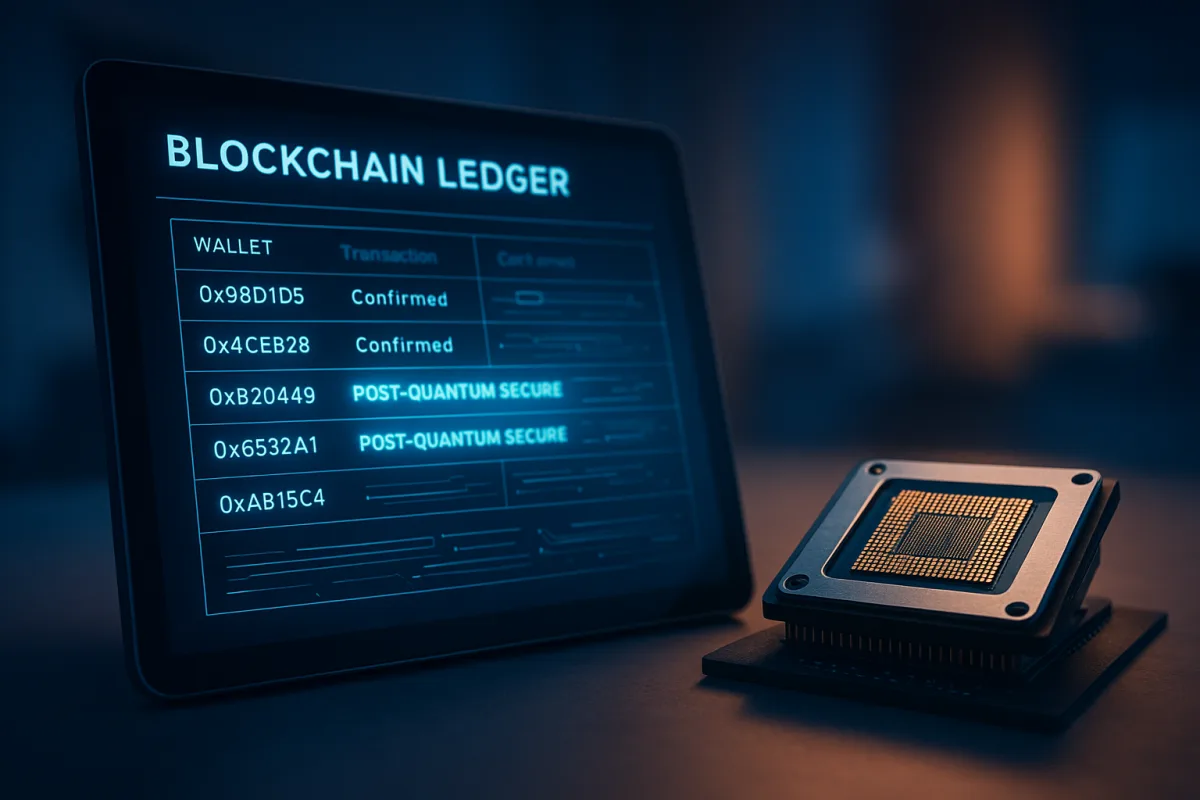
Quantum Computing and Blockchain Security: What Users and Operators Need to Do Now
Start with the exposure, not the quantum headline
The practical change is already underway: blockchain developers are moving from elliptic-curve cryptography toward signatures designed to resist quantum attacks. That is an infrastructure upgrade with costs in transaction data, wallet software, custody operations and network coordination.
The risk sits in the gap between a cryptographic breakthrough and a successful migration. A sufficiently capable quantum computer could derive private keys from some publicly exposed keys, but users may first encounter failures in backups, signing hardware, account recovery and unsupported wallets.
Today’s mainstream chains are not uniformly quantum-safe. The independent research brief is clear that no platform has fully implemented quantum-resistant cryptography across its complete stack as of October 2026, despite several projects using the language of quantum readiness.
That distinction matters. Protecting an account signature is useful, but it does not automatically protect validator signatures, consensus systems, smart-contract authentication, bridges, zero-knowledge systems or the tooling used by exchanges and institutional custodians.
The first practical task is to identify which cryptographic function secures your funds. A self-custody user needs to know whether a wallet exposes a public key before spending, while a custodian needs to map signing keys, backup procedures, hardware security modules and disaster-recovery systems.
Check whether your chain has deployment, testing or only a roadmap
Algorand is the clearest case of a production deployment, though the word deployment needs qualification. Native Falcon-1024 post-quantum accounts went live in August 2026 after the network reached 90% node support, according to Algorand-focused reporting. [2]
Those accounts permit users to upgrade signing keys without changing their wallet address, avoiding a full asset migration. That design addresses one of the difficult parts of cryptographic transitions: moving users to new security without requiring every application, counterparty and address book to change simultaneously.
By October 17, Algorand had processed more than 2.7 million transactions using post-quantum signatures, TokenPost reported. [3] That establishes use of the account feature, but it is not evidence that users found the process simple or that the whole network is quantum-resistant.
The sensible step for Algorand users is narrower. Confirm that the wallet and custody provider support Falcon-1024 accounts, ask whether the account has actually been upgraded, and retain ordinary key-security procedures because quantum-resistant signatures do not protect against phishing or compromised devices.
Ethereum has set a longer timetable because the conversion reaches more of the protocol. Ethereum.org targets post-quantum security across the execution, consensus and data layers by 2029, while describing work on cryptographic agility and migration paths. [7]
That means Ethereum users should not interpret account abstraction or wallet-upgrade discussions as present-day quantum protection. Ethereum’s challenge is less about selecting a candidate algorithm than deploying it without breaking existing wallets, applications, validators and layer-2 systems.
For Ethereum users and operators, the actionable issue is upgrade readiness. Wallet providers, smart-contract teams and rollup operators should track whether their dependencies can support alternative signature schemes, rather than waiting for a network-wide deadline to force an emergency change.
Sui has announced plans to support ML-DSA-65 for native accounts and SLH-DSA-SHA2-128s for Move smart contracts. The Block reported that the proposed model would allow opt-in quantum-safe keys, but it is not a deployed mainnet protection. [8]
That split matters for Sui application builders. An account-signature upgrade and a smart-contract-signature upgrade are different engineering projects, so a wallet claiming post-quantum support would not by itself establish that every Move application has equivalent protection.
Hedera’s plan is also account-focused. Hedera intends to introduce post-quantum account keys by 2027, allowing holders to replace keys without moving assets or changing account IDs, according to SentX’s explanation of the network’s cryptographic design. [9]
Hedera currently uses SHA-384 hashing and AES-256 encryption in relevant parts of its architecture, but those controls do not remove the vulnerability of conventional transaction signatures to a future cryptographically relevant quantum computer. [9] Planned key rotation is not the same as active protection.
XRP Ledger has a four-phase quantum-resistance roadmap, as Altcoin Buzz reported, including testing alternative signature systems and preparing emergency migration options. Its existing ability to change an account’s signing key without moving funds could make a future transition less disruptive.
However, XRP Ledger has not deployed post-quantum cryptography on mainnet. The reported 2028 target is a development objective, not a guarantee, and holders should distinguish a key-rotation capability available today from quantum-resistant signing not yet available.
Prepare for migration before it becomes urgent
Wallet users should begin by recording the provider, account type and recovery method used for each material holding. That is especially important for old addresses, paper backups, multisignature arrangements and accounts tied to inactive hardware wallets.
The central operational problem is often backward compatibility. Bitcoin’s BIP-360, merged in February 2026, defines quantum-resistant output types, but practical migration paths for existing funds are still developing, according to Quip Network. [12]
A wallet backup may recover a seed phrase but not all the state required by future signature schemes. Before accepting any stateful post-quantum signing product, users should ask whether its backup process preserves signing state safely or switches to a recovery-safe signing method.
That question becomes more important for institutions. Exchanges and custodians commonly use multiple independent signing servers for resilience, but stateful signatures require disciplined coordination so two systems do not reuse the same one-time signing material.
CryptoSlate’s reporting on Coinbase’s proposed SHRINCS design sets out the failure mode clearly. If a signer restores an old backup without a trustworthy record of its previous signatures, it must avoid its compact stateful route and use a larger stateless signature instead.
The risk is not merely inconvenience. In hash-based systems, reusing a one-time signing slot for different messages can enable forgery. That makes durable, rollback-resistant state storage a security requirement, rather than a routine database preference.
For a custody operator, the practical response is to test recovery as an adversarial process. Simulate interrupted writes, server replacement, stale backups and regional failover, then verify that the system refuses unsafe stateful signing when the history cannot be proved.
CryptoSlate notes potential mitigations such as sectorization, reserved intervals and controlled transfer of key-and-state material. Those techniques can allow partitioned signing across devices, but they add design and audit work rather than eliminating the underlying state-management problem.
Budget for larger signatures and slower throughput
The economic cost is most visible on Bitcoin. Current Schnorr signatures are 64 bytes, while proposed quantum-resistant signatures are substantially larger, increasing transaction weight and potentially reducing throughput. [4][5]
Blockstream’s analysis estimates that compact post-quantum signature approaches can grow toward roughly 580 bytes with repeated use, a level it associates with throughput near three transactions per second if that path were used exclusively. [4]
Other estimates are more severe depending on the algorithm. Research cited in the independent brief indicates that using some NIST-standard post-quantum signatures could cut Bitcoin block capacity by about 97%, from roughly 4,200 to 84 transactions per block. [6]
These estimates are scenarios, not forecasts of the fee users will pay. Transaction fees depend on signature placement, witness accounting, adoption rates, block demand, implementation choices and whether a service provider absorbs or passes on the cost.
Still, users with long-lived Bitcoin holdings should not assume an eventual quantum migration will be free. A future move from an older address to a quantum-resistant output could require more block space precisely when many holders want to migrate.
The SHRINCS proposal illustrates the trade-off. Its compact signatures depend on a reliable record of prior use, while its larger fallback works when recovery state is uncertain, prioritising the ability to spend over transaction-data efficiency.
There is also a discrepancy worth noting in published size descriptions. CryptoSlate reported a draft specification with stateful signatures from 548 to 4,619 bytes and a 5,777-byte stateless signature, while other research describes different starting sizes and growth paths. The variation reflects design and parameter choices, not a settled Bitcoin standard.
For users, the actionable point is to maintain current wallet software and avoid assuming a static backup strategy will remain sufficient. For businesses, model the fee exposure of emergency migrations and recovery transactions before committing to a signature design.
Do not confuse NIST standards with instant blockchain compatibility
NIST’s post-quantum cryptography programme has been running since 2016, and its digital-signature work continues to evaluate additional schemes and implementation options. [1] That process provides an important common reference point, but it does not install algorithms on public blockchains.
Networks still need to decide how signatures fit transaction formats, hardware wallets, smart contracts, validator systems and cross-chain infrastructure. Lattice-based schemes such as ML-DSA can require more computation and energy than established elliptic-curve approaches, according to TechRadar’s review of enterprise migration challenges. [10]
That added cost is not a reason to dismiss post-quantum upgrades. It is a reason to demand benchmarks, deployment plans and failure testing before treating a roadmap as complete. Public chains must preserve security while managing throughput and node-operating costs.
The Quantum Alliance, formed in October by nine blockchain organisations, says it will develop readiness criteria, benchmarks and migration reference designs spanning networks, wallets, zero-knowledge proofs and cross-chain compatibility. [13] The value of that work will depend on publishable standards and adoption, not the announcement itself.
Large technology companies are planning similar timelines. Google and Microsoft are both accelerating post-quantum migration efforts toward 2029, including cryptographic agility and upgraded trust infrastructure. [10] Their schedules underline that blockchain networks are dealing with an industry-wide transition, not an isolated crypto narrative.
Evaluate claims without turning them into token forecasts
A chain’s post-quantum work can reduce a future operational risk, but it does not establish a direct route to higher token value. Algorand’s live account feature is more advanced than the announced plans of several peers, yet the economic benefit depends on adoption, wallet support and whether users value the protection.
The same caution applies to smaller projects marketed as quantum-native. A claim that a network launched with quantum-safe signatures says little about liquidity, token supply, governance, audit quality or the ability to sustain secure software maintenance over years.
The Altcoin Buzz report highlighted a sharp move in the token of a newer quantum-focused project, Quantus, while also warning of low liquidity and a gap between market capitalisation and fully diluted valuation. That is the appropriate framing for any quantum-themed price move: it remains speculation.
For readers choosing infrastructure rather than tokens, the more useful questions are concrete. Is post-quantum signing live on mainnet? Can existing accounts migrate without moving assets? Does recovery work after hardware failure? Has the design been audited, benchmarked and tested under custody-scale operations?
Those questions produce less dramatic answers than a quantum-computing headline. They are also the questions that determine whether a blockchain can keep users able to transact when cryptographic assumptions eventually have to change.
Frequently Asked Questions
How does quantum computing threaten blockchain security?
Quantum computers could derive private keys from publicly exposed keys, potentially allowing attackers to access funds. The immediate risk lies in the difficulty of migrating dormant funds, old backups, and inflexible custody systems once quantum attacks become practical, rather than instant wallet draining.
Which blockchains have deployed quantum-resistant cryptography?
As of October 2026, Algorand is the only blockchain with a production deployment of quantum-resistant accounts using Falcon-1024 signatures. Other blockchains like Ethereum, XRP Ledger, Sui, and Hedera have announced plans or are testing quantum-resistant cryptography but have not yet deployed it.
What should users do to prepare for quantum threats on blockchain?
Users should identify which cryptographic functions secure their funds and confirm whether their wallets and custody providers support quantum-resistant accounts, such as Algorand’s Falcon-1024. Maintaining good key security practices remains essential because quantum-resistant signatures do not protect against phishing or compromised devices.
How do post-quantum signatures affect blockchain transaction fees?
Post-quantum signatures are significantly larger than current signatures, which can reduce transaction capacity and increase data size. For example, Bitcoin’s quantum-resistant signatures could be up to 10 times larger, potentially raising transaction fees due to increased block space usage.
What is the timeline for Ethereum's quantum resistance upgrade?
Ethereum aims to achieve post-quantum security across its execution, consensus, and data layers by 2029. Currently, no quantum-resistant cryptography has been implemented, and the focus is on developing cryptographic agility and migration paths without disrupting existing systems.
How we researched this
This article was assembled from 1 video source, 1 published article, 14 cited references.
Nothing here is based on hands-on testing. Where a figure or finding appears, it belongs to the source cited beside it, and the writing says so rather than implying otherwise. Every source is listed below so you can check it.
Sources
Sui, Algorand, XRP, Hedera Blockchains working ON QUANTUM COMPUTING! — Altcoin Buzz
Quantum-proof Bitcoin signatures would clog network nodes with 10x larger data — CryptoSlate
Post-Quantum Cryptography: Additional Digital Signature Schemes | CSRC
Algorand Says Mainnet Has Passed More Than 2.7 Million Post-Quantum Transactions | TokenPost
Quantum-resistant Bitcoin signatures could raise data size up to 10x, adding overhead - CoinNess
Sui to add post-quantum signature schemes for quantum-safe accounts | The Block
Is HBAR Quantum Resistant? Hedera Cryptography Explained | SentX
Which blockchains are quantum resistant? The chain-level answer | Quip Network Blog
Watch Quantum Computing and Blockchain Security on Youtube
Related Articles
Bitcoin Post-Quantum Migration
Explore Bitcoin post-quantum migration, quantum resistance, and how developers and custodians prepare for future quantum threats.
Quantum-Resistant Bitcoin Upgrades: Costs and Challenges
Explore quantum-resistant Bitcoin upgrades, their costs, challenges, and how they protect Bitcoin transactions from future quantum threats.
Ethereum Glamsterdam Upgrade
Learn about the Ethereum Glamsterdam upgrade, its impact on fees, smart contracts, staking, and network activity in this practical guide.

XRP Ledger Supply Bug and Security Patch Explained
Learn about the XRP Ledger supply bug, its integer overflow flaw, and the security patch that fixed this critical vulnerability in 2026.