
Tokenized Government Bonds and Blockchain Financial Products
Explore tokenized government bonds, risks, liquidity, and blockchain financial products to understand their structure and investor considerations.
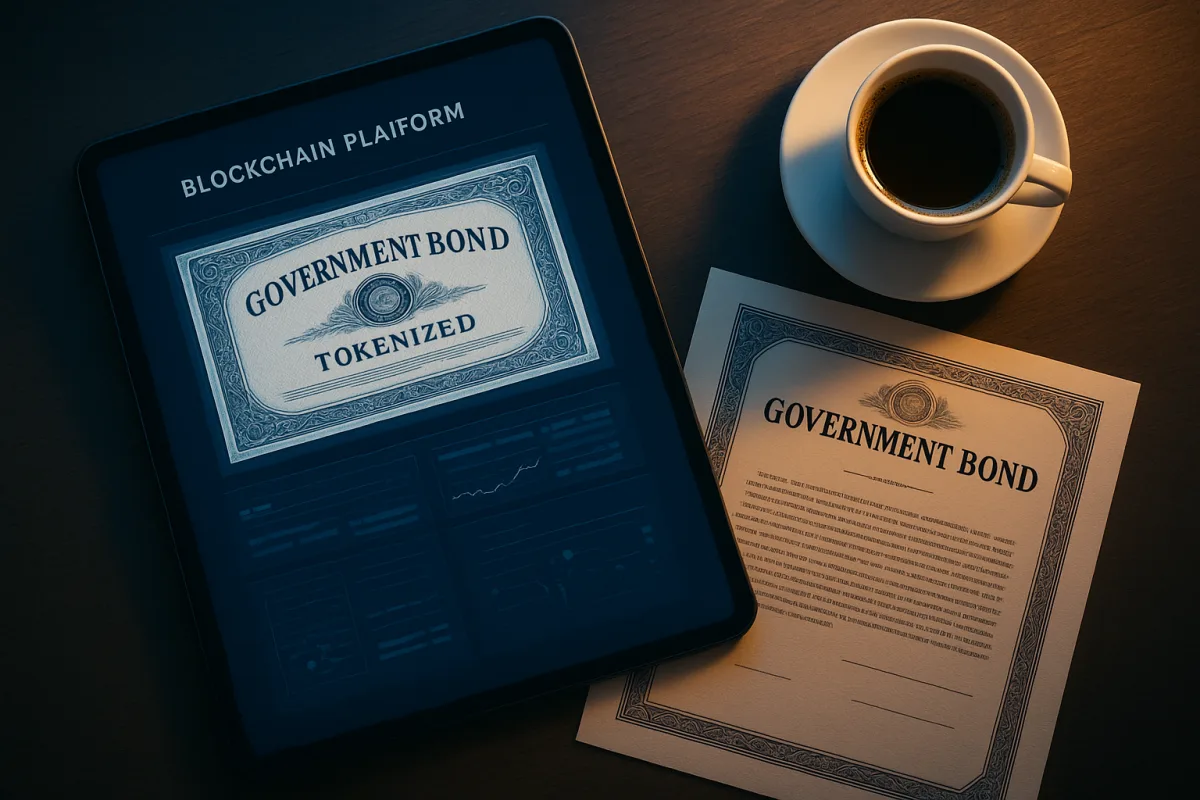
Identify what sits behind the token
A 10 billion tenge, roughly $22 million, slice of Kazakhstan’s 91-day central-bank-note auction was issued in tokenized form on Nov. 9. The notes carried a 15.72% weighted average annual yield, within a wider 50 billion tenge offering. [1][3]
The token is not the economic asset by itself. You need to establish whether it represents direct ownership of a government obligation, a beneficial interest in securities held by a custodian, or a contractual claim against an intermediary.
That changes what happens if the platform fails, the custodian becomes insolvent, or the issuer misses a payment. A tokenized stock can leave you dependent on both the issuer of the underlying share and the party holding that share in custody. [8]
We would begin with the legal documentation, not the chain name. A familiar blockchain, a large bank brand or a polished wallet interface cannot tell you whether you own the asset directly.
Separate bond yield from tokenization claims
A tokenized Treasury, money-market fund or government bill can generate yield because its issuer holds interest-bearing assets. The blockchain can change recordkeeping, transfer timing and settlement processes, but it does not create the underlying coupon or eliminate rate risk.
Kazakhstan’s tokenized notes were short-dated, maturing in 91 days, and their 15.72% weighted average annual yield reflected domestic monetary conditions. Kazakhstan’s central-bank rate was 15.75% in 2026, so the headline yield should be read against that high-rate environment. [1]
The investor cost is not limited to a quoted yield. Ask whether the displayed return is gross or net of management fees, custody fees, trading spreads, transaction fees, local withholding tax and wallet-transfer costs.
For a bond held to maturity, confirm how cash redemption works. For a fund token, confirm whether redemptions are available daily, only through approved intermediaries, or only after selling to another market participant.
Check who owes you money
Kazakhstan’s planned tokenized government bonds are expected in the first quarter of 2027 through cooperation between the National Bank of Kazakhstan and the Ministry of Finance. Those would be Finance Ministry obligations, unlike the November central-bank notes. [1][2]
The National Bank has said existing infrastructure involving the Kazakhstan Stock Exchange, the Astana International Financial Centre and Alatau City is ready for the initiative. Kazakhstan’s digital-assets law, effective May 1, 2026, recognizes digital financial assets, including tokenized securities. [2][3]
Yet the details that affect your claim remain incomplete. Neither the full provider list nor the specific blockchain infrastructure for the planned government-bond issuance has been publicly confirmed, and the investor-protection terms have not been published.
KASE’s digital-asset platform uses Solana, with BitGo supplying custody infrastructure, according to KASE. CoinDesk reported that neither firm had been confirmed as a participant in the planned Finance Ministry bond issuance. [1]
Do not assume that the chain used for a pilot will handle a later public offering. Before using a product, look for the issuer, governing law, registrar, custodian, dispute venue and the exact process for recovering access after a lost key or failed transfer.
Test the exit before buying the entry
Tokenized government debt may look easier to access than conventional bonds, especially if an app allows smaller denominations or longer trading hours. The hard part can arrive when you want cash before maturity.
The European Central Bank says there is still limited empirical evidence on whether tokenization improves bond-issuance efficiency or secondary-market liquidity. Tokenized bonds remain a nascent market, even as their technical infrastructure advances. [10]
The IMF has also warned that fragmentation across platforms can divide liquidity and raise risk. If buyers and sellers are split among separate blockchains, permissioned systems and broker networks, a token holder can have fewer routes to an executable price. [11]
That means a token may trade below its expected value when you need to sell. Traditional government-bond markets have established dealers, broad institutional participation and standardized settlement, advantages that a new token market may not yet match.
We would favor products with a disclosed redemption mechanism over products that depend solely on secondary trading. If the issuer offers only a token transfer and no direct cash redemption, treat liquidity as uncertain.
Compare the tokenized fund with the conventional fund
Wall Street’s tokenized products are moving beyond pilot language. BlackRock launched two tokenized money-market funds, BSTBL and BRSRV, in August 2026, aimed at institutional and digital-asset investors seeking blockchain-based access to money-market exposure. [6]
WisdomTree introduced its WisdomTree Onchain platform in September, after its tokenized fund assets surpassed $1.2 billion in 2026, up from $770 million at the start of the year. [7]
Those products sit at the institutional end of the market. They may suit eligible investors and digital-asset firms that need blockchain-native settlement or collateral movement, but the access rules can differ sharply from a conventional brokerage fund.
Read the prospectus and platform terms beside the token documentation. Confirm the minimum subscription, investor eligibility, dealing cutoff, settlement cycle, transfer restrictions and whether peer-to-peer transfers are permitted or subject to whitelisting.
A tokenized money-market fund is still a fund. Its value, redemption rights and risks come from the portfolio and legal structure, while its token format may add operational dependencies involving wallets, smart contracts and permissioning.
Price the custody and operational chain
Tokenization can reduce manual reconciliation and allow assets to move through blockchain systems, but it also adds a new stack of vendors. Your exposure may include the asset issuer, fund administrator, custodian, transfer agent, wallet provider, blockchain network and smart-contract operator.
Institutional investors told EY that regulatory uncertainty was a primary hurdle for 67% of respondents, while 59% cited integration with existing systems. Another 38% identified liquidity constraints. [12]
Those figures describe why large institutions are proceeding carefully even as product announcements accelerate. A bank can be comfortable with the underlying Treasury or fund but still face a costly integration project to support token transfers and compliance controls.
Ask who can pause transfers, reverse an error, upgrade a smart contract or block a wallet. In regulated products, those powers may support compliance, but they also mean the token does not operate like an unrestricted bearer asset.
Custody is another point of failure. Tokenized shares and fund interests commonly represent claims tied to assets held by a custodian, creating exposure if that custodian or the token issuer fails. [8]
Match the chain to the settlement problem
The strongest case for blockchain financial products is often settlement coordination, not a promise of instant trading profits. Cross-border transactions can require multiple banks, currencies, time zones and compliance checks before both sides receive payment.
The Bank of England, the Monetary Authority of Singapore and the Bank of Thailand tested synchronized cross-border foreign-exchange settlement through Project Meridian FX APAC. The test examined payment-versus-payment settlement, where one currency transfers only if the other transfer occurs.
The project also tested multilateral netting, which can reduce the amount of liquidity banks need to hold by offsetting obligations. The Bank of England plans a live synchronization interface in 2028, but legal arrangements, oversight and wider participation remain unresolved.
For you, this is infrastructure progress, not a retail product launch. The commercial benefit depends on whether banks, custodians and regulators adopt compatible systems, and whether savings reach end users through lower fees or faster availability.
Distinguish institutional adoption from accessible markets
A large institution putting an asset on-chain does not mean every investor can purchase it, transfer it freely or redeem it at net asset value. Many tokenized securities are permissioned products designed for known, eligible investors.
The market is growing. Tokenized U.S. Treasury products rose from $8.9 billion to roughly $14.9 billion by mid-October 2026, after reaching about $16 billion in early August, according to market estimates. [5]
Growth shows issuer and investor interest, but it does not guarantee durable liquidity in each product. Assets can sit in a small number of funds or wallets, leaving individual tokens thinly traded despite a large category headline.
Avoid treating total value locked, token supply or a project’s stated asset value as proof that you can sell at a fair price. Look for actual trading venues, reported volumes, authorized participants and documented redemption activity.
Verify the regulatory perimeter
Tokenized assets can cross legal categories. A token sold as a fund interest, bond, deposit substitute, stablecoin reserve claim or stock representation may face different rules depending on the country and on who holds it.
Kazakhstan has a statutory framework for digital financial assets, but specific safeguards for its planned tokenized government bonds have not been detailed publicly. That leaves open questions on investor eligibility, disclosure requirements, dispute procedures and treatment of operational losses. [2][3]
Regulatory uncertainty is not a paperwork problem alone. It can affect whether a platform admits customers, whether a token can move across borders, whether a broker will custody it and whether a secondary-market venue can legally list it.
We would skip any product whose legal classification is vague. If the issuer cannot state the jurisdiction, regulator, investor protections and redemption obligation in plain terms, the technology does not compensate for that uncertainty.
Build a product-by-product checklist
Before placing money into a tokenized bond, fund or equity product, write down the issuer’s name and the exact asset or portfolio backing the token. Then identify whether you hold direct title, a beneficial interest or an unsecured claim.
Check maturity and cash-flow terms for bonds, including coupon dates, currency, tax treatment and early-sale options. For funds, check the portfolio mandate, management fee, valuation timing and whether redemptions can be made in cash, stablecoins or only through an approved venue.
Next, map the operating parties: custodian, registrar, transfer agent, blockchain, wallet provider and trading venue. Find out which party has authority over lost credentials, sanctioned addresses, smart-contract upgrades and transaction reversals.
Finally, test liquidity with evidence rather than marketing. Look for reported daily volume, bid-ask spreads, redemption windows and minimum transaction sizes, then assume conditions can worsen during market stress.
Tokenized assets may make financial products easier to move and program. They do not remove the familiar costs of owning finance: credit risk, interest-rate risk, fees, custody risk and the possibility that the exit is harder than the purchase.
Frequently Asked Questions
What are tokenized government bonds and how do they work?
Tokenized government bonds are digital representations of government debt issued on a blockchain platform. They do not eliminate issuer or counterparty risk but change recordkeeping and settlement processes. Ownership can be direct or through a custodian or intermediary, affecting legal claims and redemption rights.
What risks should investors consider with tokenized bonds?
Investors should consider issuer risk, counterparty risk, liquidity risk, and platform or custodian insolvency. The token itself is not the economic asset; understanding the legal claim, redemption process, and custodian role is essential before investing.
How does liquidity affect tokenized government bond trading?
Liquidity in tokenized government bonds is limited and secondary-market trading can be difficult. Selling before maturity may require accepting a discount if buyers are scarce, as fragmentation across platforms can divide liquidity and reduce executable prices.
What legal protections exist for tokenized financial products?
Legal frameworks like Kazakhstan’s digital-assets law recognize tokenized securities, but specific investor protections for tokenized government bonds are often incomplete or unspecified. Investors should review issuer details, governing law, custodian arrangements, and dispute resolution mechanisms before investing.
How do tokenized money-market funds differ from conventional funds?
Tokenized money-market funds use blockchain to facilitate recordkeeping and transfer timing but do not change the underlying assets or yield generation. Redemption terms may vary, including daily redemptions, intermediary-only redemptions, or requiring sales on secondary markets, unlike conventional funds with standardized processes.
How we researched this
This article was assembled from 8 published articles, 12 cited references.
Nothing here is based on hands-on testing. Where a figure or finding appears, it belongs to the source cited beside it, and the writing says so rather than implying otherwise. Every source is listed below so you can check it.
Sources
Kazakhstan plans tokenized government bonds in first quarter after $22 million note sale, CoinDesk
Nvidia Employees Push Board to Bring Back Jensen Huang: Report, Decrypt
Bitcoin Price Falls 14% in a Week to $65,000 as Weekend Selling Breaks Friday’s Low, Bitcoin Magazine
Bitcoin falls below $70,000 as $870 million in bullish bets are liquidated, CryptoSlate
UK, Singapore, and Thailand central banks test cross-border FX settlement as stablecoins gain ground, CoinDesk
Bitcoin Drops to $69K On 'Concentrated Liquidation' and 'Weakening' Demand, Decrypt
Robinhood’s Crypto Trading Volume Falls 48% in October as Event Contracts More Than Double, Bitcoin Magazine
Congress Summons Ex-Nvidia CEO Jensen Huang, Lutnick Over Chip Exports to China, Decrypt
Kazakhstan plans tokenized government bonds in Q1 2027 after $22 million note sale
Kazakhstan Tests Tokenized Government Securities in First National Bank Issuance - The Astana Times
BlackRock launches two tokenized money market funds for stablecoin reserves | The Block
WisdomTree Introduces WisdomTree Onchain™ as Tokenized Fund Assets Surpass $1.2 Billion | Nasdaq
Tokenized Stocks: Security, Custody and Counterparty Risks | Guardian Resource Hub
Tokenised bonds: assessing efficiency and liquidity in a nascent market
Related Articles

Crypto Market Infrastructure and New Financial Products
Explore crypto market infrastructure and new financial products like volatility futures and tokenized settlements with key risks and usage insights.
Tokenized Securities Risks and Liquidity on Blockchain
Explore the risks, liquidity challenges, and costs of tokenized securities trading on blockchain, plus what investors must consider.
Tokenized Treasury Markets
Explore tokenized treasury markets and institutional adoption trends, including risks, growth, and regulatory frameworks in 2026.
Tokenization and Institutional Crypto Adoption
Explore tokenization and institutional crypto adoption with insights on SEC rules, trading limits, and challenges in regulated tokenized securities.