
Prediction Markets Legal Challenges and Regulation Overview
Explore key legal challenges and regulation of prediction markets, including insider trading risks and federal-state jurisdiction issues.
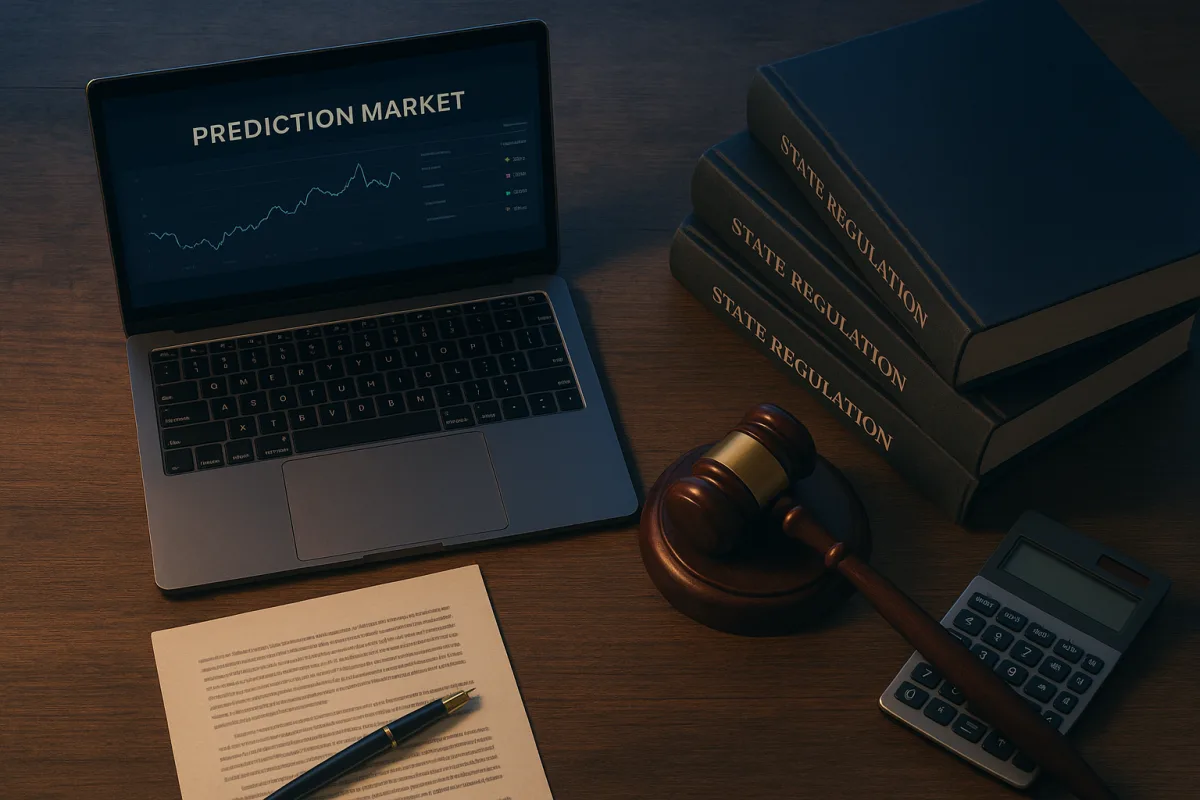
Identify the contract in front of you
A contract on the wording of a presidential speech can look like a small bet, perhaps paying about $1 if the event occurs and zero if it does not. U.S. regulators and platforms increasingly frame that payoff as an event contract within the commodities-law system. [3]
The risk arrives before settlement. A trade connected to information you learned at work can draw fraud and insider-trading scrutiny even if the contract is small, the event is public, and the platform markets itself as regulated. [1][6]
The Commodity Futures Trading Commission says it holds exclusive jurisdiction over prediction markets under the Commodity Exchange Act. In a February 2026 court filing, the agency reiterated that event contracts fall within its authority, putting these instruments closer to derivatives than traditional sportsbook wagers. [3]
That classification remains contested outside Washington. State officials have argued that contracts on elections, sports, and other outcomes are unlicensed gambling under their own laws, while platforms and the CFTC have asserted federal authority. [10][11][13]
Read the market rules before you put up capital. Confirm the resolution source, exact event deadline, cancellation language, geographic eligibility, account restrictions, and whether the platform can halt trading during a legal dispute.
Check whether your job creates an information problem
A government badge, security clearance, congressional role, campaign post, or contractor assignment changes the risk profile of even casual prediction-market activity. The House Oversight Committee’s November memorandum examined trading by officials, military personnel, and cleared individuals using nonpublic information. [1]
The committee gathered nearly 1,700 pages of documents and held five bipartisan staff briefings with prediction-market platforms about suspicious-trading detection and reporting. It concluded that Congress should consider restrictions ranging from a broad ban to targeted limits on government-linked contracts. [1]
Existing law already reaches some conduct. The committee cited the Commodity Exchange Act, as amended by the STOCK Act, which prohibits federal employees, members of Congress, and others from trading commodity futures, options, or swaps using material nonpublic information gained through their positions. [1]
The first prominent 2026 prosecution made the stakes concrete. Federal prosecutors and the CFTC charged active-duty Army Special Forces Master Sergeant Gannon Ken Van Dyke over Polymarket trades allegedly based on classified information about an operation targeting Venezuelan President Nicolás Maduro. [6]
In August, the CFTC settled insider-trading charges against Gabriel Perez, a White House teleprompter operator, over Kalshi contracts tied to nonpublic information about presidential speech content. Those are the two publicly documented government-insider cases identified through November 2026. [7]
If your work touches an outcome, do not try to solve the issue by trading through a family member, another wallet, or a small account. Ask your agency ethics office, employer compliance team, or counsel for a written answer before placing any position.
Separate enacted restrictions from proposed bans
Several bills would narrow who can trade and what markets can list, but a proposal is not a prohibition. As of November 2026, Congress had not enacted a comprehensive federal law specifically governing prediction-market participation by government employees and military personnel. [8]
The PREDICT Act, introduced in March by Representatives Adrian Smith, a Nebraska Republican, and Nikki Budzinski, an Illinois Democrat, would bar members of Congress, spouses, dependents, the president, vice president, and certain political appointees from government and political-event contracts. [8]
Senator Jeff Merkley of Oregon and Representative Jamie Raskin of Maryland introduced the Stop Corrupt Bets Act, which seeks to prohibit markets involving sports, politics, news, entertainment, and military matters. Its sponsors argue those markets are not legalized by the Commodity Exchange Act. [2]
The Stop Lawmakers From Predicting Act would focus on Congress members and immediate family trading government and political outcomes. Senator Merkley and Senator Amy Klobuchar have also pushed a separate effort focused on federal elected officials profiting from prediction markets. [5]
For a personal account, track enacted policy and your employer’s rules, not bill headlines. For an operator, assume a proposal can still affect banking relationships, market making, compliance budgets, and the willingness of liquidity providers to support politically sensitive contracts.
Confirm where you can legally access the market
A platform’s federal registration or CFTC relationship is not a universal permission slip. The current fight turns on whether federal commodities regulation preempts state gambling law, and courts have not issued a final ruling that resolves the conflict nationwide. [9][14]
Arizona brought a 20-count criminal indictment against Kalshi in March 2026, alleging illegal gambling involving election, sports, and other contracts. The charges show that exposure can include more than a civil demand to stop offering a product. [10]
New York’s attorney general sued Kalshi in July, alleging the company ran illegal and unlicensed gambling operations and seeking to halt operations and forfeit profits. The CFTC later used emergency authority that allowed Kalshi to continue operating during that dispute. [11][13]
Arkansas sued Kalshi on November 4, alleging unlicensed gambling accessible to customers aged 18 through 20. Utah filed criminal charges on October 28 against Kalshi and its co-founders, alleging violations of state gambling law. [12]
Connecticut’s Department of Consumer Protection issued Polymarket a cease-and-desist order in September, alleging unauthorized operation. A federal court also barred Kalshi sports contracts on certain Indian lands, adding another jurisdictional layer beyond state borders. [14]
Check your state at account opening and again before funding a new contract category. If a platform changes access rules, closes a market, or limits withdrawals because of legal action, the timing can affect your ability to exit or hedge a position.
Price legal uncertainty into your platform business
If you operate, build infrastructure for, or provide liquidity to a prediction-market venue, legal availability is part of market risk. Contracts can lose participants when a state restriction, platform suspension, or emergency order changes who can transact.
The CFTC expects platforms within its system to meet registration, reporting, anti-fraud, and market-integrity requirements. In its Ninth Circuit filing, the agency emphasized its view that event contracts belong under the Commodity Exchange Act. [3]
That federal position has not ended arguments over which events cross into gambling. The CFTC’s enforcement focus increased in 2026, while state actions tested contracts on sports, elections, and other public outcomes. [9][10][11]
Build compliance controls around contract categories, user location, restricted persons, suspicious trading, and auditable resolution procedures. Do not rely on a generic terms-of-service prohibition if the product lets users trade outcomes connected to official decisions or nonpublic events.
Platforms have reported that their own surveillance systems detected many suspicious incidents before regulators became involved. House Oversight specifically credited Kalshi’s upgraded controls and Polymarket’s PolyGraph surveillance tool, developed with blockchain analytics firm Chainalysis. [1]
Those controls help, but they do not eliminate liability or reputational cost. A venue that catches misconduct may demonstrate monitoring, while a venue that misses it can face questions about its policies, data retention, and escalation process.
Keep records for tax reporting before the first settlement
Event-contract profits and losses can create tax obligations, even though prediction-market tax treatment has not been packaged into a simple retail form comparable to a brokerage account’s familiar stock reporting. Keep records from the first funded transaction.
Save the timestamp, contract name, number of contracts, entry price, exit price, platform fees, deposits, withdrawals, and settlement result. Preserve screenshots or downloaded account statements when a contract resolves, especially if the platform later removes the market from view.
Do not assume a payout is tax-free because it was paid in stablecoins, crypto, dollars, or platform credits. The transaction history still needs to show what you paid, what you received, and when each event occurred.
A tax professional can apply the relevant rules to your facts, particularly if you trade frequently, use crypto to fund accounts, reside in more than one jurisdiction, or operate through an entity. Avoid reconstructing a year of trades from wallet transfers alone.
Treat price predictions as commentary, not regulatory evidence
Bitcoin Magazine’s BMTV featured market commentator Joe Carlasare arguing that Bitcoin could return to the $80,000s or $90,000s after its earlier move from $57,000 to $82,000. That is a market view, not evidence about how regulators will classify event contracts.
Prediction markets can turn those same kinds of expectations into tradeable claims, which adds resolution, surveillance, and legal exposure. A forecast about Bitcoin’s price is speculative, whether it appears in a television interview or in a binary contract.
The Securities and Exchange Commission has not published a definitive prediction-market framework. Representative Sean Casten and other House Democrats asked the SEC in July to clarify its role for contracts tied to securities or financial metrics. [4]
We would keep financial-market event contracts separate from a thesis about the underlying asset. A correct Bitcoin forecast does not answer whether a particular contract is available in your state, properly designed, or free from information asymmetry.
Watch the next enforcement notice, not just market odds
The case for restricting government officials rests on public trust and national security, not on demonstrated evidence that official trading is a major share of market volume. The two public cases in 2026 are serious, but they are not a comprehensive measure of misconduct. [6][7]
Advocates including the Center for American Progress argue that government insiders must be prevented from using sensitive information to profit in these markets. House Oversight similarly said reforms may be needed to prevent corruption and the appearance of it. [1][15]
Critics have suggested that broad participation bans could cut liquidity, but no comprehensive empirical study has quantified a liquidity or public-trust effect. Treat claims that bans will either destroy markets or clean them up as unproven forecasts.
Follow four signals: new CFTC rules or enforcement actions, federal court rulings on state preemption, enacted congressional restrictions, and platform notices affecting access or contract listings. Those developments can change what you may trade and what a platform can offer faster than the odds on a headline contract.
Frequently Asked Questions
What are the main legal challenges facing prediction markets in the US?
Prediction markets face ongoing legal challenges regarding their classification and regulation. While the Commodity Futures Trading Commission (CFTC) asserts exclusive jurisdiction under the Commodity Exchange Act, several states including Arizona, New York, Arkansas, Utah, and Connecticut have challenged these markets as illegal gambling under state laws. This federal-state jurisdiction conflict remains unresolved and affects the availability and legality of certain contracts.
How does CFTC regulate prediction markets?
The CFTC treats prediction market contracts as event contracts regulated under commodities law, similar to derivatives rather than traditional sports betting. It enforces rules against fraud and insider trading, holding exclusive jurisdiction over these markets. The agency has actively pursued insider trading cases and asserted emergency authority to keep platforms operating amid legal disputes.
What insider trading risks exist in prediction markets?
Insider trading risks arise when individuals trade on material nonpublic information related to their government, military, or contractor roles. The Commodity Exchange Act, as amended by the STOCK Act, prohibits federal employees and others from trading commodity futures using such information. Recent prosecutions and settlements, including cases involving an active-duty Army Special Forces sergeant and a White House teleprompter operator, highlight these risks.
How do state gambling laws affect prediction markets?
Some states have challenged prediction markets as unlicensed gambling, leading to lawsuits and enforcement actions against platforms. State laws in Arizona, New York, and other jurisdictions have been used to argue that certain prediction market contracts violate gambling statutes, despite federal claims of exclusive CFTC jurisdiction. This has created legal uncertainty and operational risks for platforms and traders.
What compliance steps should traders take in prediction markets?
Traders should carefully review market rules, including event definitions, deadlines, cancellation policies, geographic restrictions, and platform controls. Those with government or military roles should avoid trading on contracts related to their official duties and seek employer guidance to avoid insider trading violations. Maintaining detailed records of trades, deposits, withdrawals, settlements, and fees is important for tax reporting and legal compliance.
How we researched this
This article was assembled from 2 published articles, 15 cited references.
Nothing here is based on hands-on testing. Where a figure or finding appears, it belongs to the source cited beside it, and the writing says so rather than implying otherwise. Every source is listed below so you can check it.
Sources
Should Government Officials Be Banned From Prediction Markets? House Oversight Says Maybe, Decrypt
Joe Carlasare on “Extreme Fear” in Bitcoin: “I’m A Buyer Here”, Bitcoin Magazine
Exclusive: New Senate bill would ban prediction markets on sports, politics and military
CFTC Reaffirms Exclusive Jurisdiction over Prediction Markets in U.S. Circuit Court Filing | CFTC
Kalshi and Polymarket Insider Trading: Charges, CFTC Cases and Bills | Prediction Market Laws
United States: Eye on Enforcement - CFTC and Prediction Markets | Insight | Baker McKenzie
New York sues Kalshi, says its prediction markets are ‘illegal gambling’
CFTC flexes emergency authority to keep Kalshi operating amid New York lawsuit | The Block
Kalshi and Polymarket by US State: 2026 Legal Table | Vultax
Related Articles

Crypto Regulatory Challenges
Explore crypto regulatory challenges, legal risks, and compliance costs shaping stablecoins, blockchain records, and cross-border crypto markets.
Prediction Markets Regulation and Platform Licensing
Learn about prediction markets regulation, CFTC licensing, and legal risks for platforms operating event contracts in the US.

Crypto Regulatory Developments
Explore key crypto regulatory developments, legal challenges for prediction markets, and stablecoin compliance in the US, EU, and beyond.

Tokenized Securities Risks and Liquidity on Blockchain
Explore the risks, liquidity challenges, and costs of tokenized securities trading on blockchain, plus what investors must consider.