
Tokenized Securities Risks and Liquidity on Blockchain
Explore the risks, liquidity challenges, and costs of tokenized securities trading on blockchain, plus what investors must consider.

The quick list
Best overall: Backpack Securities, for traders seeking the strongest disclosed Solana trading activity today.
Best upcoming regulated route: Formation Securities, for verified investors willing to wait for its planned early-2027 Solana launch.
Best for institutional collateral: BlackRock’s BUIDL, for eligible institutions that want a tokenized dollar fund to support trading margin.
Best for small non-equity exposure: Paxos Gold, or PAXG, for holders who want fractional gold exposure and may borrow USDC against it on Coinbase.
A $100 tokenized share can look like an ordinary stock position in a wallet, but the first details to check are the issuer name, the venue’s eligibility screen, and the redemption route. Those three lines determine what the token costs you, who holds the underlying asset, and whether you can exit.
The central risk comes next. Tokenized securities can trade around the clock and settle through blockchain rails, but the legal claim can still depend on a custodian, transfer agent, permissioned venue, or issuer remaining operational. Guardian Security notes that transfers may not always convey unambiguous legal ownership or full shareholder rights. [8]
The market is no longer hypothetical. Tokenized stocks from the six largest issuers reached a combined $3.2 billion market capitalization by October 31, up from $585 million at the end of 2025, according to Bitquery. Binance’s bStocks accounted for $1.31 billion, or 41% of that total. [6]
Comparison table
| Option | What you get | Current scale or timetable | Trading layout | Published price and cost detail | Main trade-off |
|---|---|---|---|---|---|
| Backpack Securities | Tokenized U.S. equities on Solana, with credit integration through Kamino | $598 million of a reported $657 million Solana daily tokenized-stock volume on Nov. 2 [5] | Venue-led Solana trading, plus tokenized-equity collateral | Trading fees, spreads, and minimums not provided here | Strong reported activity does not establish legal rights, custody terms, or depth for every stock |
| Formation Securities | Planned tokenized Exodus, Forward Industries, and Galaxy Digital shares | Planned early 2027 launch [[3]](https://www.theblock.co/news/defi/2026-11-09-formation-tokenized-securities-solana-436060 "Formation notifies SEC to operate first tokenized securities venue on Solana | The Block") | Permissioned Solana automated market maker pools for verified investors [[1]](https://www.sec.gov/newsroom/press-releases/2026-90-sec-issues-innovation-exemption-facilitate-trading-tokenized-nms-stock-request-comment "SEC.gov | SEC Issues “Innovation Exemption” to Facilitate the Trading of Tokenized NMS Stock and Request for Comment") |
| BlackRock BUIDL | Tokenized interest-bearing dollar fund claims, backed by cash, Treasury bills, and repos | Ethereum hosted $15 billion in distributed asset value as of Nov. 9, though not all is BUIDL | Permissioned fund tokens used as off-exchange or exchange margin | Fund and collateral haircuts not disclosed in the announced framework | It is a managed dollar-fund claim, not a stock and not an ETH substitute |
| Paxos Gold, PAXG | Token representing one fine troy ounce of custodied gold, with fractional ownership | Added to Base on Nov. 6 | Held onchain, potentially used as Coinbase loan collateral | PAXG-specific borrowing limits and rates were not public | Gold pricing pauses on weekends for loan-health calculations, and liquidation remains possible |
The market is bigger than the venues you can actually use
DEX trading in tokenized stocks reached $12.4 billion over the 30 days through November 3, according to EdgeX. BNB Chain accounted for about 32% of that reported volume. [15] That figure signals demand, but volume does not tell you whether a specific stock has a narrow spread when you need to sell.
Base has become one visible center of activity. Coinbase tokenized stocks recorded $2.49 billion in decentralized-exchange volume during October, close to Robinhood’s $2.61 billion, while Aerodrome handled 96.5% of Base tokenized-stock volume, according to iCrypto24. [4]
That concentration is a cost issue. A market can report large aggregate turnover while still relying on one venue or a small set of liquidity pools. If liquidity shifts, your execution price may move sharply, especially on a larger order.
OneBullEx estimates tokenized-stock bid-ask spreads can be 50 to 200 basis points wider than those on traditional exchanges. Its example compares a 1.5% tokenized-stock spread with 0.02% in conventional equities. [9] The reported advantage of instant settlement can disappear quickly if entry and exit each cost more.
Backpack Securities: the live liquidity leader, with unanswered ownership questions
Backpack Securities is the strongest current choice in this roundup if your screen starts with reported Solana trading activity. Coinpaper reported that the platform processed $598 million, or 91%, of Solana’s $657 million tokenized-stock volume on November 2. [5]
That is a useful measure of relative scale, not a guarantee of execution quality. A single day’s volume does not disclose the number of active counterparties, the order size available at quoted prices, or whether the most-liquid names match the stock you need.
Backpack also sits in a broader Solana credit arrangement. Kamino, a Solana lending protocol, says it has originated more than $20 billion in loans with zero bad debt, completed more than 30 independent audits, and undergone four formal verifications. [12]
Those are Kamino’s reported lending and security credentials, not an assurance about every tokenized equity or every venue participant. Before treating a stock token as collateral, you would need the platform’s liquidation threshold, eligible assets, pricing source, and rules during volatile market hours.
We would rank Backpack first for readers who need evidence of current market activity, but not because volume settles the more important question of what rights attach to a particular token. The issuer documentation and custody chain still need to do that work.
Formation Securities: the clearest U.S. regulatory route, but it is still a launch plan
Formation Securities has notified the SEC that it intends to operate a tokenized-securities venue on Solana, with tokenized shares of Exodus Movement, Forward Industries, and Galaxy Digital among its first products. The Block reported an expected early-2027 launch. [3]
Its framework comes from the SEC’s September 17 Innovation Exemption. The relief allows qualifying blockchain platforms to facilitate trading in tokenized National Market System stocks without registering as conventional national securities exchanges, subject to conditions and ongoing comment. [1]
The exemption lasts five years, expiring in September 2031. Skadden describes it as conditional relief, meaning its terms and regulatory treatment can change while platforms are operating. [13] That is not the same thing as permanent securities-market infrastructure.
Formation’s design is expected to use permissioned automated market makers and liquidity pools, with trading limited to verified investors. The SEC requires covered tokenized stocks to provide the same rights as their conventional counterparts, including voting and dividends. [1]
That requirement is meaningful, but readers should look for the contractual mechanism that delivers those rights. Formation has not publicly detailed fees, liquidity incentives, spread targets, smart-contract security architecture, or how investors would move positions if the venue later ceases operations.
We would place Formation ahead of unstructured offshore-style stock-token offerings on regulatory clarity, provided its final documents match the announced model. But it remains an upcoming venue, so its actual trading depth, cost, and operating resilience are speculation until launch.
BUIDL and PAXG: securities-style collateral is not stock trading
BlackRock’s BUIDL illustrates why tokenization does not automatically create demand for a blockchain’s native asset or for stock tokens. The fund is a permissioned tokenized claim on cash, U.S. Treasury bills, and repurchase agreements, designed to maintain a stable $1 token value.
Standard Chartered and OKX announced a framework allowing eligible clients to post BUIDL as trading collateral while continuing to receive the fund’s yield. CryptoSlate reported that the arrangement can place tokens in off-exchange custody at Standard Chartered or allow deposits for exchange margin.
For an institution, BUIDL’s appeal is balance-sheet efficiency. It can retain dollar-fund exposure while supporting trades. For an individual looking for tokenized stocks, it is a different product entirely, with eligibility, custody, and managed-fund dependencies.
Paxos Gold offers another comparison point. Each full PAXG token represents one fine troy ounce of physical gold in custody, while fractional holdings allow smaller exposures. CryptoSlate reported that Paxos added PAXG to Base on November 6 and that Coinbase users could borrow USDC against it through Morpho.
The borrowing feature adds liquidity without a sale, but it also creates liquidation risk. Coinbase’s loan guidance says PAXG collateral pricing updates during approximately 23 weekday hours and pauses when gold markets are closed, including weekends, so loan health may not immediately reflect market moves.
Neither BUIDL nor PAXG is a substitute for buying an equity. They belong in this comparison because they show where tokenization is currently generating clear utility: collateral mobility, fractional ownership, and faster transfer of claims, not necessarily a cheaper stock trade.
Blockchain controls can change your exit route
The promise of self-custody needs careful limits when the asset depends on a token issuer, bridge, or application. Lisk’s shutdown offers a recent warning: holders who left assets on its former Ethereum layer-2 network lost the usual portal and bridge when they closed November 2.
CryptoSlate reported that Lisk now plans a manual claims process in January 2027, but has not specified eligibility, user steps, or payment timing. A token can survive a chain shutdown while the route to move or redeem it depends on an operator’s future process.
Governance risk can also reach balances directly. Polygon proposed recovering roughly 70 million POL from five wallets linked to incidents affecting Polymarket and Binance, moving the native tokens without signatures from those addresses. The proposal had not set an activation block or finalized software release as of November 9.
The Polygon proposal concerns POL, not tokenized stocks. Its relevance is structural: blockchain ownership can still be subject to network-rule changes approved by governance and adopted by validators. For securities tokens, you need to know who can freeze, reissue, burn, or transfer balances.
Security vendors also remain a point of dependency. Chainalysis restored Reactor, KYT, and Address Screening after an incident exposed usernames, password hashes, and live login tokens for all users, CryptoSlate reported. Its Investigations API and Rapid Lookup remained under maintenance on November 9.
For a tokenized-stock venue, compliance screening and wallet-risk systems can determine whether transfers clear or accounts remain accessible. A public blockchain may operate continuously while the compliance layer around regulated securities does not.
Who each option suits
Backpack Securities suits an eligible trader focused on the most substantial disclosed Solana tokenized-stock activity. It has the best reported liquidity signal, but you should still inspect each asset’s issuer, redemption terms, and executable spread before treating headline volume as available liquidity.
Formation Securities suits a verified investor who wants a planned U.S. venue operating under the SEC’s Innovation Exemption. It is the option to watch for legal structure and issuer-rights disclosure, not one to use today, because launch, fees, and trading depth remain unpublished.
BUIDL suits eligible institutional clients managing collateral and dollar liquidity. Its attraction is the ability to use a yield-bearing fund claim as margin, while its limits are permissioned access, managed-fund exposure, and a structure that does not provide equity ownership.
PAXG suits holders seeking tokenized gold and potentially USDC liquidity without immediately selling their gold exposure. It does not suit readers seeking stock-market participation, and borrowers need to account for variable eligibility, undisclosed PAXG loan terms, and liquidation risk during price moves.
Frequently Asked Questions
What are the legal risks of tokenized securities?
Tokenized securities may not always convey clear legal ownership or full shareholder rights. The legal claim to the underlying asset can depend on custodians, transfer agents, permissioned venues, or issuers remaining operational, meaning a token balance does not guarantee enforceable ownership. These risks persist despite blockchain settlement.
How does liquidity affect tokenized stock trading?
Liquidity varies significantly across venues and tokens. For example, Backpack Securities accounted for 91% of Solana’s reported $657 million daily tokenized-stock volume on November 2, 2026, indicating strong activity there. However, high reported volume does not guarantee narrow spreads or deep liquidity for every stock.
What costs are involved in trading tokenized securities?
No platform currently publishes a complete all-in cost including spreads, fees, custody charges, and withdrawal costs. Tokenized-stock spreads can be 50 to 200 basis points wider than conventional equity markets, increasing trading expenses compared to traditional stocks.
Can blockchain settlement eliminate custody risks?
Blockchain settlement does not eliminate custody risks. Legal ownership and shareholder rights may still depend on custodians, issuers, and other intermediaries. A token balance on the blockchain might not equate to a legally enforceable claim.
What should investors check before trading tokenized stocks?
Investors should verify the issuer name, the venue’s eligibility screening process, and the redemption or exit routes. These factors determine the token’s actual cost, who holds the underlying asset, and whether the investor can exit the position. Venue access and legal rights are critical considerations beyond 24-hour trading claims.
How we researched this
This article was assembled from 6 published articles, 15 cited references.
Nothing here is based on hands-on testing. Where a figure or finding appears, it belongs to the source cited beside it, and the writing says so rather than implying otherwise. Every source is listed below so you can check it.
Sources
Formation notifies SEC to operate first tokenized securities venue on Solana, The Block
Tokenized gold can now back a Coinbase loan. The price feed takes weekends off, CryptoSlate
Crypto’s crime-tracking giant restores its main tools after hackers exposed every user’s login data, CryptoSlate
Your crypto can survive a blockchain shutdown. Your way out might not, CryptoSlate
Why Wall Street can use Ethereum without betting on ETH, CryptoSlate
Polygon wants to move 70 million POL without the wallet holders’ signatures, CryptoSlate
Formation notifies SEC to operate first tokenized securities venue on Solana | The Block
Tokenized Stocks Are Worth $3.2B; 41% Are Binance's bStocks - Bitquery
SEC Paves the Way for Blockchain Stock Trading in Landmark Shift
Tokenized Stocks Risks: Issuers, Custody and Smart Contracts | Guardian Resource Hub
The Regulatory Landscape for Tokenized NMS Stocks: What You Need to Know | OneBullEx
Solana (SOL) gets tokenized stock venue under SEC framework, trading Galaxy (GLXY), Forward (FWDI)
Kamino and Backpack Securities Expand Credit for Tokenized U.S. Equities | Nasdaq
Formation Securities Notifies SEC of Intent to Operate First Tokenized Securities Venue on Solana
Tokenized Stocks Generate $12.4 Billion in DEX Trading Volume Over 30 Days
Related Articles
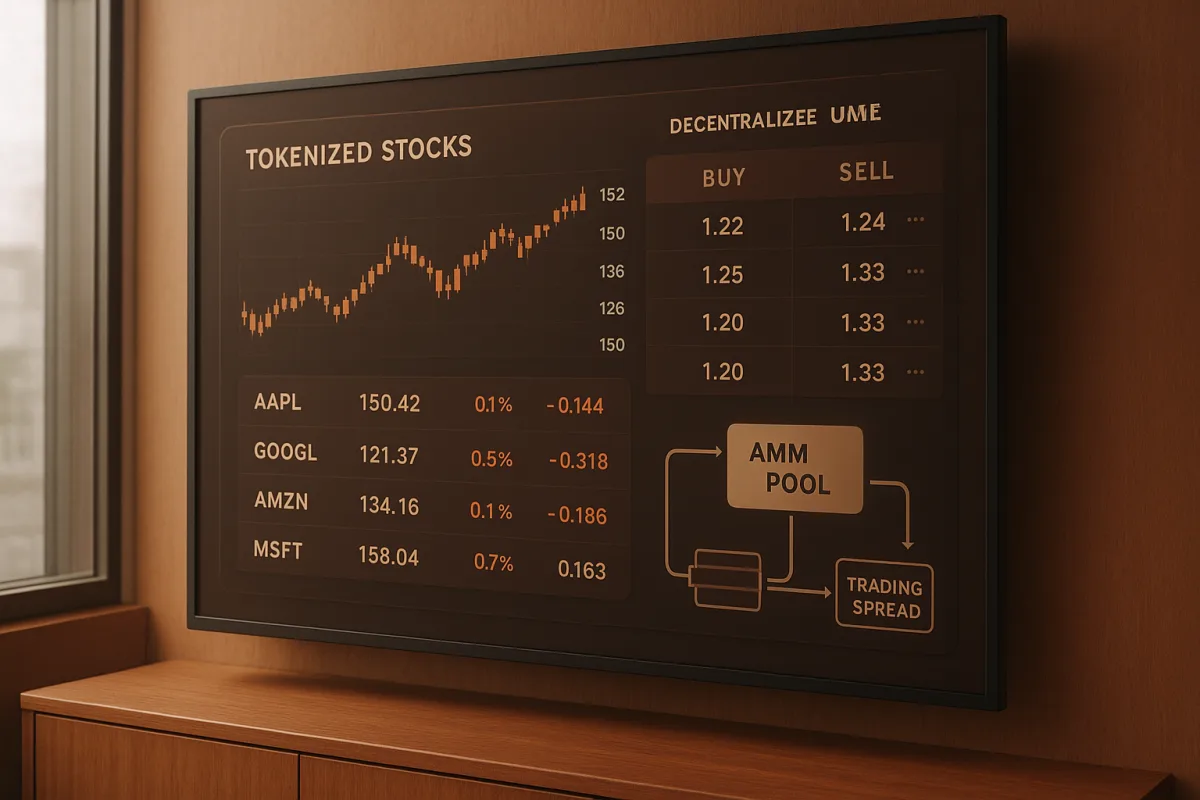
Tokenized Stock Trading and Market Structure Innovations
Explore tokenized stock trading, SEC's Innovation Exemption, AMM market structures, and trading costs in blockchain-based equity markets.

Crypto Regulatory Challenges
Explore crypto regulatory challenges, legal risks, and compliance costs shaping stablecoins, blockchain records, and cross-border crypto markets.
Tokenized Stocks Institutional Adoption and Regulatory Pushback
Explore institutional adoption of tokenized stocks and ETFs amid regulatory pushback and SEC innovation exemptions.
Tokenization and Institutional Crypto Adoption
Explore tokenization and institutional crypto adoption with insights on SEC rules, trading limits, and challenges in regulated tokenized securities.