
Tokenized Stock Trading and Market Structure Innovations
Explore tokenized stock trading, SEC's Innovation Exemption, AMM market structures, and trading costs in blockchain-based equity markets.
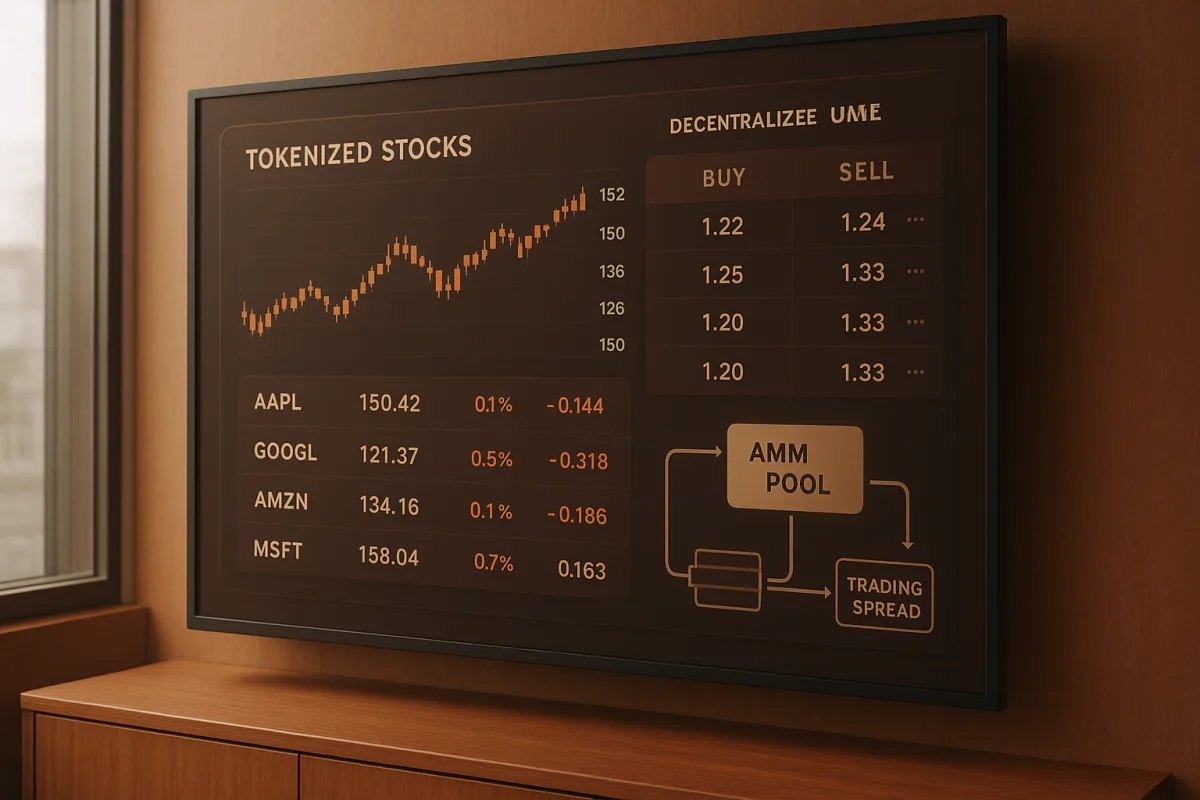
The SEC has opened a route, not a new exchange
The Securities and Exchange Commission has granted a five-year Innovation Exemption for certain tokenized National Market System stocks to trade on blockchain-based venues without those venues registering as national securities exchanges or alternative trading systems. The result is a regulatory test bed, not the migration of U.S. equities onto public chains. [1]
The principal risk is that “tokenized stock” can describe materially different products. A token may represent a legally recognized entitlement to a share, or it may be an offshore debt instrument whose value follows a share without delivering the rights that make an equity investment an equity.
That distinction is central to the SEC’s design. To qualify, the onchain instrument must provide rights equivalent to those attached to the underlying NMS stock, including voting and dividend rights, rather than merely giving holders a price-linked claim. [1][7]
The agency is also keeping the trial small. Eligible tokenized securities venues face caps of 0.25% of normal daily volume for Tier 1 securities and 2.5% for Tier 2 securities, alongside limits on the number of symbols traded. [1][10]
Those percentages matter more than the headline that stocks can trade onchain. A large, liquid U.S. equity may trade billions of dollars daily on its primary market. A venue restricted to a small fraction of that activity will not initially replace Nasdaq or the New York Stock Exchange.
The market-structure innovation is the AMM
The most consequential feature is not that a stock can be represented by a token. It is that the SEC permits qualifying venues to use automated market makers, or AMMs, for trading, subject to controlled access and the exemption’s other conditions. [1][7]
An AMM is software that quotes a trade from a pool of two assets, rather than waiting for a conventional market maker to post a bid and offer. In its simplest form, a pool might contain tokenized shares and dollar-backed settlement tokens.
A trader buying tokenized shares deposits settlement tokens into the pool and withdraws stock tokens. The pool’s inventory changes immediately. Because fewer stock tokens remain after the purchase, the formula raises the marginal price for the next buyer.
In the common constant-product design, the quantities of the two assets are linked by a formula, often described as x multiplied by y equals k. The formula does not know whether the asset is a meme token or a claim on a listed company.
That mechanical simplicity is useful. It can make a market available continuously, settle transactions according to code, and reduce dependence on a centralized order-book operator. But it does not create liquidity by itself, and it does not guarantee a fair execution price.
What a trade actually costs
For a conventional stock order, the visible cost may be a commission, exchange fees and the bid-ask spread. The equivalent on a tokenized-stock AMM can include a protocol fee, blockchain transaction costs, a price impact from the pool, and the economic cost of compliance.
The crucial variable is pool depth. Suppose a pool holds $1 million of a tokenized stock and $1 million of a dollar token. A small purchase changes inventory only slightly. A large purchase removes enough stock tokens to move the quoted price sharply.
That price movement is slippage. It is the difference between the price visible before an order and the average price actually obtained as the AMM moves along its curve. It is not necessarily misconduct. It is the mathematical consequence of demanding immediacy from a finite pool.
Research on AMMs identifies thin markets as a structural problem: when liquidity is fragmented or limited, automated pricing rules can produce high price impact and volatile prices relative to external markets. [3] Tokenizing an established share does not remove that constraint.
Arbitrageurs are expected to narrow the difference. If an AMM prices a tokenized share above its price on a traditional exchange, a trader could buy the share where it is cheaper and sell the tokenized version into the pool, subject to custody and conversion mechanics.
That process only works if the token can be created or redeemed efficiently, settlement is reliable, and legal ownership is clear. If conversion is slow, restricted or unavailable, the token may trade at a persistent premium or discount to the underlying share.
This is why the issuer-rights requirement is more than a legal detail. A robust redemption route links the onchain token to the underlying security. Without it, an AMM may be pricing a separate instrument that happens to reference a familiar ticker.
Who supplies liquidity, and why
AMMs need liquidity providers to deposit both sides of the pool. In exchange, those providers receive a share of trading fees. Under the SEC framework, liquidity providers using their own capital can receive conditional relief from dealer-registration requirements. [1][7]
Their business is not risk-free yield. A liquidity provider is effectively standing ready to buy when traders sell and sell when traders buy. During one-sided demand, the pool ends up holding more of the asset falling in price and less of the asset rising.
For a tokenized stock, this inventory risk is particularly relevant around earnings, corporate actions and market-wide shocks. A pool can continue quoting through an event, but its liquidity providers may require higher fees or wider effective pricing to accept the risk.
The venue also must control participation. The SEC’s framework requires permissioned access, public disclosure of platform and affiliate trading activity, auditable smart contracts on permissionless ledgers, and synchronization with halts in the underlying stock’s primary market. [1][10]
That combination produces a hybrid structure. The ledger and pricing mechanism may be public-chain technology, but users will not simply connect an anonymous wallet and trade regulated equities. Know-your-customer screening, eligibility controls and market surveillance remain part of the transaction cost.
Why existing stock tokens may not qualify
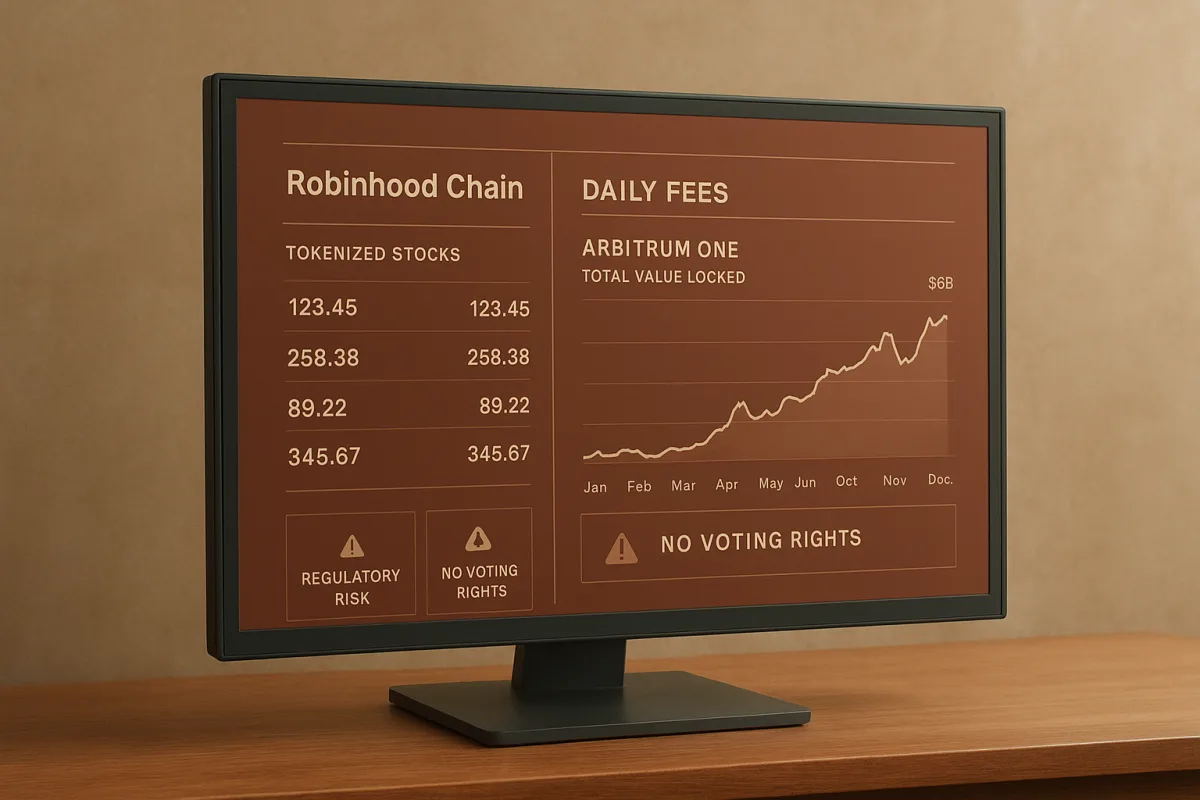
Robinhood Chain illustrates the gap between tokenized price exposure and tokenized ownership. Its stock-token product is issued through Robinhood Assets, a Jersey-based entity, as an offshore debt-security structure rather than direct ownership of the referenced shares. [8][9]
Under that design, holders do not currently receive conventional voting rights. Dividends are generally reinvested and reflected through adjustments to the token’s multiplier, rather than paid directly as a cash distribution to the token holder. [8]
Robinhood has said it plans in-kind redemption and voting rights, but those features remain prospective as of September 2026. Whether the final structure would satisfy the SEC’s equivalent-rights standard has not been established. [8][1]
The company’s activity demonstrates demand, but not regulatory equivalence. CryptoWisser reported Robinhood Chain reached roughly $989 million in daily DEX volume and close to $710 million in total value locked on September 1. [4]
Other reported figures point in the same direction. OneBullEx cited weekly tokenized-stock spot volume near $3 billion across platforms by early September, led by Robinhood Chain, BNB Chain and Solana. [5] These are activity measures, not proof of securities-market quality.
A report from Gokhshtein said tokenized stocks traded $1.41 billion during an 89.5-hour traditional-market shutdown, with Robinhood Chain accounting for 57% of weekend volume. [6] Weekend access is commercially attractive, but it also heightens the question of reference pricing when stock exchanges are closed.
With no primary-market price updating, an AMM’s quote reflects its own inventory, derivatives hedging and participants’ expectations of the next opening price. That is a genuine price-discovery process, but it can be volatile and cannot be assumed to match the eventual cash-equity opening.
The issuer gets a veto
The SEC has addressed another problem exposed by offshore stock-token models: public companies may object to third parties creating blockchain instruments referencing their shares. Before trading begins, the venue must notify the issuer and provide an opportunity to object. [1][7]
This safeguard makes the market slower to launch but clearer in accountability. A tokenization provider, custodian, transfer agent, liquidity provider and trading venue each need contracts, operational procedures and disclosures that can withstand issuer and regulatory scrutiny.
That is expensive compared with deploying a price-tracking token on an offshore venue. The benefit is that a qualifying token should have a stronger legal claim to being a share, rather than a derivative wrapped in a familiar ticker symbol.
The economics therefore favor firms able to combine securities infrastructure with blockchain operations. That could include issuer-sponsored tokenization providers, custodians and transfer agents, as well as trading systems that can enforce access rules without abandoning public-chain settlement. [7][10]
The CFTC move is adjacent, not interchangeable
The Commodity Futures Trading Commission has separately provided no-action relief for passive software providers connecting users to regulated derivatives markets. The relief can remove a broker-registration requirement only where the software is genuinely passive and orders route to registered entities. [11][12]
The software cannot custody customer funds, generate trading signals, decide transactions or control the order flow in the manner of a broker. The user remains a customer of the registered futures commission merchant, introducing broker or designated contract market. [11]
This may enable wallets and trading interfaces to function as regulated access layers. It does not make every crypto application a derivatives broker, and it does not legalize offshore perpetual-futures platforms for U.S. users merely because their front end is software.
The SEC exemption and CFTC letter therefore solve different market-structure questions. The SEC framework concerns secondary trading of real tokenized stocks with shareholder rights. The CFTC relief concerns how passive applications may connect customers to already regulated derivatives venues.
Both initiatives matter because Congress’s Clarity Act stalled in a procedural vote, leaving agencies to use existing authority. The SEC’s five-year window is evidence of regulatory movement, but its narrow limits show that market participants should not confuse experimentation with settled policy. [1][7]
The commercial test now is straightforward: can regulated venues offer execution, conversion and investor protections competitive with established equity markets, while preserving the operational advantages of onchain settlement? Trading volume alone will not answer it. Depth, rights, redemption and compliance will.
Frequently Asked Questions
What is the SEC Innovation Exemption for tokenized stock trading?
The SEC’s Innovation Exemption is a five-year regulatory relief allowing certain blockchain-based venues to trade tokenized National Market System stocks without registering as national securities exchanges or alternative trading systems. It is a limited test bed with caps on trading volumes and requires tokenized stocks to confer rights equivalent to the underlying shares, including voting and dividends. This exemption does not authorize existing offshore stock tokens that lack these shareholder rights.
How do automated market makers work in tokenized stock markets?
Automated market makers (AMMs) use a liquidity pool containing two assets, such as tokenized shares and settlement tokens, to facilitate trades without traditional bid-offer posting. When a trader buys tokenized shares, they deposit settlement tokens into the pool and withdraw stock tokens, which changes the pool’s inventory and adjusts prices according to a formula (commonly x*y=k). This allows continuous pricing based on supply and demand within the pool.
What are the costs involved in trading tokenized stocks onchain?
Onchain trading costs include more than just network fees; in thin AMM pools, factors like spreads, slippage, liquidity-provider compensation, and compliance overhead significantly affect whether a quoted price is executable. These costs can make trading less efficient and impact price accuracy, especially when liquidity is limited.
How does tokenized stock ownership differ from traditional stock ownership?
Tokenized stocks under the SEC Innovation Exemption must provide rights equivalent to traditional stocks, including voting and dividend rights. However, many existing offshore tokens, such as Robinhood Chain’s stock tokens, currently do not confer normal voting rights or direct dividend payments; instead, dividends are reinvested to increase token value. This distinction is crucial because not all tokenized stocks represent true equity ownership.
What market structure innovations are enabled by tokenized stock trading?
The key innovation is the use of automated market makers (AMMs) for trading tokenized stocks, permitted under the SEC exemption. AMMs enable continuous pricing and liquidity provision through algorithmic pools rather than relying on traditional market makers, potentially increasing market efficiency and accessibility on blockchain platforms.
How we researched this
This article was assembled from 3 video sources across 2 channels, 8 published articles, 12 cited references.
Nothing here is based on hands-on testing. Where a figure or finding appears, it belongs to the source cited beside it, and the writing says so rather than implying otherwise. Every source is listed below so you can check it.
Sources
Wall Street FINALLY Surrenders To Bitcoin — Coin Bureau
HUGE Robinhood Chain Top 5 Token Updates — Altcoin Buzz
Washington Just Put Stocks Onchain. Altcoin Season Starts! — Altcoin Buzz
SEC opens door to tokenized U.S. stock trading. Here’s who could benefit — CoinDesk
US sanctions Iranian crypto exchange BitBank over alleged bitcoin transfers to IRGC — The Block
CFTC Opens Door for Crypto Apps to Offer Regulated Derivatives Access — Decrypt
SEC Green Lights Tokenized Stock Trading Despite Clarity Act Fail — Bitcoin Magazine
JPMorgan says bitcoin could get more support than gold if ETF hedging eases — The Block
Andrew Yang Calls for AI Kill Switch as Safety Fears Mount — Decrypt
As RWA trading surges on Hyperliquid, Dragonfly’s Qureshi makes the case for a multichain future — The Block
Bitcoin Bounces as Markets Brace for the Fed’s Next Move — Decrypt
How Automated Market Makers Approach the Thin Market Problem in Cryptoeconomic Systems
Robinhood Chain DEX Volume Hits Record $989 Million as TVL Approaches $710 Million
Tokenized Stocks Trade $1.41B During 89.5-Hour Traditional Market Shutdown | Gokhshtein
SEC Opens Five-Year Route for Tokenized U.S. Stocks to Trade Onchain
Do Robinhood Stock Tokens Have Voting Rights? 1:1 Share Redemption Plan Explained| KuCoin
CFTC Clears Passive Crypto Trading Software From Broker Rule
CFTC Opens Door for Crypto Apps to Offer Regulated Derivatives Access
Watch Tokenized Stock Trading and Market Structure Innovations on Youtube
Also from the sources
Related Articles
Robinhood Chain Insider Trading Case and Blockchain
Explore Robinhood Chain's blockchain growth and details of the insider trading case involving former engineers.

Crypto Regulatory Challenges
Explore crypto regulatory challenges, legal risks, and compliance costs shaping stablecoins, blockchain records, and cross-border crypto markets.

XRP Price Predictions: Ripple vs. SEC News & $100 Forecast Analysis
Discover Crypto explores xrp price predictions amid breaking news on the Ripple vs. SEC lawsuit. Insights on regulatory shifts, ETF applications, and $100 xrp forecasts are discussed, alongside Cold Storage recommendations and technical analysis for potential $8 and $20 xrp targets.
Robinhood Chain Growth, Challenges, and Tokenized Stocks
Explore Robinhood Chain's growth, challenges, and tokenized stocks, including fee surges, risks, and comparison with Arbitrum One.