
Robinhood Chain Growth, Challenges, and Tokenized Stocks
Explore Robinhood Chain's growth, challenges, and tokenized stocks, including fee surges, risks, and comparison with Arbitrum One.
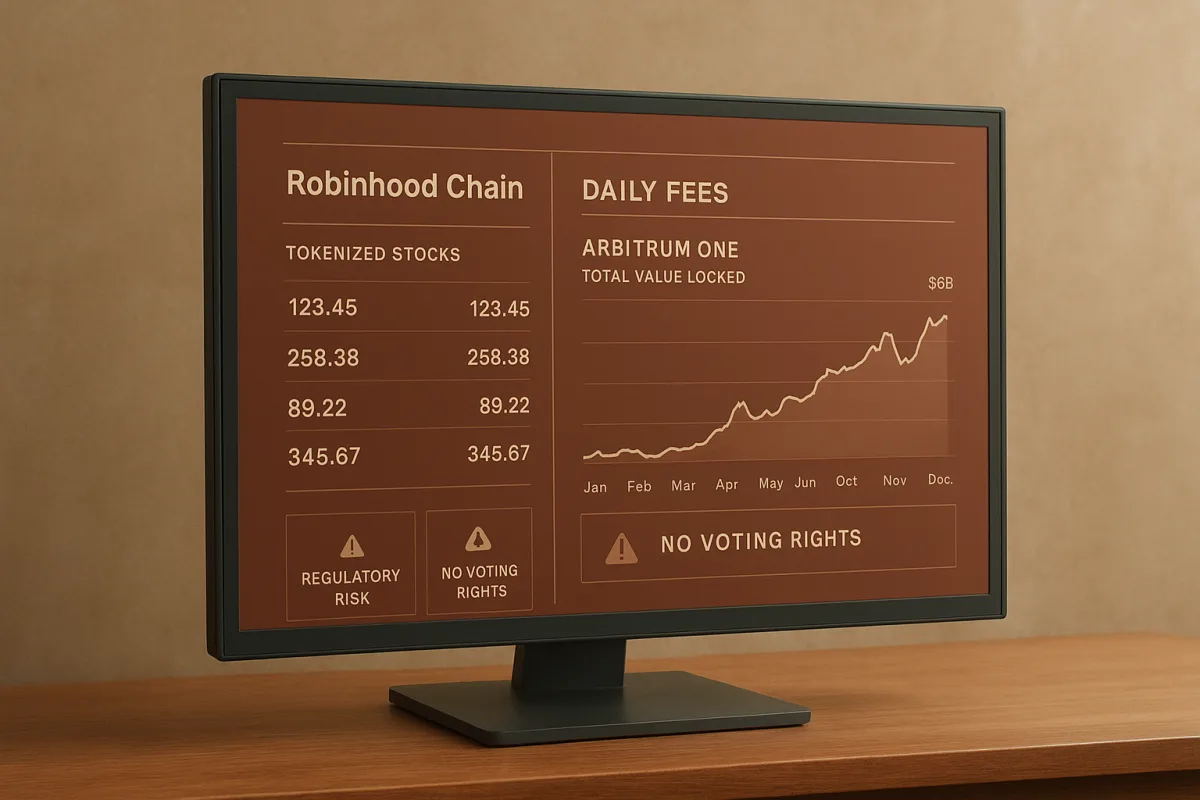
Robinhood Chain vs Arbitrum One: the choice
The decision is between using Robinhood Chain, a new Ethereum layer-2 built for tokenized stock trading and consumer-facing onchain activity, or Arbitrum One, the older Ethereum layer-2 with deeper total value locked and a broader DeFi base.
Robinhood Chain’s risk is unusually concentrated. It combines legally unsettled stock-linked tokens, 24/7 automated-market-maker trading, memecoin liquidity and an infrastructure record that already includes a block-production interruption two months after launch.
That does not make Arbitrum One risk-free. It remains an Ethereum DeFi network, so users still face smart-contract failure, bridge risk, volatile collateral and liquidation risk. The distinction is that those risks are familiar and distributed across a more mature ecosystem.
Robinhood Chain is not competing with Ethereum itself in a simple sense. It is built with Arbitrum technology, pays transaction fees in ETH, and shares part of its fee income with the Arbitrum ecosystem. The commercial comparison is therefore about distribution and product design, not a wholly separate technical stack. [12][16][18]
Coin Bureau’s coverage described the central attraction clearly: Robinhood began with a large retail brokerage audience, a wallet funnel and tokenized equities already positioned as the network’s flagship product. Established DeFi chains generally need to pay or persuade users to bridge in first.
Comparison table
| Criterion | Robinhood Chain | Arbitrum One |
|---|---|---|
| Primary use case | Tokenized stock and ETF exposure, plus trading-heavy consumer DeFi and memecoin activity | Broad Ethereum-native DeFi, including lending, decentralized exchanges, derivatives and asset management |
| Scale of locked capital | $2.77 billion TVL in early September, about 7.8% of Ethereum layer-2 TVL | $12.34 billion TVL, about 35% of Ethereum layer-2 TVL [[11]](https://www.growthepie.com/answers/most-value-secured-ethereum-l2?utm_source=openai "Which Ethereum L2 has the most total value secured (TVS)? |
| Fee momentum | $3.75 million in daily fees on Sept. 1, ahead of Ethereum mainnet’s reported $422,492 that day [8] | Larger and more established ecosystem, but not matching Robinhood Chain’s reported single-day fee spike |
| Tokenized equities | Core product, with stock-linked ERC-20 instruments designed for onchain transfer and use | No comparable Robinhood-issued stock-token franchise |
| Legal structure of equity tokens | Debt securities issued by Robinhood Assets Limited, not direct shares, without shareholder rights [6][[13]](https://trustswap.com/robinhood/stock-tokens?utm_source=openai "Are Robinhood Stock Tokens Real Shares? | Robinhood Chain") |
| Trading hours and pricing | Designed for continuous trading, but prices can diverge from underlying U.S. market prices when traditional markets are closed | Crypto assets trade continuously, but the network is not primarily built around stock-price tracking |
| Liquidity profile | Significant activity is tied to memecoins and stock-memecoin pools, creating thinner and potentially unstable price discovery | Deeper TVL and a wider spread of established DeFi venues and assets |
| Network reliability record | A 14-minute block-production halt on Sept. 4, with no disclosed root cause [2][3] | Longer operational history, though blockchain and smart-contract outages remain possible |
| Fees and native token | Fees paid in ETH. Robinhood Chain has no native token and no announced plan to introduce one. [[17]](https://www.mexc.co/crypto-pulse/article/does-robinhood-chain-have-a-token-eth-gas-hood-and-airdrop-rumors-explained-128806?utm_source=openai "Does Robinhood Chain Have a Token? ETH Gas, HOOD and Airdrop Rumors Explained | MEXC Crypto Pulse")[18] |
| Best fit | Users specifically seeking Robinhood-issued stock-token exposure and developers targeting Robinhood’s retail distribution | Users and developers needing deeper liquidity, broader protocol choice and less dependence on one issuer |
1. Scale and growth: Robinhood wins the rate, Arbitrum wins the base
Robinhood Chain’s early numbers are difficult to dismiss. It launched publicly on July 1, then reportedly produced $3.75 million of fees on Sept. 1, exceeding Ethereum mainnet’s $422,492 on the same day. [8]
That result is meaningful as a measure of demand for blockspace, but it is not the same as Robinhood corporate revenue or a reliable annual earnings run rate. Fee spikes can reflect trading frenzies, automated activity and temporary incentives.
The more durable scale measure is TVL, though it too has limitations. Robinhood Chain held roughly $2.77 billion in TVL in early September, versus $12.34 billion on Arbitrum One and $14.39 billion on Base. [11]
On that measure, Robinhood Chain remains a challenger. Its TVL represented about 7.8% of Ethereum layer-2 TVL, while Arbitrum One accounted for roughly 35%. The newcomer has grown quickly, but it has not displaced the established liquidity centers. [11]
Coin Bureau’s reported transaction and revenue figures suggest Robinhood’s brokerage distribution has shortened the usual cold-start problem for a chain. That is a business advantage, particularly for consumer products that can be surfaced through a recognizable retail platform.
Arbitrum One’s advantage is different. It has accumulated capital, applications and users over a longer period. For activity that needs varied collateral, established lending pools, multiple exchanges and interoperable DeFi primitives, that base still matters more than a fast fee day.
2. Product fit: Robinhood wins for stock tokens, but with an important caveat
For a non-U.S. user whose specific requirement is onchain access to selected U.S. stocks and ETFs, Robinhood Chain is the direct choice. Its Stock Tokens are built to move as ERC-20 instruments through the network’s applications. [6][16]
That convenience is not equivalent to buying a share through a securities broker. Robinhood’s structure uses debt securities issued by Robinhood Assets Limited, a Jersey entity, which track the economic performance of referenced equities. [6][13]
Holders do not obtain legal or beneficial ownership of the underlying shares. They do not receive voting rights, shareholder status or direct claims against the issuer whose stock price the token references. The research brief also specifies no dividends for token holders.
This distinction has commercial consequences. A user can gain price exposure, but does not become an investor in the corporate-governance sense. For someone who needs conventional shareholder rights, neither a stock token nor a DeFi venue is an adequate substitute for direct securities ownership.
Arbitrum One falls down on the opposite criterion. It is not a turnkey stock-token network with Robinhood’s distribution, custody structure and product catalogue. It is better understood as a venue for Ethereum-native assets and financial applications, not as an onchain retail brokerage.
3. Market structure: both offer 24/7 trading, but Robinhood’s price risk is sharper
Continuous trading is Robinhood Chain’s main functional claim. The network allows stock-linked tokens to trade when U.S. equity markets are closed, a feature that conventional brokerages generally do not offer in the same form.
The cost is that there may be no continuously open underlying cash market to anchor the price. The Defiant’s discussion with market participants identified price dislocations and weak best-execution protections in automated market makers as a serious issue.
An AMM prices an asset from the available pool rather than routing an order across a regulated national market system. In thin pools, a relatively small trade can shift prices sharply, particularly when a tokenized stock is paired with a volatile memecoin.
That was central to the controversy around AMC Entertainment’s token. AMC chief executive Adam Aron said the company had no connection to the tokenized instrument, called the practice unacceptable and said the company would consult outside securities lawyers. [6]
This is important wording: AMC’s public objection and threatened legal review are not the same as a filed lawsuit or enforcement action. The available research identifies no SEC action specifically against Robinhood over these tokens.
Robinhood’s chief legal officer responded publicly that the firm would not stop trading the AMC-linked token, according to CryptoSlate. The dispute is therefore live, but its legal outcome is unknown. [6]
Arbitrum One has no equivalent single-issuer controversy because it does not rely on Robinhood’s stock-token structure. It still hosts permissionless protocols, however, so users must assess each asset issuer, smart contract and liquidity pool separately.
4. Regulation and ownership: neither solves the securities question
The SEC’s January 2026 statement says tokenized securities remain securities regardless of the technology used to represent them. Tokenization changes settlement and transfer mechanics, not the underlying legal classification. [1]
That is a direct challenge to simplistic claims that putting an asset onchain removes financial regulation. It does not. The harder questions concern who issues the instrument, who can trade it, what disclosures apply and how investor protections work across jurisdictions.
Robinhood restricts its Stock Tokens from U.S. persons, reflecting that constraint. Yet the SEC has delayed a tokenized-asset exemption amid concerns about third-party issuers, while it continues reviewing NYSE Arca’s proposed tokenized-securities trading rule. [7]
The market is therefore in a transitional period, not a settled one. Robinhood’s model may prove workable, may be revised, or may meet restrictions. Forecasting which outcome occurs would be speculation, and the current public record does not justify it.
Arbitrum One is not insulated from this environment. Any tokenized security issued or traded through applications on the network would still be subject to securities law. Its advantage is structural: it does not make a single stock-token issuer the center of its proposition.
5. Reliability and incentives: Arbitrum has the better record, Robinhood has the louder warning
Robinhood Chain stopped producing blocks for at least 14 minutes beginning at 12:57 p.m. UTC on Sept. 4, stalling transactions during a period of high activity. Reports said no funds were lost and Robinhood’s traditional brokerage service was unaffected. [2][3][4]
The root cause remains undisclosed. It may be tempting to attribute the halt to transaction volume, sequencer design or a smart-contract failure, but no reported evidence establishes any of those explanations.
The incident does not prove the chain is unreliable. It does establish that its operational resilience has not yet been tested over the length of market cycles handled by Arbitrum One. For financial activity, that distinction is material.
Robinhood Chain also has no native cryptocurrency. Transactions use ETH, and there are no public plans for a native token or revised fee model. That avoids another speculative token layer, but may limit developer incentives relative to competing networks. [17][18]
Arbitrum One has a more developed network identity and broader developer ecosystem, though its ARB token is primarily a governance asset rather than a simple claim on transaction income. Neither model removes the need to judge protocol-level risks independently.
6. The memecoin problem: attention is not financial infrastructure
Robinhood Chain’s growth story cannot be separated from speculative token trading. Coin Bureau reported that token launchpad Pons at one stage enabled large volumes of new memecoin creation, while tokenized equities appeared in liquidity pools against meme assets.
Altcoin Buzz’s hypothetical $1,000 high-risk portfolio captures the character of this market. It split funds among PONS, Prolog, NET, INDX, Cash Cat, AI and Stonk Broker, while repeatedly warning that each was highly speculative.
Those are not stock investments merely because some projects use stock-token pools, treasuries or reward mechanisms. Cash Cat was described by Altcoin Buzz as having no operating product, while AI holders do not own Nvidia despite the token’s connection to an NVDA-linked pool.
The distinction matters because reported fee income can be produced by turnover rather than lasting capital formation. A memecoin paired with an equity-linked token may create volume, but it can also produce price gaps, manipulation opportunities and rapid liquidity withdrawals.
Arbitrum One also hosts speculative assets, so it is not a conservative alternative by default. Its edge is the ability to choose from a wider range of applications and avoid making a decision based on one newly launched, stock-token-centered trading environment.
Who each option suits
Robinhood Chain suits non-U.S. users who specifically want 24/7, onchain economic exposure to Robinhood-issued stock and ETF tokens, and developers seeking access to Robinhood’s retail distribution. It falls down for anyone requiring actual share ownership, voting rights, established liquidity or a long reliability record.
Arbitrum One suits users and developers whose priority is established Ethereum DeFi infrastructure, deeper TVL, broader protocol choice and less dependence on one issuer’s stock-token framework. It falls down for users who want Robinhood’s particular stock-token product and an integrated retail-brokerage route into onchain markets.
The honest result is not a universal winner. Robinhood Chain is the sharper product for its narrow purpose, tokenized-equity trading and consumer distribution. Arbitrum One remains the stronger choice for broader DeFi activity, where liquidity depth and operational history matter more than novelty.
Frequently Asked Questions
What factors contribute to Robinhood Chain's rapid fee growth?
Robinhood Chain’s rapid fee growth, reaching $3.75 million in daily fees on September 1, 2026, is driven by heavy trading activity, including substantial memecoin speculation and tokenized stock trading. Its design for continuous 24/7 trading and a large retail brokerage audience funnel also contribute to high transaction volumes, despite its total value locked (TVL) being far below larger Layer-2s like Arbitrum One.
How do Robinhood Stock Tokens differ from traditional stocks?
Robinhood Stock Tokens are structured as debt securities issued by Robinhood Assets Limited, rather than direct shares of the referenced companies. They do not confer shareholder rights such as voting, dividends, or ownership, making them fundamentally different from traditional stocks. This legal structure remains unsettled and subject to ongoing regulatory scrutiny.
What are the main risks of trading tokenized stocks on Robinhood Chain?
The main risks include the lack of shareholder rights since the tokens are debt securities, regulatory uncertainty, and potential legal challenges. Additionally, price volatility and discrepancies can occur due to 24/7 trading and lower liquidity, with significant activity tied to speculative memecoins rather than stable tokenized equities. Smart contract vulnerabilities and market manipulation risks also apply.
How does Robinhood Chain compare to Arbitrum One in DeFi and tokenized stocks?
Robinhood Chain focuses on tokenized stock exposure and consumer-facing trading, offering 24/7 onchain access to selected U.S. stocks and memecoin liquidity, but with a smaller TVL ($2.77 billion) and a shorter operational history. Arbitrum One has a broader Ethereum-native DeFi ecosystem with deeper TVL ($12.34 billion) and more established protocols, but does not offer a comparable tokenized stock franchise. Robinhood Chain uses Arbitrum technology and shares fees with its ecosystem.
What caused the recent Robinhood Chain network outage?
The cause of the 14-minute Robinhood Chain network outage on September 4, 2026, remains undisclosed. Despite reports confirming the halt amid high network activity, Robinhood has not provided a definitive technical explanation, and no funds were lost during the incident.
How we researched this
This article was assembled from 4 video sources across 4 channels, 3 published articles, 18 cited references.
Nothing here is based on hands-on testing. Where a figure or finding appears, it belongs to the source cited beside it, and the writing says so rather than implying otherwise. Every source is listed below so you can check it.
Sources
Is Robinhood BEATING Ethereum? — Coin Bureau
I Put $1000 Into 7 Robinhood Chain Tokens! PONS, $AI, CASHCAT, STONKBROKER & More — Altcoin Buzz
Balancing Markets Tighten — TheChartGuys
🟢 LIVE : Tokenized Stocks and Memecoins: Revolutionary Primitive or Retail Wipeout? — The Defiant
What Is Robinhood Chain? The Ethereum Layer-2 Network for Tokenized Stocks and Meme Coins — Decrypt
A major outage and corporate backlash hit Robinhood Chain at the peak of its growth — CryptoSlate
Crypto Traders Are Pairing Meme Coins With Stocks on Robinhood—And It's Working (Sort Of) — Decrypt
Robinhood Chain suffers 14-minute network outage - Chain Tech Daily
Robinhood Chain Stalls as Network Outage Halts Transactions | WildWeb24 — AI, Crypto & Wealth News
Robinhood Chain Goes Live With Tokenized Stocks and a Key Ownership Caveat
Robinhood Chain Fees Hit Record $3.75M As Arbitrum Revenue Share Grows
Robinhood Chain Hits $10B Weekly DEX Volume, Captures 38% Of Ethereum L2 Fees | OneBullEx
Robinhood Chain Revenue Tests the Limits of the Crypto-Beta Narrative | Investing.com
Which Ethereum L2 has the most total value secured (TVS)? | growthepie
Arbitrum takes 10% as Robinhood Chain posts a record $3.75 million fee day | Zoomex News
Robinhood Chain is scaling quickly, but tokenized stocks are still a small share of the activity
Does Robinhood Chain Have a Token? ETH Gas, HOOD and Airdrop Rumors Explained | MEXC Crypto Pulse
Watch Robinhood Chain Growth, Challenges, and Tokenized Stocks on Youtube
Also from the sources
Related Articles

Robinhood Chain Ecosystem Growth and Token Activity
Explore Robinhood Chain ecosystem growth, token activity, fee revenue, and risks in its tokenized stocks and launchpad tokens.
Robinhood Chain Insider Trading Case and Blockchain
Explore Robinhood Chain's blockchain growth and details of the insider trading case involving former engineers.
Tokenized Stock Trading and Market Structure Innovations
Explore tokenized stock trading, SEC's Innovation Exemption, AMM market structures, and trading costs in blockchain-based equity markets.

Tokenized Treasury Markets
Explore tokenized treasury markets and institutional adoption trends, including risks, growth, and regulatory frameworks in 2026.