
Robinhood Chain Insider Trading Case and Blockchain
Explore Robinhood Chain's blockchain growth and details of the insider trading case involving former engineers.
The quick list
- Best overall: Uniswap’s UNI, for readers assessing the most established protocol with a measurable connection to Robinhood Chain trading flow.
- Best value: Arbitrum’s ARB, for readers comparing infrastructure exposure to an Arbitrum Orbit chain rather than chain-native meme tokens.
- Best for small spaces: Robinhood Chain’s SPY synthetic token, for those examining tokenized stock exposure in a comparatively disclosed $17.4 million market, without shareholder rights. [2]
- Best for high-risk launch activity: PONS, for readers tracking launchpad fees and token creation, where most newly graduated tokens reportedly lose value quickly.
- Best for pure speculation: Cashcat, for observers of unofficial ecosystem memes rather than users seeking a claim on Robinhood or its revenues.
Robinhood Chain’s numbers look large. The composition matters more.
Robinhood Chain has become large enough to affect where decentralized-exchange volume lands, but the decision for market participants is not whether the chain has attracted activity. It has. The harder question is what that activity represents and whether it can remain after incentives fade.
The risk is that headline turnover may overstate adoption by Robinhood customers or demand for tokenized equities. Robinhood Wallet accounts for less than 1% of activity on the chain, according to Crypto Briefing, pointing instead to external applications, automated traders and other wallets. [16]
The chain launched on July 1, 2026 and crossed more than $3 billion in weekly DEX volume in its opening week, with more than 65,000 users. By August, monthly active users reportedly reached 2 million. [13] Those are rapid numbers, but they do not establish user quality or retention.
September daily DEX turnover ranged from $1.33 billion to $1.92 billion across more than 4 million trades and 220-plus pools. [13][17] Yet no complete market-capitalisation figure exists for Robinhood Chain or most of its token suite, making claims about aggregate network value difficult to verify.
Robinhood Chain is an Arbitrum Orbit Layer 2, uses ETH for gas and has no official chain token. That last detail distinguishes it from conventional Layer 2 launches, where token issuance can dominate early liquidity and trading figures. [11][13]
Its structure also leaves a clear centralisation trade-off. Robinhood operates a single sequencer, and a 14-minute interruption on September 4 reportedly caused 8,400 missed blocks, though no funds were lost. [12] Fast execution is useful, but reliance on one operator remains material.
Comparison table: infrastructure, equities and speculation
| Option | What it represents | Size or disclosed metric | Price and ownership trade-off | Main risk |
|---|---|---|---|---|
| Uniswap’s UNI | Governance token of the DEX that processes much of Robinhood Chain activity | Uniswap handled up to 98% of Robinhood Chain volume on some days [14] | No chain-native token exposure, but protocol economics may benefit from volume | Volume can migrate, and fee or burn narratives do not establish token value |
| Arbitrum’s ARB | Token associated with the Orbit ecosystem underlying Robinhood Chain | Robinhood Chain is built through Arbitrum Orbit [[11]](https://tangem.com/en/learning-hub/post/robinhood-chain/?utm_source=openai "Everything You Need To Know About Robinhood Chain | Tangem Learning Hub") | Indirect infrastructure link rather than direct Robinhood Chain ownership |
| SPY synthetic token | Robinhood-issued stock-token exposure tied to SPY | $17.4 million market cap after a 1,314% 30-day rise [[2]](https://www.onebullex.com/news/articles/robinhood-chain-spy-token-surges-1-314-to-17-4-million-market-cap-2?utm_source=openai "Robinhood Chain SPY Token Surges 1,314% To $17.4 Million Market Cap | OneBullEx") | Tracks economic exposure, but holders do not own shares or vote [7][8] |
| PONS | Chain-native launchpad and token | Project reported $12 billion processed in two months and $125 million paid to creators [[3]](https://robinswap.trade/news/top-10-robinhood-chain-tokens-2026-09-12/?utm_source=openai "Top 10 Robinhood Chain tokens today: September 12, 2026 | RobinSwap") | Tokens can pair with ETH, USDG or tokenized stocks |
| Cashcat | Unofficial Robinhood-themed memecoin | No reliable market-cap figure supplied | No equity claim, protocol claim or official endorsement | Meme-driven pricing, impersonation risk and weak disclosure |
| NightShades | Four-token, NFT-linked survival game | Project reported $450,000 revenue in 48 hours [[3]](https://robinswap.trade/news/top-10-robinhood-chain-tokens-2026-09-12/?utm_source=openai "Top 10 Robinhood Chain tokens today: September 12, 2026 | RobinSwap") | Outcomes are intentionally driven by onchain randomness |
| Standard Reserve | NFT-charter and token buyback project | Project reported 7,800 holders and 22,000 ETH processed on day one [[3]](https://robinswap.trade/news/top-10-robinhood-chain-tokens-2026-09-12/?utm_source=openai "Top 10 Robinhood Chain tokens today: September 12, 2026 | RobinSwap") | It describes itself as a “central bank,” but is not a bank |
| PARE | Split-token system for stock price exposure and future dividends | Apple, SPY, QQQ and Pfizer series were reported live [[3]](https://robinswap.trade/news/top-10-robinhood-chain-tokens-2026-09-12/?utm_source=openai "Top 10 Robinhood Chain tokens today: September 12, 2026 | RobinSwap") | Depends on Robinhood’s stock-token infrastructure |
| Netnet Capital’s NET | Reserve-backed fund-token model | Team said about $2 million was deposited into Netnet Credit [[3]](https://robinswap.trade/news/top-10-robinhood-chain-tokens-2026-09-12/?utm_source=openai "Top 10 Robinhood Chain tokens today: September 12, 2026 | RobinSwap") | Treasury includes stock tokens, stablecoins and Morpho positions |
The tokenized-stock option: exposure without ownership
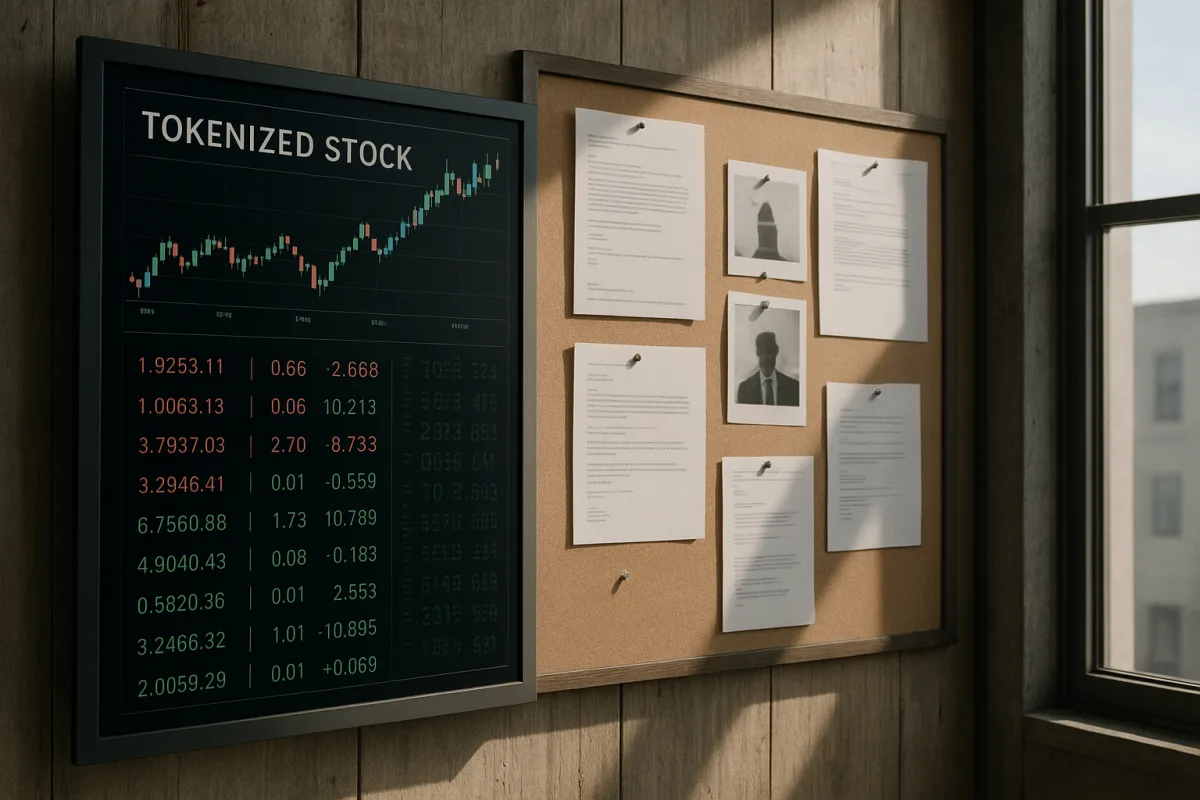
Robinhood’s stock tokens are the chain’s central commercial pitch, but the legal and economic distinction needs to be explicit. They are issued by Robinhood Assets, Jersey Limited as offshore debt securities, not ordinary shares in the companies whose prices they track. [7][8]
That means a token tracking an S&P 500 fund, Apple or Nvidia may provide economic exposure, but it does not convey shareholder or voting rights. The products are unavailable to US users and certain other jurisdictions. [7][8][9]
The SPY synthetic token is the clearest example with disclosed market data. OneBullEx reported a 1,314% gain over 30 days and a $17.4 million market capitalisation as of September 7. [2] That rise shows demand or trading momentum, not a conclusion about fair value.
Robinhood has said it plans to introduce one-for-one in-kind redemption and voting rights, according to coverage by KuCoin and CryptoEconomics. [8][9] Neither feature had been implemented in the supplied reporting, so they should be treated as proposed product changes, not current protections.
The tokenized-equity proposition has another complication. CoinDesk reported Robinhood Chain’s early success was driven more by memecoins than stocks. [15] High volumes therefore do not by themselves prove that tokenized securities are the chain’s primary source of sustainable activity.
The more established beneficiaries: Uniswap and Arbitrum
Uniswap’s UNI is the comparatively legible protocol token in this group because the DEX has been central to Robinhood Chain trading. ETHNews reported Uniswap processed as much as 98% of the chain’s volume on some days. [14]
That concentration matters for revenue and burn narratives, but it also creates concentration risk. If token trading moves to a different venue, Uniswap’s apparent Robinhood Chain advantage could weaken quickly. The chain’s volume does not belong permanently to any one application.
Arbitrum’s ARB has an even more indirect connection. Robinhood Chain is built with Arbitrum Orbit, making it an infrastructure validation case rather than a direct token-value vehicle. [11] Investors cannot infer a simple ownership interest in Robinhood Chain from ARB.
The distinction is important because token markets often compress several claims into one chart: technology adoption, fee sharing, token burns, future governance and momentum. Those are separate propositions. Neither UNI nor ARB provides a straightforward claim on Robinhood’s brokerage revenue.
For comparison, Cardano’s recent fee data offers a useful broader warning against equating transaction counts with durable token economics. CryptoSlate found its fees covered only 0.668% of staking rewards over a year, despite substantial onchain activity. [5]
Robinhood Chain is not Cardano, and the numbers are not directly comparable. The point is narrower: a large transaction total cannot establish sustainable economic value unless fees, incentives, ownership rights and cost of maintaining the network are separately disclosed.
Launchpads and memes: PONS, Cashcat and the cost of churn
PONS is the clearest vehicle for measuring Robinhood Chain’s more speculative economy. RobinSwap reported that the launchpad said it processed $12 billion over two months and paid more than $125 million to creators, including payments in stock tokens. [3]
The trade-off is unusually stark. PONS lets projects pair tokens against ETH, USDG or tokenized equities, a feature that ties memecoin creation to Robinhood’s stock-token infrastructure. But reported onchain analysis placed the graduation rate at about 1%. [3]
More importantly, the same analysis cited by RobinSwap found the median graduated token was down roughly 90% after 24 hours. [3] That is evidence of a launch market designed around issuance, fees and short holding periods, not a dependable measure of asset formation.
Cashcat sits further out on the speculation spectrum. It is an unofficial meme token based on early naming lore around Robinhood, rather than a token issued or endorsed by the company. Its relevance is cultural and trading-driven, not contractual.
This distinction is more than semantic. The independent research brief documents scam tokens disappearing from user wallets after purchase, with losses described as unrecoverable. CoinScoop also reported Relay’s confirmation of that pattern. [10] A familiar brand theme does not establish authenticity.
Academic research on Ethereum and BNB Chain has documented ecosystems shaped by token spammers, rug pulls and sniper bots. [1] That research does not prove wrongdoing by every Robinhood Chain project, but it provides a reasonable baseline for interpreting anonymous, rapidly launched tokens.
Game and reserve tokens: NightShades, Standard Reserve, PARE and NET
NightShades, built by Meebco and Clutch Markets, is explicit about its volatility mechanism. Chainlink randomness determines daily game outcomes among knights, zombies, ghosts and watchers, with liquidity able to be removed before trading resumes. [3]
RobinSwap reported two associated tokens rose roughly 11 times while two lost about 90% after the first cycle. [3] That is not conventional market discovery. It is scheduled, rule-based redistribution with an unusually clear winner-loser design.
Standard Reserve deserves equally careful framing. The project calls itself a sovereign onchain central bank, but it does not take deposits and is not regulated as a bank. [3] Its reported first-day statistics are notable but come from the project team.
Those reported figures included 7,800 holders, 22,000 ETH processed through a Uniswap v4 pool and 2,400 ETH drawn into vaults. [3] The product had routing bugs and was only a day old, conditions that make durable conclusions especially premature.
PARE is structurally more connected to the tokenized-stock theme. It splits a Robinhood stock token into separate claims on price exposure and future dividends, with reported series for Apple, SPY, QQQ and Pfizer. [3]
But PARE’s audit was nearing completion rather than complete, and its product depends on Robinhood’s underlying stock-token framework. [3] That dependency includes the underlying ownership limitation: the starting token does not deliver ordinary equity ownership or voting rights. [8]
Netnet Capital’s NET is another hybrid: a reserve-backed token supported by tokenized stocks, stablecoins and Morpho positions. Its team reported roughly $2 million deposited into its isolated Morpho lending markets under the Netnet Credit product. [3]
The key valuation trade-off is reflexivity. A treasury can grow, but a reserve-backed token’s market price can still trade above or below the value and liquidity of its backing assets. The available reporting does not supply enough independent data to settle that question.
The Hyperliquid case puts operational information under scrutiny
On September 15, US authorities unsealed charges against two former Robinhood engineers over alleged trading on confidential Hyperliquid listing information. The Block reported charges under the Commodity Exchange Act and wire-fraud statutes. [4]
Prosecutors allege that each individual made more than $50,000 by front-running trades based on non-public information. [4][5] The case is notable because it targets alleged front-running on a decentralized perpetual-futures platform, rather than a conventional securities exchange.
The alleged conduct concerns Hyperliquid trades and confidential listing information, not a finding that Robinhood Chain itself was manipulated. Keeping that separation clear matters, since the chain is already exposed to separate concerns around bots, anonymous tokens and single-sequencer operation.
The defendants are presumed innocent, and no trial date or legal outcome appears in the available reporting. [4][5][6] It is therefore speculation to claim that the case will alter Robinhood’s policies, Hyperliquid’s market structure or the regulatory treatment of decentralized perps.
Still, the episode makes a practical point for market structure. Decentralized settlement does not remove the value of private information held by employees, developers, market makers or listing teams. Confidential information can remain a tradable advantage before any transaction reaches a blockchain.
Who each option suits
Uniswap’s UNI suits readers comparing established DEX infrastructure with Robinhood Chain’s flow. Its case rests on observable venue usage, although the relationship remains vulnerable to migration and does not create a direct claim on Robinhood’s business. [14]
Arbitrum’s ARB suits readers focused on Layer 2 infrastructure and Orbit adoption. It is the cleaner comparison for those separating a network’s technical stack from its culture-token trading, but its economic linkage to Robinhood Chain is indirect. [11]
The SPY synthetic token suits analysts examining tokenized-equity market structure. Its disclosed $17.4 million size makes it easier to track than many chain-native tokens, but its 1,314% monthly rise and lack of voting rights require caution. [2][8]
PONS suits observers studying issuance economics, creator payouts and launchpad turnover. It does not suit analysis that assumes most launched tokens retain value, given the reported 1% graduation rate and roughly 90% median one-day decline. [3]
Cashcat suits readers tracking social momentum and unofficial chain branding. It has no disclosed ownership claim on Robinhood, no dependable market-capitalisation dataset and elevated authenticity risk where similarly branded scam tokens have already been reported. [10]
NightShades suits researchers of onchain games and deliberately programmed volatility. Its game mechanics make price dispersion a feature, rather than evidence of fundamental adoption, and the reported 11-fold gains and 90% falls demonstrate the cost. [3]
Standard Reserve, PARE and Netnet Capital’s NET suit readers examining experiments around onchain reserves, dividend splitting and collateralised stock-token lending. Each has a defined product concept, but early-stage disclosure, dependence on Robinhood stock tokens and unresolved audit or valuation questions remain central.
Frequently Asked Questions
What is the Robinhood Chain insider trading case about?
The insider trading case involves two former Robinhood engineers charged on September 15, 2026, with front-running confidential listing information on the Hyperliquid platform. They allegedly profited over $50,000 each by trading on this nonpublic data. The case highlights operational-information risks but does not indicate a failure of the Robinhood Chain itself.
Who are the Robinhood engineers charged with insider trading?
Two former Robinhood engineers were charged with violations of the Commodity Exchange Act and wire fraud related to front-running crypto listings on Hyperliquid. Their identities have been reported in news sources but are not detailed in the article. Legal proceedings are ongoing, and the accused are presumed innocent until proven otherwise.
How does the insider trading case affect Robinhood Chain?
The insider trading case underscores risks related to operational information but does not demonstrate a systemic failure of Robinhood Chain. It is an unresolved legal matter focusing on individual conduct rather than the chain’s technology or market integrity.
What are the trading volumes and token types on Robinhood Chain?
Robinhood Chain recorded daily decentralized exchange volumes ranging from $1.33 billion to $1.92 billion in September 2026, with over 4 million trades across more than 220 pools. Token types include synthetic stock tokens like SPY, which had a $17.4 million market cap, as well as speculative and launchpad tokens such as PONS and Cashcat.
Do Robinhood stock tokens provide actual share ownership?
No, Robinhood stock tokens offer price exposure but do not confer ordinary shareholder rights or voting power. They are issued as offshore debt securities by Robinhood Assets (Jersey) Limited and remain unavailable to U.S. users, meaning holders do not have direct equity ownership in the underlying companies.
How we researched this
This article was assembled from 2 video sources, 8 published articles, 18 cited references.
Nothing here is based on hands-on testing. Where a figure or finding appears, it belongs to the source cited beside it, and the writing says so rather than implying otherwise. Every source is listed below so you can check it.
Sources
HUGE Robinhood Chain Move! Don’t Miss This Bull Run! — Altcoin Buzz
HUGE Robinhood Chain Top 5 Token Updates — Altcoin Buzz
Crypto Long & Short: Six signs a crypto winter is ending — CoinDesk
Anchorage expands institutional custody to Etherlink, tokenized uranium — Cointelegraph
Cardano fees covered just 0.7% of staking rewards as transactions fall 72% — CryptoSlate
Blockchain finance platform Theo launches tokenized silver backed by $40 million in active leases — CoinDesk
Coinbase faces greater fallout from CLARITY Act setback: Saxo — Cointelegraph
A LatAm telecom operator is putting part of its finances on Avalanche — CoinDesk
Bitcoin awaits Fed rate decision below $76K as analysis discounts ‘dovish surprise’ odds — Cointelegraph
A stolen coin can be returned. A leaked identity cannot. — CoinDesk
Robinhood Chain SPY Token Surges 1,314% To $17.4 Million Market Cap | OneBullEx
Top 10 Robinhood Chain tokens today: September 12, 2026 | RobinSwap
DOJ charges Robinhood former engineers with front-running crypto listings on Hyperliquid | The Block
Two Robinhood Engineers Face Charges in Hyperliquid Insider Trading Case - Crypto Economy
Robinhood engineers indicted for Hyperliquid perps insider trading | ReverseRugPull
Robinhood Chain Goes Live With Tokenized Stocks and a Key Ownership Caveat
Do Robinhood Stock Tokens Have Voting Rights? 1:1 Share Redemption Plan Explained| KuCoin
Relay Confirms Robinhood Chain Scam Tokens Vanishing From Wallets — Funds Unrecoverable – CoinScoop
Everything You Need To Know About Robinhood Chain | Tangem Learning Hub
NOXA Goes Dark After $12M in Fees, Exposing Robinhood Chain's Single Point of Failure
What's the Big Deal About Robinhood Chain? Why the L2 Is Thriving | CoinMarketCap
Robinhood's blockchain finds early success — Thanks to memecoins, not stocks
Robinhood Wallet accounts for less than 1% of on-chain activity on its own chain
Robinhood Chain Hits Record $1.43B Daily Trading Volume | SignalPlus
Robinhood Engineers Charged in Hyperliquid Insider Trading Case
Watch Robinhood Chain Developments and Insider Trading Case on Youtube
Also from the sources
Related Articles

Robinhood Chain Ecosystem Growth and Token Activity
Explore Robinhood Chain ecosystem growth, token activity, fee revenue, and risks in its tokenized stocks and launchpad tokens.
Robinhood Chain Growth, Challenges, and Tokenized Stocks
Explore Robinhood Chain's growth, challenges, and tokenized stocks, including fee surges, risks, and comparison with Arbitrum One.

South Korea Tokenized Securities Roadmap
Explore South Korea's tokenized securities roadmap, phases, eligible assets, and regulatory changes starting in 2027.
Altcoin Market Dynamics and Key Project Comparisons
Explore altcoin market dynamics with a detailed comparison of Ethereum, Hyperliquid, and other key projects in 2026.