
Tokenized Deposit Cross-Border Payments
Learn how tokenized deposit cross-border payments work between DBS and JPMorgan for US dollar transfers and key operational insights.
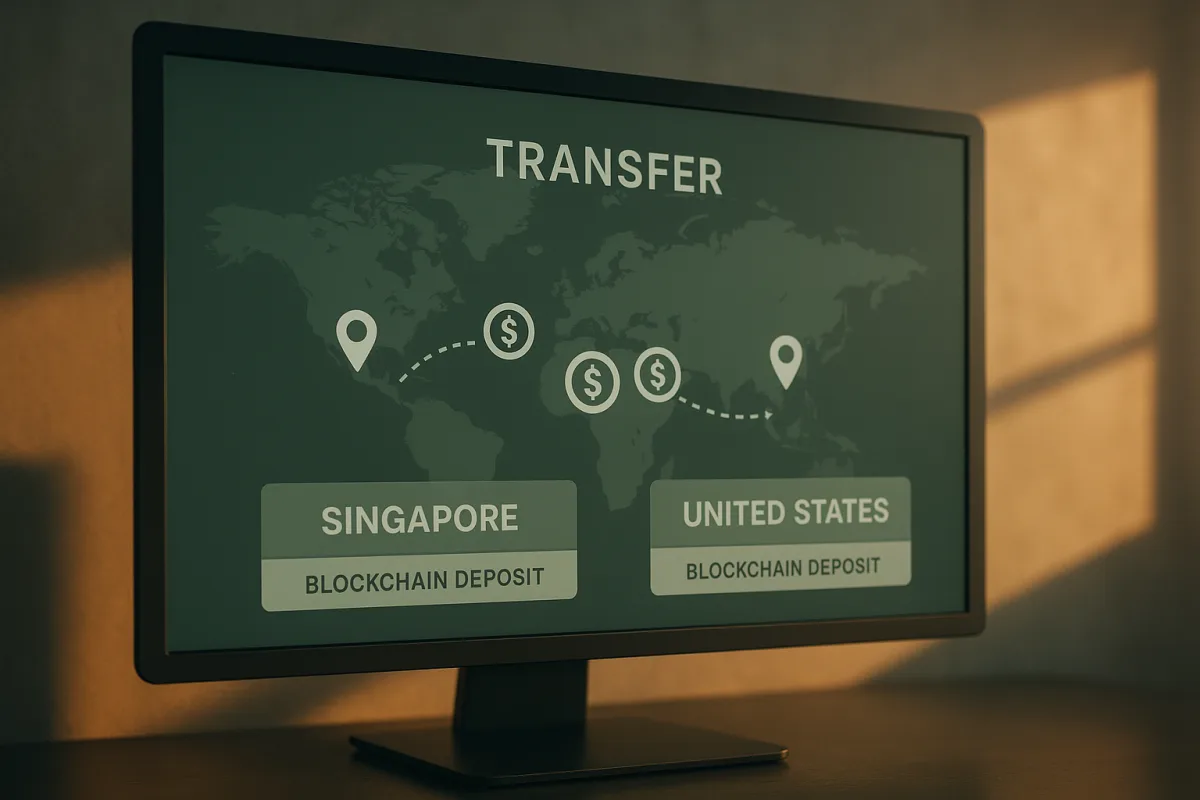
Map the payment flow
A US dollar balance held at DBS in Singapore can now move to JPMorgan’s Kinexys blockchain deposit network in the United States, or the other direction, through tokenized deposits. DBS and JPMorgan launched the service on Nov. 16, 2026, with Ant International as its first client. [1]
The risk appears before the payment leaves your screen: “24/7” does not mean every connected cash account, compliance process, or bank ledger runs without interruption. Traditional-bank-account transfers still face a three-hour maintenance window every Saturday, from 3 p.m. to 6 p.m. Eastern Time. [5]
A tokenized deposit is a bank deposit represented on a blockchain, not a separate stablecoin balance and not a token whose value is meant to trade independently. The payment remains tied to the issuing bank’s deposit obligations, account controls, and onboarding requirements. [2]
Start by drawing the route for one payment. Identify the legal entity sending dollars, its DBS or JPMorgan account, the receiving entity, the destination account type, and whether the recipient actually needs US dollars or needs a local-currency conversion afterward.
Confirm that your account is on the right rail
The new connection links DBS Token Services and JPMorgan’s Kinexys Blockchain Deposit Account network for US dollar transfers between Singapore and the United States. It is an institutional banking service, not a retail wallet product available to anyone holding a crypto address. [3]
Ask your relationship bank whether your entity is eligible for tokenized deposit accounts, which account permissions are needed, and whether each subsidiary must be separately onboarded. A group treasury team should not assume that a parent company’s access extends to every affiliate.
Confirm whether the payment begins and ends on blockchain deposit accounts. The headline claims of continuous, near-real-time movement apply to those blockchain-account transfers, while an instruction that touches a conventional bank account can follow different processing and maintenance rules. [4]
We would begin with two accounts already inside the DBS-Kinexys corridor. Adding another correspondent bank, a local clearing system, or an off-platform recipient can reintroduce the delays the tokenized transfer is meant to avoid.
Set the payment terms before funding the account
A fast transfer does not answer the commercial questions around it. Put the amount, currency, value date, beneficiary, invoice reference, permitted purpose, recall process, and exception owner in the payment instruction before treasury pre-funds the sending account.
DBS and JPMorgan have described their interoperability work as enabling payment-versus-payment transfers without directly integrating their underlying ledgers. That can reduce the risk of one side completing while the other fails, but the public technical description remains high-level. [1]
Do not write an internal policy that assumes atomic settlement across every workflow. The banks have not published a detailed interoperability protocol or a full account of how settlement finality, failed instructions, reversals, and disputes are handled in every scenario.
For foreign exchange payments, establish which party supplies the exchange rate and when it becomes binding. Project Simbolon, a Monetary Authority of Singapore and Deutsche Bundesbank test, used payment-versus-payment settlement for euro-Singapore dollar trades so that one currency’s final transfer depended on the other. [2]
Price the full transfer, not the token movement
No public schedule specifies the transaction fee or exact settlement time for the DBS-Kinexys tokenized deposit service. Treat “instant” and “real-time” as operational descriptions of the blockchain-account experience, not as a contracted cost or service-level commitment. [1]
Request a written quote that separates account fees, transfer fees, connectivity charges, minimum balances, foreign exchange spreads, liquidity costs, and charges for investigations or returned payments. If a payment needs manual review, the speed of the token rail may not be the factor that determines completion.
Compare that quote with your existing correspondent-bank path using actual payment records. Include the cost of prefunding, idle dollar balances, reconciliation labor, and late-payment exposure, not only the wire fee your bank places on a monthly statement.
We would skip any promised savings calculation that assumes every dollar can move continuously. The known Saturday maintenance period and any compliance intervention can affect when cash is available, which is often more consequential to treasury than the quoted transfer charge. [5]
Fund liquidity on both sides
Tokenized deposits can make a transfer faster only if usable funds are already available in the right account. For a Singapore-based company paying US expenses, that may mean holding dollars at DBS, JPMorgan, or both, depending on the payment route and account design.
Set a minimum operating balance for each entity and an escalation threshold for top-ups. A team that drains the destination account after every transfer can create the same urgent funding cycle that conventional cross-border banking produces, only on a faster rail.
Keep the old route active during the initial program. Your contingency plan should identify who can send an emergency conventional wire, who authorizes it, which account receives it, and how the team avoids paying the same invoice twice.
This is a bank-network product, so the core risk is not token price volatility. The exposure is to the deposit-taking institutions, their systems, their compliance decisions, the availability of the interoperability link, and the cash-management controls around your accounts.
Build compliance checks into the payment file
Cross-border payments still require sanctions screening, know-your-customer controls, transaction monitoring, and recordkeeping. A blockchain representation of the deposit does not remove these requirements, and a flagged payment may wait for review regardless of the network’s operating hours.
Give compliance teams the same transaction data they receive for conventional payments: legal entity names, beneficial-owner records where required, beneficiary information, payment purpose, invoice support, and country-specific documentation. Do not leave that data in a separate spreadsheet outside the payment workflow.
Singapore’s Project BLOOM is intended to support uses of tokenized deposits and regulated stablecoins in payments, while DBS and JPMorgan co-lead its work on transfers across blockchain platforms. [2] That policy support does not establish identical legal treatment in every receiving jurisdiction.
Ask for the contract terms governing data access, transaction records, insolvency treatment, and dispute resolution. Those terms determine what happens when a payment is frozen, rejected, duplicated, or challenged, not the marketing language around tokenization.
Test the operating day, including the weekend
Run a controlled payment with a low-value internal transfer before using the rail for payroll, tax, or a major supplier deadline. Test initiation, approvals, monitoring, confirmation, reconciliation, and the receiving entity’s ability to apply the funds correctly.
Schedule one test near the Saturday maintenance period if your process will involve traditional accounts. Document what the dashboard shows during the interruption, whether an instruction queues or fails, and who receives an alert when a payment misses its expected window. [5]
Ant International’s use of the service shows that a large cross-border operator can employ it for cash management across markets. It does not reveal the fees paid, volumes processed, exception rates, or whether the model fits a smaller company’s payment pattern. [2]
Measure the result against your current rail. Track elapsed time from approval to confirmed receipt, number of manual touches, reconciliation breaks, funds held in transit, foreign exchange execution quality, and any payment that needed bank intervention.
Expand only after the controls work
The strongest first use case is internal US dollar liquidity management between related entities that already bank with DBS and JPMorgan. The payer and recipient can align account access, payment references, approvals, and accounting treatment before external counterparties enter the process.
Move next to selected recurring vendors only after finance can reconcile the tokenized deposit transfer to invoices and bank statements without manual reconstruction. Give vendors a conventional-bank fallback until they have confirmed their receiving instructions and remittance process.
Avoid presenting tokenized deposits as a broad answer to every cross-border payment problem. They currently operate in a defined Singapore-US corridor, with access controlled by participating banks and with public details on pricing, throughput, and settlement mechanics still limited. [3]
DBS’s survey found that more than half of 422 business leaders across 11 markets either used tokenized deposits or planned to use them. [2] That signals institutional interest, not a verified measure of payment volume, cost savings, or market share.
Keep tokenized deposits separate from market-token exposure
Treasury teams may encounter tokenized Treasury funds, tokenized credit products, stablecoins, and tokenized deposits in the same vendor conversation. Keep them in separate policies because they serve different purposes and carry different claims on cash, assets, or issuers.
CoinDesk reported that distributed tokenized real-world asset value stood at $39.5 billion, down 1.7% over 30 days, while holder counts rose 6% to 5.75 million. [1] Those figures describe a broader onchain asset market, not the volume or reliability of DBS-Kinexys payments.
Do not fund an operating payment program with an assumption that tokenized assets will hold their market value or provide immediate liquidity under stress. Operating cash needs contractual access to money at the required time, while investment products can face valuation, redemption, and liquidity constraints.
For this service, we would keep the mandate narrow: move already-held US dollar deposits between approved institutional accounts, monitor every exception, and retain a conventional payment route. The claimed efficiency is promising, but your controls determine whether it becomes a cheaper and faster payment process.
Frequently Asked Questions
What are tokenized deposit cross-border payments?
Tokenized deposit cross-border payments represent bank deposits on a blockchain, allowing US dollar balances to move between eligible blockchain deposit accounts in different countries, such as between Singapore and the United States. Unlike stablecoins, these tokenized deposits remain tied to the issuing bank’s deposit obligations and compliance requirements, rather than existing as independent tradable tokens.
How do DBS and JPMorgan enable tokenized deposit transfers?
DBS and JPMorgan connect their blockchain deposit account networks, DBS Token Services and Kinexys Blockchain Deposit Account network, to facilitate 24/7 US dollar transfers between Singapore and the US. Their interoperability solution enables payment-versus-payment settlement without directly integrating their underlying ledgers, allowing near-real-time tokenized deposit transfers on blockchain accounts.
What are the operational considerations for tokenized deposit transfers?
Transfers involving blockchain deposit accounts can occur near real-time, but those touching traditional bank accounts face a three-hour maintenance window every Saturday. Treasury teams should pre-fund sending accounts, specify detailed payment instructions, and maintain liquidity in operating accounts until transfers are irrevocably settled. It is also important to confirm account eligibility and onboarding requirements for each entity involved.
How do tokenized deposits differ from stablecoins in cross-border payments?
Tokenized deposits are representations of actual bank deposits on a blockchain and retain the issuing bank’s deposit claims and controls. Stablecoins, by contrast, are separate digital tokens whose value is intended to trade independently. Tokenized deposits are not designed to function as independent tradable tokens but as direct claims on bank deposits.
What fees and liquidity management are involved in tokenized deposit transfers?
No public fee schedule is available for the DBS-Kinexys tokenized deposit service, and settlement times are not contractually guaranteed despite claims of instant transfers. Users should request detailed quotes covering account fees, transfer fees, foreign exchange spreads, liquidity costs, and charges for exceptions. Maintaining liquidity in each operating account until settlement is final is critical due to the bank-dependent nature of tokenized deposits.
How we researched this
This article was assembled from 4 published articles, 7 cited references.
Nothing here is based on hands-on testing. Where a figure or finding appears, it belongs to the source cited beside it, and the writing says so rather than implying otherwise. Every source is listed below so you can check it.
Sources
Bitcoin was supposed to gain as AI faltered, but it crashed. Here's why., CoinDesk
Singapore, Germany test cross-border FX settlement with CBDCs, Cointelegraph
BTC price tags 18-week low into Nvidia earnings: Three things to know in Bitcoin this week, Cointelegraph
DBS, JPMorgan’s Kinexys launch 24/7 transfers of tokenized deposits, Cointelegraph
DBS, JPMorgan launch instant tokenized deposit transfers between US and Singapore | The Block
DBS and JPMorgan link blockchain deposit networks for 24/7 dollar transfers
DBS and Citi partner to enable instant 24/7 cross-border USD payments with tokenised deposits
Related Articles

Tokenized Bank Deposits and Blockchain Infrastructure
Explore tokenized bank deposits, their differences from stablecoins, and the evolving blockchain infrastructure in banking.
XRP and Altcoin Market Developments and Challenges in 2026
Explore XRP and altcoin market developments, comparing tokenization, payments, and challenges in 2026’s crypto landscape.

Tokenized Stocks Institutional Adoption and Regulatory Pushback
Explore institutional adoption of tokenized stocks and ETFs amid regulatory pushback and SEC innovation exemptions.
Tokenization Settlement Layer
Explore how tokenization improves the settlement layer for institutional assets, preserving custody and compliance while enabling blockchain efficiency.