
Robinhood Chain Ecosystem Growth and Token Activity
Explore Robinhood Chain ecosystem growth, token activity, fee revenue, and risks in its tokenized stocks and launchpad tokens.

The quick list
Best overall: Robinhood Chain, for users evaluating the highest reported fee growth and broadest stock-token, DEX and derivatives activity.
Best for launch activity: PONS, for users tracking high-volume token creation and bonding-curve trading, with correspondingly high token and manipulation risk.
Best documented new alternative: PAIR, for users examining stock-token-paired launches and a stated buyback policy rather than an unverified protocol claim.
Best for derivatives scale: Lighter, for users comparing perpetuals volume and open interest tied to tokenized equities.
Best for yield-market design: Pendle, for users looking at fixed-yield and variable-yield markets on tokenized stock exposure.
Best avoided as a valuation comparison: DELTA, BOW, MANCER and PARE, because the supplied Altcoin Buzz coverage contains claims about them but independent research found no verifiable public launch or token data.
What the reader is actually choosing
The practical question is whether Robinhood Chain’s fee growth represents durable financial infrastructure or a short-lived concentration of speculative token issuance. The answer matters because fees, liquidity and settlement design can persist, while most early ecosystem tokens do not necessarily do so.
The risk is visible before comparing individual projects. Robinhood Chain stock tokens are not ordinary shares held directly onchain. Robinhood’s documentation describes them as tokenized debt securities issued by Robinhood Assets (Jersey) Limited, designed to provide economic exposure rather than shareholder rights. [16]
That distinction has consequences. Token holders can receive the economics associated with dividends, but they do not receive the voting rights of the collateral shares. The U.S. Securities and Exchange Commission has also stated that tokenized securities remain securities under federal law, regardless of the technology used to issue or transfer them. [1]
Robinhood says the products are not offered to U.S. persons, but that does not remove regulatory uncertainty. The expansion comes as Nasdaq received approval for a tokenized-equities trading pilot in March, suggesting regulated market infrastructure is moving toward tokenization, though through more conventional compliance channels. [7]
For market participants, then, Robinhood Chain is a comparison of execution venues and financial wrappers, not simply an argument over whether tokenized shares are “real.” The market can price an instrument tied to a stock, but thin liquidity can make that price materially diverge from the underlying security.
CoinDesk reported that an AMC-linked token pair traded at about 60 times AMC’s reference share price, according to Securitize chief executive Carlos Domingo. That is an extreme example, but it demonstrates the price-discovery problem when the token market is shallow and fragmented.
Robinhood Chain versus other Layer 2 networks
Robinhood Chain launched its mainnet on July 1, 2026, built as an Arbitrum Orbit chain with tokenized stocks, decentralised exchange trading and DeFi products as its commercial centre. Robinhood also announced a Chainlink integration at launch. [8][9]
Its early numbers are unusually large for a new Layer 2, although dates and methodologies vary. FXStreet reported $3.75 million of daily fee revenue on September 1, Zoomex reported daily fees and revenue above $4 million soon after, and CoinNess put the peak at $6.12 million on September 4. [4][5][6]
Those differences should not be ignored, but they do not change the broad direction. The chain’s reported daily fees increased rapidly, with the research brief placing cumulative fees near $39 million by early September. That is meaningful revenue generation, even if it is too early to call it recurring.
The clearest comparison is with Arbitrum One, its underlying ecosystem. One report put Robinhood Chain daily fees at $2.13 million against just $12,238 for Arbitrum One on the cited day, yet Arbitrum retained a far larger total value locked figure of roughly $1.5 billion to $2 billion, compared with Robinhood Chain’s reported $796 million. [14][15]
That gap separates turnover from sticky capital. Robinhood Chain has generated more fee-intensive activity, likely reflecting trading and launchpad speculation. Arbitrum has deeper capital committed across a broader, more established application base. Neither metric alone establishes long-term competitive superiority.
Optimism cannot be fairly placed in the same fee table from the available research. Its TVL and ecosystem are widely tracked, but the brief found no comparable detailed mid-2026 fee data. Treating missing figures as evidence of weak activity would be speculation.
| Option | Reported scale | Price or fee data | Product layout | Main trade-off |
|---|---|---|---|---|
| Robinhood Chain | About $796 million TVL reported, versus $1.5 billion to $2 billion for Arbitrum [[15]](https://eco.com/support/en/articles/15183711-arbitrum-vs-optimism-2026-fees-tvl-ecosystem?utm_source=openai "Arbitrum vs Optimism 2026: Fees, TVL, Ecosystem | Support") | $3.75 million to $6.12 million reported daily fees across early September dates [4][[5]](https://www.zoomex.com/en/news/48dffbf1?utm_source=openai "Robinhood Chain Daily Fees and Revenue Both Clear $4 Million | Zoomex News")[6] |
| PONS | Claims $10 billion cumulative volume and $93 million creator earnings | Reported near $0.58 after a nearly 25% one-day decline | Bonding-curve launches moving toward Uniswap v4 liquidity | Activity can be driven by low-quality launches, bots and short-term speculation |
| PAIR | Early-stage, no independently established TVL in supplied research | Roughly $95,000 in reported early buybacks and burns [[13]](https://chainstack.com/robinhood-chain-growth/?utm_source=openai "What's Behind Robinhood Chain's Growth | Chainstack Blog") | Launches paired with stock tokens including NVDA, TSLA, SPY and AMC |
| Lighter | $39.5 billion reported August volume and more than $1 billion open interest | Reported 17.5 million LIT bought back, around 7% of circulating supply | Perpetual futures, including tokenized-equity markets with up to 10x leverage | Leverage and RWA-linked perpetuals add liquidation and basis risks |
| Pendle | Early Robinhood Chain markets, no comparable TVL provided | Volume reportedly rose 47% around expansion | Yield and principal-token markets for tokenized stocks | Liquidity and maturity depth remain early relative to established Pendle markets |
| DELTA, BOW, MANCER, PARE | No independently verifiable public scale found | No reliable price comparison available | Claimed liquidity, lending, routing and dividend-splitting functions | Investors cannot assess token supply, audits, teams or live adoption reliably |
PONS: the scale leader, but not necessarily the cleanest business
Among the ecosystem tokens discussed in the supplied Altcoin Buzz transcripts, PONS has the strongest reported operating numbers. The launchpad says it surpassed $10 billion in volume and generated about $93 million for token creators, while 30% of its token supply had reportedly been burned.
Its reported single-day activity was more revealing than reassuring. Altcoin Buzz cited 27,609 token launches, nearly $976 million in bonding-curve volume and approximately $10.3 million in seven-day protocol revenue. Those figures imply substantial demand for issuance, but they do not establish that demand is sustainable.
The PONS token itself reportedly traded just above $0.58 after declining nearly 25% in 24 hours. That is not a valuation signal by itself. It is evidence that a token linked to launchpad activity can be highly sensitive to profit-taking, leveraged positioning and large-wallet flows.
This is also where market-structure risk is highest. Academic research into Ethereum and BNB Chain token ecosystems has documented the prevalence of spammers, rug pulls and sniper bots, problems that are likely relevant wherever permissionless, low-cost token creation becomes popular. [3]
PAIR: a more specific launchpad bet
PAIR is a separate token and protocol from PARE, despite their similar names. According to the supplied Altcoin Buzz transcript, PAIR allows projects to launch against Robinhood stock tokens such as NVDA, TSLA, SPY and AMC instead of solely ETH or stablecoins.
The appeal is straightforward. A new token paired with a stock-linked asset can attract traders who want both speculative token exposure and exposure to a familiar equity reference. Its weakness is equally straightforward: it can trap thinly traded stock-token liquidity inside volatile meme-token pools.
Independent research provides firmer support for PAIR than for most of the smaller names. PAIR launched on August 29, and reported immediate buybacks and burns worth roughly $95,000. AWS also partnered with the launchpad on August 31, according to the research brief. [13]
Still, a buyback is not equivalent to guaranteed value capture. Altcoin Buzz noted that PAIR’s reported fee split gives about 70% to creators and 30% to the protocol, with the team saying most of its share is used for buybacks. That remains a team policy, not a binding economic right.
Lighter and Pendle: the more financialised alternatives
Lighter is the clearest example of Robinhood Chain activity moving beyond token issuance. Altcoin Buzz reported that the perpetuals venue processed about $39.5 billion in August volume, with open interest above $1 billion and Robinhood Wallet accounting for roughly 17% of daily flow.
The venue reportedly added perpetual markets tied to AMC, TSM and other real-world assets, with leverage up to 10x. This is where headline volume should be treated particularly carefully: perpetual trading can generate substantial fees and turnover without requiring equivalent cash-market demand.
Lighter says it repurchased 17.5 million LIT tokens since its token generation event, representing roughly 7% of circulating supply. That is a reported revenue-to-buyback mechanism, not proof that future revenue will remain sufficient to support future purchases.
Pendle offers a different layout. It has introduced yield markets for tokenized Nvidia exposure through October and Pfizer through December, allowing traders to separate price exposure from yield exposure or provide liquidity into a stated maturity date.
That structure is closer to a rates market than a memecoin launchpad, but it carries its own limits. A yield market is only as useful as its liquidity, pricing oracle, maturity depth and the legal robustness of the underlying stock token. Early volume growth does not resolve those questions.
DELTA, BOW, MANCER and PARE: claims without enough evidence
Altcoin Buzz described DELTA as a liquidity-management layer, BOW as a Morpho-based lending protocol, MANCER as a routing and order-management interface, and PARE as a dividend or multiplier-splitting product for stock tokens. These are plausible categories for an expanding ecosystem.
But independent research found no verifiable public information confirming the launch, token metrics, audits or market data for DELTA, BOW, MANCER and PARE as of September 10. Their inclusion in promotional or influencer coverage is therefore not enough to establish a price, market capitalization or usable product comparison.
That does not prove the projects are fraudulent or inactive. It means the available evidence does not support treating them as peers of PONS, PAIR, Lighter or Robinhood Chain itself. The appropriate classification is unverified, rather than early but investable.
The same caution applies to MANCER’s claimed $100 million valuation floated in the Altcoin Buzz transcript. That was explicitly presented as a commentator’s opinion, not a financing, listed market capitalization or independently assessed valuation.
The infrastructure constraint behind the fee numbers
Robinhood Chain’s commercial proposition is that it combines brokerage distribution with onchain execution. It uses ETH for gas, includes Uniswap-based trading infrastructure and allows tokenized stock exposure to circulate alongside native crypto assets. [9][16]
The central trade-off is control. The research brief notes that the sequencer is centralized and operated by Robinhood. That can improve operational coordination and user experience, but it creates a concentrated point of control over transaction ordering and network operations.
This matters especially in launchpad and derivatives markets, where bot activity, liquidations and transaction ordering can affect outcomes. Reports of scam tokens disappearing from wallets with unrecoverable losses underline the operational risks in the broader ecosystem, even where exact loss totals remain unavailable. [10][11]
Who each option suits
Robinhood Chain suits market observers comparing fast fee growth with the risks of centralized sequencing, tokenized-security regulation and non-voting equity exposure. It is the ecosystem-level option, not a single-token comparison.
PONS suits analysts tracking token-launch economics, bonding-curve volume and creator-fee distribution. Its price volatility and exposure to low-quality launches make it unsuitable as a proxy for the chain’s broader financial infrastructure.
PAIR suits observers interested in whether stock-token liquidity can become the quote asset for new token launches. Its stated buyback programme and AWS partnership are notable, but its economics remain early and policy-dependent.
Lighter suits traders and researchers focused on the growth of tokenized-equity perpetuals. The reported volume and open interest are large, but leverage means fee growth can be more cyclical and risk-sensitive than spot-market activity.
Pendle suits users examining whether tokenized stocks can support a functioning onchain yield curve. Its product design is more financially specific than launchpad tokens, though early liquidity and the structure of stock tokens remain constraints.
DELTA, BOW, MANCER and PARE suit only researchers prepared to wait for verifiable documentation, contracts, audits and market data. At present, the available evidence does not support a reliable price, size or product-quality ranking for any of them.
Frequently Asked Questions
What drives Robinhood Chain ecosystem growth?
Robinhood Chain’s growth is driven primarily by measurable activity such as high daily fee revenues, which rose from about $3.75 million on September 1, 2026, to a peak of $6.12 million on September 4. The ecosystem centers on tokenized stocks, decentralized exchange trading, and DeFi products, supported by integrations like Chainlink and a strong launch of AMM and derivatives activity.
How does Robinhood Chain generate fee revenue?
Fee revenue on Robinhood Chain comes from trading activity on its decentralized exchange, token issuance, and derivatives trading. The chain reported cumulative fees near $39 million by early September 2026, with daily fees surpassing $6 million at peak, significantly exceeding fees on some other Layer 2 networks like Arbitrum.
What are the risks of Robinhood Chain stock tokens?
Robinhood Chain stock tokens are tokenized debt securities providing economic exposure without shareholder voting rights. They are not offered to U.S. persons and remain unregistered securities, creating regulatory uncertainty under SEC rules. Additionally, the chain’s sequencer is centralized and controlled by Robinhood, raising centralization and operational risks.
How do Robinhood Chain launchpad tokens compare?
Among launchpad tokens, PONS has the largest reported scale with $10 billion in volume and $93 million paid to creators but also shows high price volatility and manipulation risk. PAIR is a newer, more documented launchpad token with a stated buyback and burn policy, while other tokens like DELTA, BOW, MANCER, and PARE lack verifiable public data for confident comparison.
What distinguishes Robinhood Chain from other Layer 2s?
Robinhood Chain stands out for its unusually high fee revenue and focus on tokenized stocks and derivatives as core commercial activities. It launched as an Arbitrum Orbit chain with Chainlink integration, and its fee generation has surpassed that of Arbitrum’s native network, despite having lower total value locked. However, its sequencer is centralized, contrasting with the decentralization goals of many Layer 2s.
How we researched this
This article was assembled from 3 video sources, 8 published articles, 16 cited references.
Nothing here is based on hands-on testing. Where a figure or finding appears, it belongs to the source cited beside it, and the writing says so rather than implying otherwise. Every source is listed below so you can check it.
Sources
5 Robinhood Chain Tokens to Watch: $PAIR $DELTA $BOW $MANCER $PARE — Altcoin Buzz
Robinhood Chain Is Eating Crypto: PONS, INDEX, CRO, DASH, SUI — Altcoin Buzz
Robinhood Chain Fees Smash Records | PONS, TAO, SOLANA, PUMPFUN — Altcoin Buzz
Robinhood’s CEO Vlad Tenev fires back at AMC CEO in escalating fight over stock tokens — CoinDesk
U.S. Treasury sanctions another widespread cyber-scam hub, Xinbi Guarantee — CoinDesk
Bitcoin and Ethereum race quantum clock as U.S. backs $300 million hardware push — CoinDesk
Consensys to split MetaMask into its own firm while staying silent on IPO — CoinDesk
Crypto Long & Short: Inside the 300-to-1 onchain gap between the dollar and euro — CoinDesk
Kalshi election data goes live on DoubleZero ahead of U.S. midterms — CoinDesk
PayPal expands stablecoin rails with custom token issuance platform — CoinDesk
Hunter Biden's new LAPTOP token lost 98% of its value in under an hour after $1.6 billion debut — CoinDesk
Robinhood expands prediction markets despite legal uncertainty
Robinhood Chain hits record daily fee revenue, boosts Arbitrum
Robinhood Chain Daily Fees and Revenue Both Clear $4 Million | Zoomex News
Robinhood Chain daily fee revenue tops $6M, hits another record - CoinNess
SEC approves Nasdaq tokenized equities trading pilot | The Block
Relay Confirms Robinhood Chain Scam Tokens Vanishing From Wallets — Funds Unrecoverable – CoinScoop
What's the Big Deal About Robinhood Chain? Why the L2 Is Thriving | CoinMarketCap
Robinhood Chain Fees Hit $2.13M, Topping Arbitrum One as ARB Jumps 26% | Finobird
Watch Robinhood Chain and Token Ecosystem Growth on Youtube
Also from the sources
Related Articles
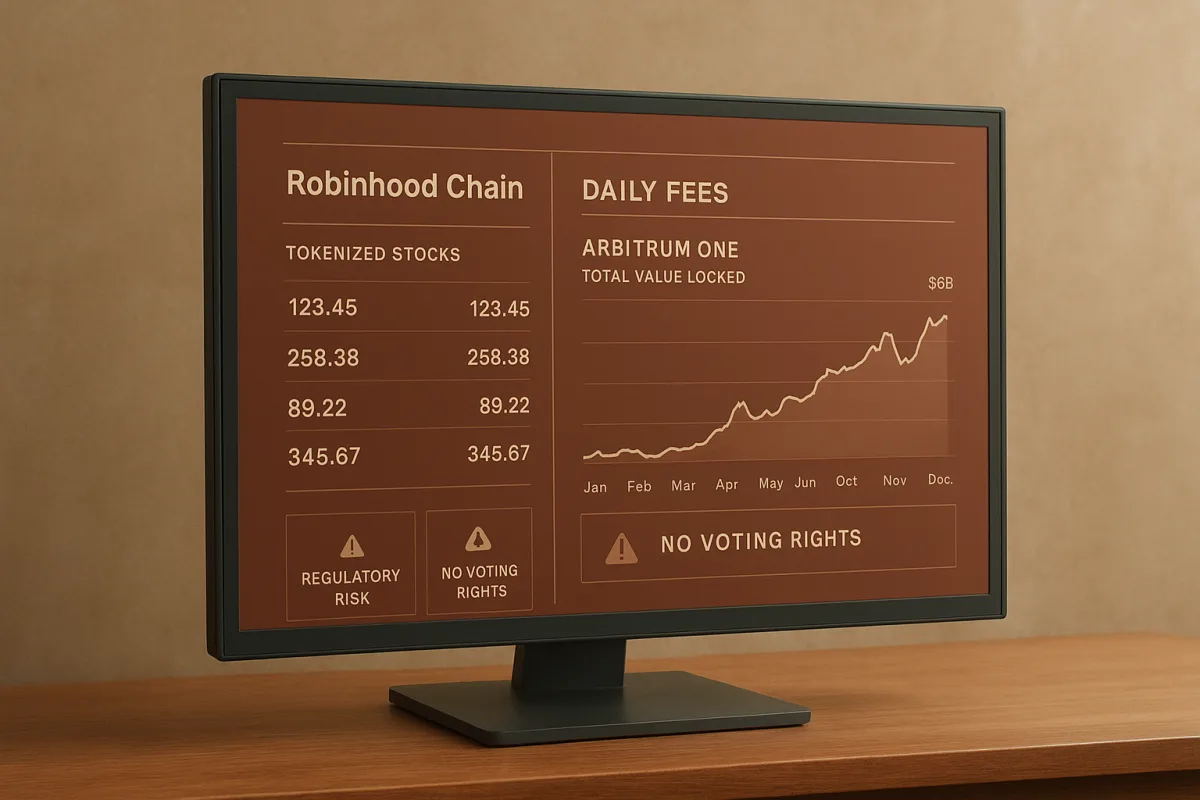
Robinhood Chain Growth, Challenges, and Tokenized Stocks
Explore Robinhood Chain's growth, challenges, and tokenized stocks, including fee surges, risks, and comparison with Arbitrum One.
Robinhood Chain Insider Trading Case and Blockchain
Explore Robinhood Chain's blockchain growth and details of the insider trading case involving former engineers.

Tokenized Treasury Markets
Explore tokenized treasury markets and institutional adoption trends, including risks, growth, and regulatory frameworks in 2026.
DeFi Exploits September 2026
Detailed overview of major DeFi exploits in September 2026, including Payy, Duelbits, and Meter security incidents and their user impacts.