
Institutional Trends After Binance Hack
Explore institutional trends and Bitcoin market resilience after the $6.3B Binance hack, including ETF flows and custody risk management.

Bitcoin After the Binance Hack: Resilience Has a Price
A record theft, and a contained Bitcoin selloff
Binance suffered a $6.3 billion cryptocurrency theft on October 29, the largest recorded crypto hack, with US authorities attributing the attack to North Korea’s TraderTraitor group. [1] [3] Bitcoin nevertheless traded near $77,400 on October 31, roughly 4% below its pre-attack level. [8]
The risk is that price stability can obscure a fragile market structure. A centralized exchange can replenish customer assets, but rising derivatives exposure, weak ETF demand, and a new security shock can still turn a shallow decline into a sharper move.
Binance said it had replaced 90% of affected assets by November 1 using corporate funds, its Secure Asset Fund for Users, and its futures insurance fund. [3] The exchange resumed Bitcoin withdrawals after saying it had covered 95% of losses, while the remaining gap consisted mainly of less-liquid tokens. [5]
That is a substantial operational response, but it is not the same as a completed recovery. Binance had not published a verified update confirming full replenishment beyond that point, and the liquidity of the remaining tokens will determine how expensive replacement becomes.
Blockchain and stablecoin issuers also froze about $3 billion in affected assets, separate from Binance’s own replacement effort. [3] The split matters for customers and markets: frozen assets may aid recovery, while Binance’s treasury deployment determines whether customers can withdraw on schedule.
Cointelegraph reported that Bitcoin’s immediate decline was milder than the average 8.3% first-day drop Anchorage Digital had measured after earlier exchange exploits. [8] That comparison supports the resilience argument, but it is a short-window comparison, not evidence that the market has fully absorbed the event.
Bitcoin held up, but leverage did not disappear
CryptoSlate recorded $1.53 billion in crypto-wide liquidations over the 24 hours covered by Block Scholes’ October 30 note, with 84% coming from long positions. [7] Forced selling cleared some risk, but open interest began rebuilding even as Bitcoin traded near $77,000.
On Binance’s BTC-USDT perpetual market, open interest rose 4.5% between 23:00 UTC on October 29 and 04:00 UTC on October 30 after holding steady during the initial fall. [7] Coinalyze later showed $28 billion of aggregate Bitcoin open interest, up 3% over 24 hours. [7]
Those figures are not directly interchangeable. The Binance reading covers one perpetual contract, while Coinalyze aggregates selected BTC/USD, BTC/USDT, and BTC/USDC markets, and dollar-denominated open interest rises with price as well as new contracts. [7]
Still, the shared message is clear: liquidation alone did not produce a broad, clean deleveraging. For you, that means a recovery driven by expanding futures positions deserves less confidence than one supported by steady spot demand and restrained funding costs.
Funding remained positive but close to neutral during the shock. CryptoSlate cited October 31 readings of positive 0.01% eight-hour funding on Binance’s USDT contract and positive 0.0065% on Bybit’s equivalent market. [7]
Positive funding is not a prediction of liquidation, and neither rate establishes broad speculative excess by itself. It does show that longs were still paying shorts, so traders should watch whether that cost rises as Bitcoin attempts to reclaim higher prices.
Crypto Banter framed the $72,000 to $80,000 area as a technical support zone, citing visible limit orders and moving-average levels. That is a trader’s interpretation, not independently verified demand, and those orders can disappear if macro conditions or spot selling deteriorate.
ETF demand recovered in the quarter, then stumbled
The institutional demand picture improved materially in the third quarter. US spot Bitcoin ETFs attracted $6.34 billion of net inflows in Q3 after approximately $5 billion of outflows in Q2, while Bitcoin rose about 43% over the quarter. [8] [11]
BlackRock’s iShares Bitcoin Trust, IBIT, accounted for roughly 81% of those Q3 inflows, or about $5.1 billion. [9] Concentration is the catch: one large vehicle drove much of the apparent institutional return, leaving the market exposed if that channel slows.
September 21 produced nearly $999 million of net daily ETF inflows, the largest daily haul reported in 2026. [10] August and September brought $3.52 billion and $2.65 billion, respectively, demonstrating that the recovery was not limited to one session. [7]
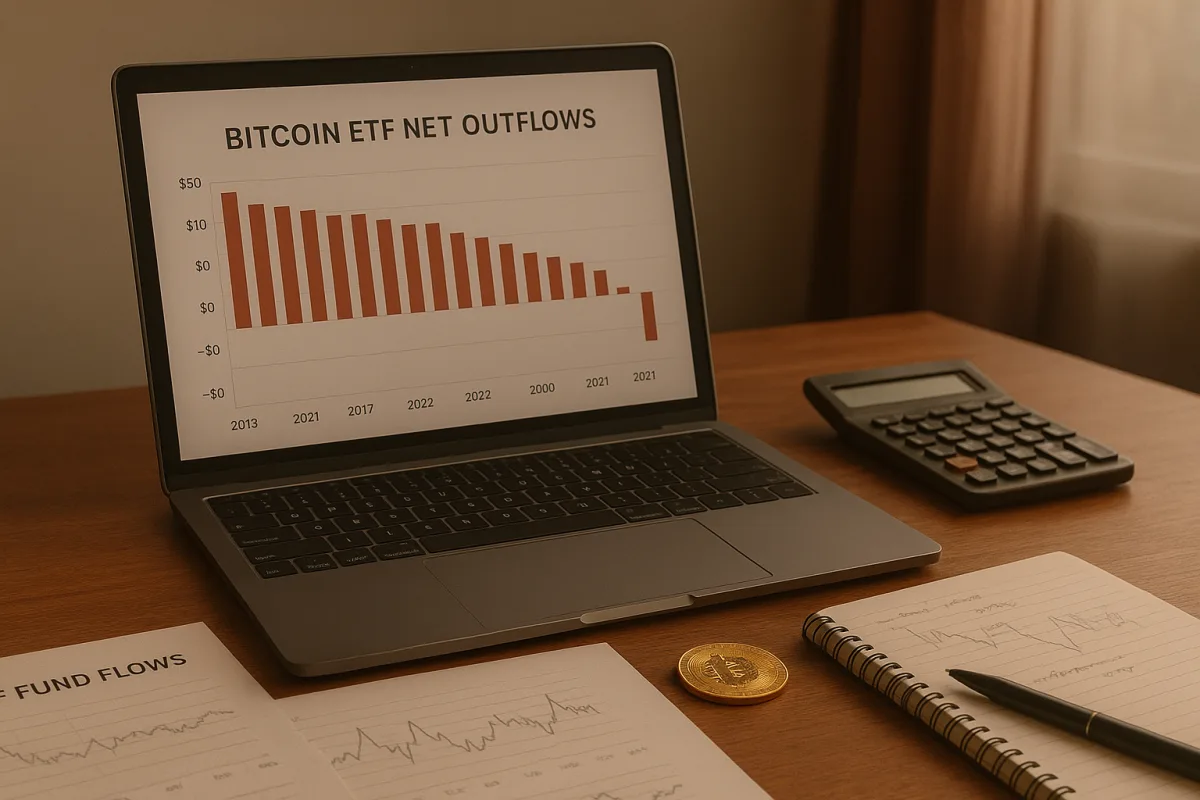
Then the post-hack week delivered the opposite signal. Farside Investors data cited by CryptoSlate showed $643 million of net US spot Bitcoin ETF outflows on October 30, erasing $440.8 million of inflows from October 26 through 29. [13]
The completed week ended with $202.4 million in net outflows. Five of 12 funds recorded withdrawals, seven reported zero flows, and none posted inflows that day. [13] That is a meaningful reversal, though one day does not establish an institutional exit.
Bitcoin Magazine’s Tyler Evans, chief investment officer of UTXO Management, called ETFs the marginal buyer and said flows had flipped from “highly negative” in Q2 to strong accumulation in Q3. His view is consistent with the quarterly data, but it remains a market participant’s interpretation.
For a project seeking treasury capital or institutional users, the implication is straightforward. Do not model ETF inflows as permanent new demand, and do not assume a higher Bitcoin price means allocators will fund a riskier protocol, token, or custody product.
Institutions are buying access, not necessarily direct coins
The institutional adoption wave is increasingly about regulated access and operational control. Blockstream Chief Executive Adam Back told Bitcoin Magazine that Swiss banks are exploring Bitcoin custody, tokenization, and advisory work as client demand grows and investors move funds from managed accounts to exchanges.
That is a different behavior from a fund buying Bitcoin through an ETF. A wealth manager may want custody, compliance workflows, reporting, insurance, onboarding, and a clear division between trading venue and asset custodian before it offers clients exposure.
Back described pension funds, insurance portfolios, and professionally managed savings pools as a potential “third wave” after individuals and ETFs. He cited proposed model portfolio allocations of 2% to 4%, but no published data shows pension funds broadly adopting those allocations yet.
The evidence for future institutional adoption is therefore real but thin. Banks, custodians, and product issuers are building infrastructure, while verified figures showing large pension-fund Bitcoin allocations have not been published.
Deutsche Bank plans to offer Bitcoin and Ether custody to European institutional clients by the end of 2026, subject to regulatory approval. [12] That plan follows a wider move toward regulated custody, but a planned service is not the same as assets under custody or client demand.
The Binance breach will likely reinforce this infrastructure push. Institutions can accept Bitcoin price volatility, but a treasury committee will struggle to accept unclear signing authority, opaque recovery processes, or a provider that cannot explain which assets are segregated and insured.
Security is becoming an operating cost
The Binance incident arrived alongside another security warning. Chainalysis disclosed on October 30 that an external actor accessed internal systems and tools, potentially exposing customer names, email addresses, user IDs, and organization-role labels. [9]
Chainalysis said it had found no indication that clear-text passwords, multifactor-authentication secrets, session tokens, investigation content, or transaction-query results were accessed. [9] That is encouraging, but exposed identity data can still make highly targeted phishing and account takeover attempts easier.
Physical coercion is also rising. CertiK counted 52 publicly reported crypto wrench attacks in the first half of 2026, up from 39 a year earlier, while home invasions rose to 20 from one. [12] Those attacks target people with access, not protocol code.
For a founder, the cost is clear: security cannot sit only with developers. You need transaction-approval policies, separated duties, withdrawal limits, hardware controls, employee phishing procedures, and an escalation path that works outside business hours.
We would start with custody design before token design or growth spending. A project can recover from a missed product launch, but a compromised multisig signer, leaked customer list, or unavailable withdrawal system can erase years of trust in a day.
Macro conditions still set the market’s ceiling
Bitcoin’s resilience also sits inside a restrictive macro backdrop. The Federal Reserve raised rates to 3.75% to 4.00% on September 16, then held that range on October 28, when Bitcoin briefly rose to $81,687 before retreating below $80,500. [18] [19]
That pattern is a warning against simple Fed narratives. A rate hold removed one immediate uncertainty, but it did not create cheap funding, and 16 of 18 Federal Open Market Committee policymakers expected at least one additional rate increase before year-end.
Higher yields compete with speculative assets for capital and increase the cost of financing for leveraged companies. Energy-price pressure tied to geopolitical conflict has also complicated the inflation outlook, making an easier monetary-policy path uncertain.
The November 6 US employment report is the next scheduled macro test for Bitcoin risk appetite. A report that pushes markets toward expectations of tighter financial conditions could pressure Bitcoin, particularly if open interest grows faster than spot and ETF demand.
Crypto Casey pointed to a possible post-midterm relief rally and cited a $442 million weekly return to ETF inflows before the October 30 reversal. That argument is speculative, because election outcomes do not automatically determine crypto policy, fund flows, or the Federal Reserve’s response.
Price forecasts deserve the same restraint. Crypto Casey acknowledged that an earlier November 17 call for $100,000 was unlikely with Bitcoin in the low-$80,000 range, while The Modern Investor repeated claims that Bitcoin could reach $800,000 or more. Neither forecast establishes a tradable certainty.
What this market means for your project
Bitcoin’s post-hack performance shows a market with deeper institutional channels than prior cycles, not a market free of structural risk. ETFs, corporate treasuries, bank custody programs, and regulated products can absorb demand, but they also bring concentration and redemption risk.
Strategy illustrates the financing trade-off. The company held 848,517 BTC as of October 23, yet reported a negative 3.7% year-to-date BTC yield on October 25, meaning Bitcoin holdings had not kept pace with assumed diluted shares. [11]
CryptoSlate reported that Strategy raised about $21.2 billion through capital-markets activity in the first 10 months of 2026, while its preferred-stock structure created recurring dividend obligations. [11] Bigger Bitcoin holdings do not automatically mean better economics for shareholders or a durable treasury model.
If you are planning a Bitcoin-linked company, avoid copying the headline number. Build for transparent reserves, conservative liabilities, and a customer base that can survive a drawdown without forced selling, because funding costs and redemptions often matter more than the treasury total.
The institutional wave is arriving through products that remove wallet complexity and shift risk into custody, compliance, and governance. We would build for that reality: prove controls first, make assets and liabilities legible, and assume the next security shock will test your operations before it tests your pitch.
Frequently Asked Questions
How did the Binance hack affect institutional Bitcoin investment?
The Binance hack caused a significant operational disruption but did not trigger a broad institutional selloff in Bitcoin itself. Bitcoin’s price declined about 4% immediately after the hack, a milder drop than typical for such events, suggesting some market resilience. However, institutions remain cautious due to the increased risks around exchange and custody systems separate from Bitcoin’s network.
What are the trends in Bitcoin ETF flows after the Binance hack?
Bitcoin spot ETFs experienced a net inflow of about $887 million since mid-July 2026, partially reversing earlier outflows. Q3 2026 saw $6.34 billion in inflows, with strong contributions from major funds like BlackRock’s iShares Bitcoin Trust. Despite these inflows, ETF demand remains fragile, and flow reversals should be viewed as signals to watch rather than confirmations of recovery.
How are institutions managing custody risk post-Binance hack?
Institutions are prioritizing custody, signing controls, and incident response before pursuing growth. They are increasingly entering Bitcoin through regulated wrappers and qualified custodians as regulatory frameworks evolve, reflecting heightened attention to security and operational risk following exchange attacks like Binance’s.
What does the Binance hack reveal about Bitcoin market resilience?
The hack showed that Bitcoin’s price can remain relatively stable despite large-scale exchange breaches, indicating resilience in the underlying network and market. However, this stability masks underlying fragility, as rising derivatives exposure and weak ETF demand could still lead to sharper price moves if further shocks occur.
How have institutional strategies changed following the Binance hack?
Institutional strategies now emphasize separating exchange and custody risk from Bitcoin network risk, building stronger security controls, and preparing for slower growth amid higher interest rates. There is less focus on price-target marketing, with more caution around assumptions about demand, policy, and liquidity in the current environment.
How we researched this
This article was assembled from 5 video sources across 4 channels, 8 published articles, 19 cited references.
Nothing here is based on hands-on testing. Where a figure or finding appears, it belongs to the source cited beside it, and the writing says so rather than implying otherwise. Every source is listed below so you can check it.
Sources
WARNING: Biggest Crypto Hack In History & What It Means For Bitcoin! [GET READY], Crypto Banter
Bitcoin’s NEXT LEG UP? 🚀 November Setup After a Lackluster Uptober, Crypto Casey
Adam Back: Pension Funds Are Bitcoin's "Third Wave" of Adoption, Bitcoin Magazine
This Bitcoin News Is Going To Shock The Daylights Out Of You The Rich Are Preparing In Silence, The Modern Investor
Tyler Evans: Bitcoin ETF Flows Flipped From “Highly Negative” to “Strong Accumulation”, Bitcoin Magazine
Binance says 90% of stolen assets replenished, targets Sunday withdrawals, Cointelegraph
Bitcoin’s recovery faces rising derivatives exposure and $643 million in ETF outflows, CryptoSlate
Bitcoin held up better than expected after Binance hack, Strive CEO says, Cointelegraph
Chainalysis breach exposed customer names, emails and company roles, CryptoSlate
Bitcoin turns 18: Has the original rebel grown up?, Cointelegraph
Saylor calls new Bitcoin bull market, but Strategy’s own numbers reveal a costly problem, CryptoSlate
Texas brothers sentenced to 15 years in prison for armed crypto robbery, kidnapping, Cointelegraph
Bitcoin ETFs lose $643 million in a day, wiping out the week’s inflows, CryptoSlate
FBI blames North Korea for stolen billions from Binance in biggest hack in history
Binance says it has replaced 90% of stolen crypto after massive $6.3 billion breach
Binance Reports 90% Replenishment, Updates PoR After $6.3B Hack
Binance resumes bitcoin withdrawals after $6.3 billion hack | The Straits Times
The $6.3bn Binance hack explained - 5 things you need to know
Bitcoin ETF Inflows Turn Positive for 2026, Erasing $5.7B Hole | CoinMarketCap
Bitcoin ETFs See Nearly $1B Inflow, Biggest Daily Haul in 2026 | CoinCodex
Deutsche Bank plans bitcoin, ether custody for institutional clients in Europe | The Block
Who Is Buying Bitcoin in 2026? Institutions, Funds and Cities
Bitcoin Price Returns to $81K as Federal Reserve Holds Rates Steady
Watch Bitcoin Market and Institutional Trends Post-Binance Hack on Youtube
Also from the sources
Related Articles

Binance $6B Hack and Its Impact on Crypto Markets
Explore the Binance $6B hack details, market impact, asset freezes, and Binance's response to this major crypto security incident.

Bitcoin ETF Institutional Investment Trends and Market
Explore Bitcoin ETF institutional investment trends, key products, and how institutions navigate crypto exposure and market risks.
Bitcoin ETF Outflows Explained
Understand Bitcoin ETF outflows, their impact on institutional flows, and what ETF redemptions mean for Bitcoin prices and market dynamics.

Bitcoin Bull Market Signals and Price Rally Analysis
Explore Bitcoin bull market signals, ETF inflows, and price rally factors shaping the current market conditions and potential trends.