
Binance $6B Hack and Its Impact on Crypto Markets
Explore the Binance $6B hack details, market impact, asset freezes, and Binance's response to this major crypto security incident.
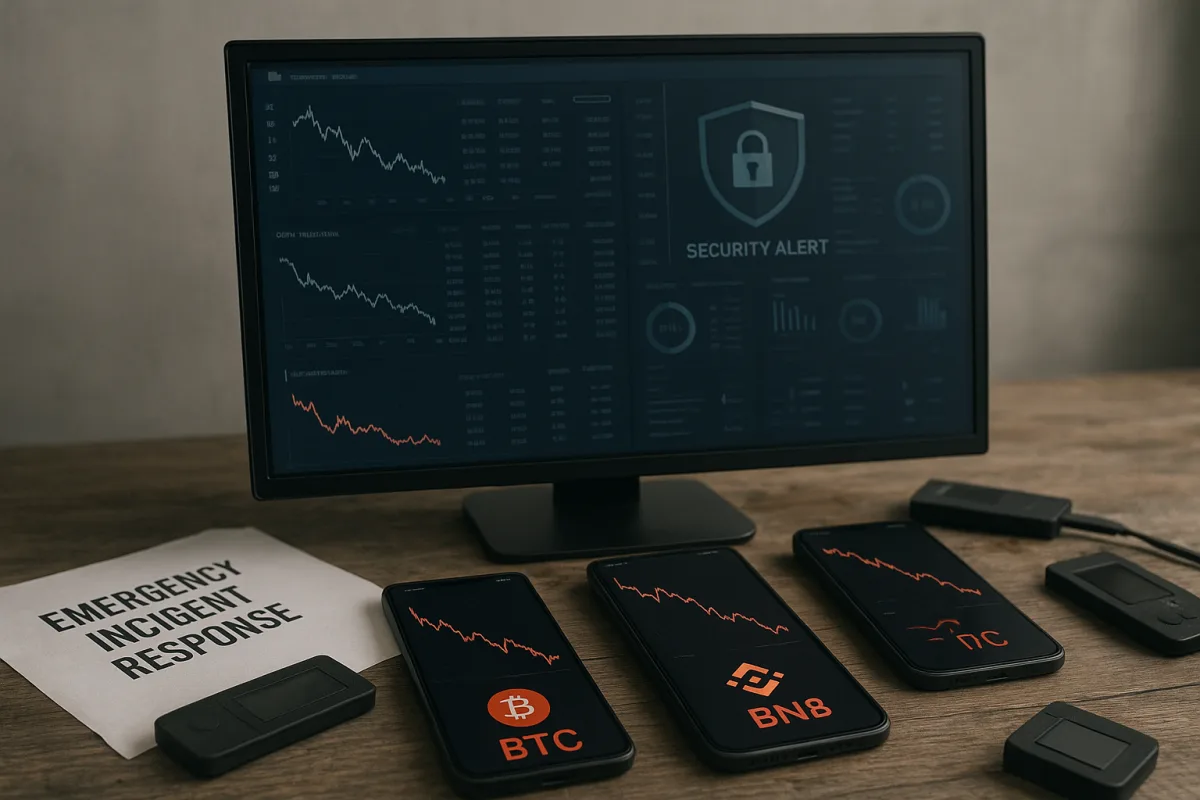
A security incident became a market event
The shift is straightforward: a breach at a major centralized exchange has again become a broad market-liquidity event, rather than a problem contained to one company’s balance sheet. Binance’s reported $6.3 billion loss was followed within hours by price declines, leveraged liquidations, withdrawal suspensions and emergency intervention from stablecoin issuers.[3][6]
The immediate risk is that confirmed facts are being mixed with incomplete forensic claims. Binance has confirmed the scale of the incident and its preliminary view that a compromised DevOps engineer’s laptop enabled unauthorized withdrawals, but it has not identified the attackers or published the detailed post-mortem needed to establish how the initial compromise occurred.[3][11]
That distinction matters because the market has already drawn conclusions beyond the available evidence. Reports linking the attack to North Korean operators are plausible given prior industry incidents, but Binance has not confirmed attribution. Treating an attribution hypothesis as a settled fact creates its own operational and regulatory noise.[1][2]
The market reaction, by contrast, is not speculative. The Block reported that Bitcoin dropped below $77,000, a 4.5% decline during the episode, while Ether traded below $2,240 and Binance Coin fell 7.1% to $698.65. More than $1 billion in leveraged futures positions were liquidated within hours.[6]
Bitcoin Magazine recorded Bitcoin briefly trading near $76,300 after reaching a 24-hour high around $81,890 earlier in the session. That sequence matters more than a single closing price because it shows a familiar crypto-market pattern: security headlines prompt spot selling, which then forces liquidation in derivatives markets.[5]
This was therefore not evidence that the Bitcoin protocol itself failed, nor proof that every exchange faced an immediate solvency problem. It was a repricing of custody, operational-security and counterparty risk, amplified by leverage in markets that trade continuously and can react before facts are established.
What Binance says happened
Binance’s preliminary account is narrower than early commentary about a stolen master key or a fundamental cryptographic failure. The exchange said a compromised laptop used by a DevOps engineer gave an attacker access to a service container, which was then used to submit unauthorized withdrawals.[3]
The company says it has found no evidence that private keys were leaked. That does not establish that key-management controls were irrelevant, but it does mean descriptions of the event as a proven private-key theft are unsupported by Binance’s published findings.[3][11]
Blockchain-security firm Blockaid separately told Cointelegraph that the activity appeared consistent with misuse or compromise of signing infrastructure rather than extraction of a key. Its preliminary analysis focused on malicious authorizations and account delegation, but this assessment should still be treated as analysis, not a completed forensic record.[3]
The distinction is financially meaningful. A leaked private key can imply a direct failure of custody architecture and potentially a wider exposure across systems using related controls. A compromised device or service container instead points first to privileged-access management, software supply-chain controls and transaction-approval workflows.
Neither scenario is minor. But the remediation costs differ, as do the implications for exchanges, wallet providers and projects that operate automated treasury functions. The absence of evidence for a leaked key does not prove the surrounding control environment was adequate. It only limits what has been confirmed publicly.
Binance suspended deposits and withdrawals while it conducted security checks, revoked the affected address authorization and said it would publish an updated proof of reserves following remediation. It has also said it will cover losses through its Secure Asset Fund for Users, known as SAFU, and company funds.[3]
That assurance reduces the immediate prospect of customer losses if it is honoured, but it does not remove market risk. Users could not freely move assets while withdrawals were paused, and a promise of reimbursement is not the same thing as normal settlement, liquidity or restored confidence.
Why the freeze was large, but incomplete
The most striking response came from centralized stablecoin issuers. Tether froze more than $1.567 billion in USDT and Circle froze roughly $823 million in USDC connected to the suspected attacker, while other issuers including Ripple, World Liberty Financial and Paxos reported additional restrictions or freezes.[1][9]
Binance says blockchain partners froze roughly $3 billion of affected assets on-chain. The figure is substantial, amounting to nearly half of the exchange’s reported $6.3 billion impact, but it should not be read as a guaranteed recovery figure. Frozen assets still require legal, technical and administrative resolution.[3]
The response also exposed a structural divide across crypto assets. Issuers of centrally administered stablecoins can blacklist addresses because they control the relevant token contracts. Bitcoin and Ether have no comparable issuer capable of freezing balances unilaterally at the protocol level.[9][10]
CoinDesk’s on-chain reporting found that 18,270 Bitcoin, valued around $1.4 billion at the time, was divided into 19 wallets. Seventeen held exactly 1,000 BTC, with the remaining two holding 832.5 BTC and 437.7 BTC. None had moved at the time of reporting.
Those coins are not impossible to trace. They are simply harder to immobilize. Bitcoin can become difficult to realize if centralized exchanges, over-the-counter desks and compliant swap providers identify and reject it, but the network itself will still validate transactions carrying those coins.
The same pressure applied to assets that could be swapped before a freeze. Decrypt reported wallets associated with the exploit using decentralized venues including Uniswap and Aave to convert stablecoins into Ether or borrow Ether against stablecoin collateral. Those activities showed the time sensitivity of the response.
Aave subsequently froze its DAO-operated markets across V3 and V4 as a precaution, pausing new deposits and borrowing while allowing withdrawals and repayments from existing positions, according to reporting cited by CryptoSlate. Kamino also paused selected borrowing markets on Solana.[7]
These measures were not evidence that Aave’s or Kamino’s smart contracts had been exploited. They were risk controls intended to prevent potentially tainted collateral from being converted into more difficult-to-freeze assets or from creating bad-debt and liquidity problems elsewhere in decentralized finance.
Exchange and regulatory response
The response from exchanges and infrastructure providers was operational before it was regulatory. Binance halted withdrawals, stablecoin issuers blacklisted addresses, and decentralized-finance protocols paused markets. Each action reduced an immediate route for asset movement, but each also constrained ordinary users and market liquidity.[2][3]
That is the central trade-off. Emergency controls can limit contagion, yet they also demonstrate that parts of the market depend on administrative intervention. For stablecoin issuers, address-freezing authority is a feature during a theft and a governance or counterparty consideration at other times.
There has been no confirmed new global regulatory regime or formal compliance requirement introduced specifically in response to this hack as of October 30. Reporting from Axios and the Associated Press instead points to intensified scrutiny and discussion, with concrete official measures still pending.[1][2]
That restraint is important. It would be easy to predict an immediate wave of new rules, mandatory proof-of-reserves standards or blanket constraints on exchange wallets. Such outcomes are possible subjects of policy debate, but none should be presented as an established regulatory consequence yet.
The likely near-term response is more practical and less dramatic: exchanges, custodians and institutional clients are likely to reassess hot-wallet limits, signing procedures, employee-device controls and exposure to single operational environments. CoinDesk reported a rush among institutional investors to move assets from exchanges after the event.[5]
Whether that becomes a durable shift is less clear. Previous exchange failures have prompted temporary withdrawal surges, followed by renewed deposit growth when trading conditions normalize. The available evidence supports heightened caution now, not a confident prediction that centralized trading will permanently lose its dominant role.
Why markets reacted beyond Binance
Bitcoin’s decline reflected more than direct sales from hacked wallets. The market had to price several unknowns at once: the possibility of further unauthorized movements, temporary restrictions on Binance withdrawals, uncertainty about recovery, and the risk that funds would be converted through liquid crypto markets.
BNB’s 7.1% decline to $698.65 was more specific. The token carries direct exposure to sentiment around the Binance ecosystem, so its move was a more concentrated assessment of platform and counterparty risk than Bitcoin’s broader decline.[6]
Altcoins tend to be especially sensitive in this setting because they often have thinner liquidity, more leveraged derivatives activity and less established institutional demand than Bitcoin. That does not mean every decline was caused by the hack alone, since wider market conditions always affect prices.
Monero’s reported rise during the episode illustrates the difficulty of interpreting short-term token moves. Decrypt noted a roughly 6% increase in the privacy-focused asset, but a single-session gain is not proof that attackers were buying it or that a durable market rotation had begun.
The more defensible conclusion is that hacks intensify demand for liquidity and clarity. Traders sell assets with uncertain custody exposure, reduce leveraged positions and seek instruments they believe can be moved or settled quickly. These reactions can reverse, but the liquidation data show they were real.
What project operators should take from it
For teams planning a blockchain project, the key lesson is not simply to avoid holding assets on an exchange. It is to map every path by which a valid-looking transaction can be authorized, including employee devices, cloud credentials, service containers and automated signing systems.
A multi-signature label alone does not solve this problem if signers can be manipulated through compromised interfaces or delegated smart-contract permissions. Projects need to know who can create, alter, approve and broadcast a transaction, as well as which systems can change those permissions.
The Binance incident also argues for separating treasury operations from application operations. A service that needs access to a production environment should not automatically possess the ability to create unrestricted asset withdrawals. Limits, time delays and human review may reduce speed, but they reduce loss severity.
Teams should also plan their response around asset-specific constraints. USDT and USDC may be subject to issuer freezes, while Ether and Bitcoin are not. A treasury that assumes all stolen assets can be stopped on-chain is making a planning error with potentially large financial consequences.
Finally, projects should avoid treating proof of reserves as a substitute for operational-security evidence. Reserve reporting can show assets at a point in time, but it does not demonstrate that privileged access is controlled, transaction policies are enforced or incident-response authority is ready to act.
Binance has promised a fuller technical post-mortem once facts are verified.[3] Until that document is available, the confirmed trend is narrower but still consequential: operational compromise at a major exchange can move billions, interrupt market access and push losses through crypto’s interconnected trading and lending infrastructure within hours.
Frequently Asked Questions
What caused the Binance $6 billion hack?
The hack was caused by a compromised laptop belonging to a Binance DevOps engineer. This breach allowed attackers to access a service container and submit unauthorized withdrawal transactions. Binance has not disclosed the full technical failure chain or the initial attack vector.
How did the Binance hack affect cryptocurrency markets?
The hack triggered a rapid market reaction, with Bitcoin falling below $77,000 (a 4.5% decline), Ethereum dropping below $2,240, and Binance Coin (BNB) falling 7.1% to $698.65. Additionally, more than $1 billion in leveraged futures positions were liquidated within hours, showing how security incidents at major exchanges can quickly impact broader crypto markets.
What assets were frozen after the Binance hack?
Approximately $3 billion of the stolen assets have been frozen on-chain. This includes over $1.5 billion in Tether (USDT) and $800 million in Circle’s USD Coin (USDC). Freezing is effective mainly for centralized stablecoins that can blacklist addresses, but recovery is partial since stolen funds are often converted into non-freezable tokens.
Did Binance lose private keys in the hack?
Binance has found no evidence that wallet private keys were leaked during the hack. The breach appears linked to compromised operational infrastructure rather than a direct theft of private keys, which has different implications for custody and security controls.
How did leveraged futures respond to the Binance hack?
Following the hack, more than $1 billion in leveraged futures positions were liquidated within hours. This reflects a common crypto-market pattern where security-related news prompts spot selling, which then forces liquidations in derivatives markets due to leverage.
How we researched this
This article was assembled from 8 published articles, 11 cited references.
Nothing here is based on hands-on testing. Where a figure or finding appears, it belongs to the source cited beside it, and the writing says so rather than implying otherwise. Every source is listed below so you can check it.
Sources
Binance hacker splits $1.4 billion of bitcoin into 19 wallets that no one can freeze — CoinDesk
Binance investigating hack as suspicious outflows reach up to $5.8 billion — The Block
Binance hack may involve private key ‘misuse,’ not theft: Blockaid CEO — Cointelegraph
Binance Hacker Hunts for Exit Ramps as DeFi Exchanges Pause Markets — Decrypt
Bitcoin Price Briefly Slides to $76,300 as Binance Confirms Hack Estimated at $6.3 Billion — Bitcoin Magazine
LIVE: Binance suspends withdrawals amid massive crypto hack — Protos
Binance hacker splits $1.4 billion of bitcoin into 19 wallets that no one can freeze — CoinDesk
Binance flags 'potential security issue,' says approximately $6.3 billion impacted
Binance sufre un hackeo de 6.300 millones: la mayor plataforma de criptomonedas bloquea activos
Binance hack sparks rush by institutional investors to pull crypto from exchanges
Bitcoin slides below $77,000, BNB drops amid Binance hack | The Block
Binance Hack 2026: $5.57 Billion in Bitcoin and Ethereum Stolen
Binance Releases First $6.3B Hack Findings, Reports No Key Leak Evidence
Related Articles
DeFi Exploits September 2026
Detailed overview of major DeFi exploits in September 2026, including Payy, Duelbits, and Meter security incidents and their user impacts.

Bitcoin and Crypto Market Technical Analysis and Trading
Explore Bitcoin and crypto market technical analysis, key price levels, liquidity insights, and practical trading strategies for October 2026.

Ethereum Market Outlook 2026: Price, Adoption, and Risks
Explore Ethereum market outlook 2026 with insights on price recovery, institutional adoption, derivatives impact, and future protocol risks.

Bitcoin Technical Analysis and Trading Strategies Explained
Learn bitcoin technical analysis, key support/resistance levels, volume signals, and trading strategies to navigate crypto market movements effectively.