
Bitcoin ETF Outflows Explained
Understand Bitcoin ETF outflows, their impact on institutional flows, and what ETF redemptions mean for Bitcoin prices and market dynamics.
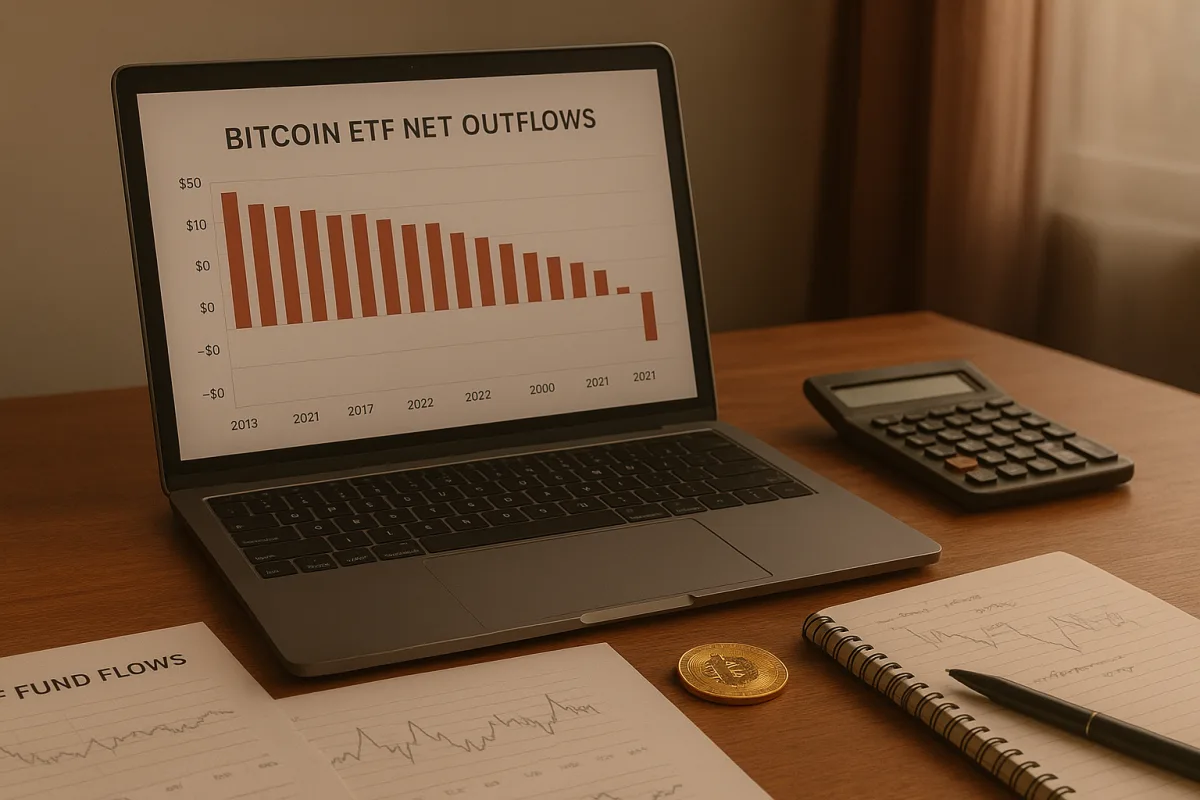
The $729 million number is a flow, not a Bitcoin sale order
The immediate event was straightforward. U.S. spot Bitcoin ETFs saw $484.9 million in net outflows on Oct. 8, followed by $244.1 million on Oct. 9, according to reported fund-flow data, taking the two-day total to about $729 million. [2][12]
The risk is less straightforward. A large outflow can add sell-side pressure to Bitcoin, but it does not prove that every shareholder has become bearish, nor that the ETF issuer sold precisely that amount of Bitcoin at the moment redemptions were reported.
That distinction matters because “Bitcoin ETF outflows” is now often used as shorthand for institutions selling Bitcoin. It is a useful headline, but an imprecise description of the machinery underneath it.
The recent figures were large enough to matter. Bitcoin fell below $82,000 around Oct. 8, roughly 6% below that week’s $86,978 peak, while the reported ETF withdrawals erased the modest net inflows recorded at the start of October. [2][6]
But causality remains unproven. The research record does not provide comprehensive ETF flow data for every October trading day, and it does not establish that ETF redemptions, rather than macroeconomic news and spot-market selling, caused the price decline.
What an ETF outflow actually means
A spot Bitcoin ETF is a listed fund, not a Bitcoin exchange account. Investors buy and sell shares in the fund through brokers, generally on stock exchanges, while the fund itself holds Bitcoin or has exposure designed to track Bitcoin’s price.
Most of the time, one investor selling ETF shares does not make the fund sell Bitcoin. Another investor can simply buy those shares in the secondary market. The number of ETF shares outstanding stays the same, and the fund’s Bitcoin holdings need not change.
A true net outflow occurs when shares are redeemed through the ETF’s primary-market mechanism. This is where a limited group of specialist financial firms, known as authorised participants, enters the process.
An authorised participant can deliver a block of ETF shares to the issuer and receive the corresponding value of the fund’s underlying assets, or cash, depending on the fund structure and redemption process. The redeemed shares are then cancelled.
If redemptions exceed creations, the ETF’s shares outstanding decline. That is the point at which a reported net outflow reflects capital leaving the fund structure rather than merely changing hands between investors.
For a Bitcoin ETF, the economic effect is that less Bitcoin exposure is required to support the smaller pool of outstanding shares. The sponsor, custodian and trading counterparties may therefore need to reduce Bitcoin holdings or hedge exposure.
That is why the flow data matter. The reported $484.9 million outflow on Oct. 8 was not merely a count of investors hitting the sell button on a brokerage screen. It indicated that, after creations and redemptions were netted, the U.S. spot Bitcoin ETF complex shrank by that amount. [2]
Why the fund may not sell Bitcoin immediately
The timing between an ETF outflow and an underlying Bitcoin sale is not always neat. ETF shares trade throughout the day, while primary-market creations and redemptions are processed through institutional counterparties under operational deadlines.
A fund sponsor may also use cash transactions, Bitcoin transfers, market makers and liquidity providers in different combinations. The result is that daily flow data are a strong indicator of changing demand, but not a transaction-by-transaction audit trail of spot Bitcoin sales.
This is one reason the phrase “ETFs dumped coins,” used in recent crypto livestream coverage by Lark Davis and Discover Crypto, should be treated cautiously. The flow figure is real, but it does not identify the precise execution timing, venue or counterparty for any associated Bitcoin sale.
The cost of this simplification is analytical. Readers may assume that a $485 million daily outflow means $485 million of immediate selling on an exchange such as Coinbase or Binance. The actual market impact may be spread across trades, hedges, inventory management and later settlement activity.
It can also work in reverse. When ETF investors are creating shares, the fund or its counterparties may have to acquire Bitcoin. Yet even then, an inflow does not tell readers whether those purchases lifted spot prices directly, were pre-hedged, or were matched against existing inventory.
Who is behind the redemptions
“Institutional flows” can describe several very different investors. Registered investment advisers, hedge funds, family offices, corporate treasuries, endowments and retail investors using brokerage accounts can all own ETF shares.
That variety is important because the motivation behind selling can differ sharply. A long-only allocator may trim a Bitcoin position after a sharp rally. A hedge fund may close a market-neutral trade. An adviser may rebalance a model portfolio because Bitcoin’s price moved relative to equities and bonds.
The ETF route has made these positions easier to establish and unwind. U.S. spot Bitcoin ETFs were approved in January 2024, creating a regulated listed wrapper for investors that did not want to arrange direct custody, operational security or crypto-exchange access.
The quarter before this pullback shows why a two-day figure should not be made to carry too much meaning. U.S. spot Bitcoin ETFs took in $6.34 billion during the third quarter of 2026, reversing roughly $5 billion of second-quarter outflows. [5]
Late September also included a reported $2.4 billion weekly net inflow, the largest such week since October 2025. [5] Early October then began with $134.4 million of inflows over two trading sessions before the larger withdrawals emerged. [6]
That sequence is not evidence of a stable institutional consensus. It is evidence that Bitcoin ETFs have become active portfolio instruments, subject to the same rapid allocation changes seen in sector funds, commodity products and macro trades.
Emory University’s reported $15.8 million commitment to spot Bitcoin ETFs illustrates the wider investor base, but one endowment allocation does not establish a durable trend for every institution. [5] Public ETF flows aggregate unlike motivations into one daily number.
The trade that can make outflows look more bearish than they are
One reason ETF flows can mislead is the Bitcoin basis trade. In its basic form, a trader buys spot Bitcoin exposure, including through an ETF, while selling Bitcoin futures. The trader is attempting to capture the gap between futures prices and spot prices.
This is not necessarily a directional bet that Bitcoin will rise. It is a relative-value trade whose economics depend on futures premiums, financing costs, fund fees, collateral requirements and the expected time needed to close the positions.
If the futures premium narrows, or if funding and balance-sheet costs rise, the trade can stop working. The investor may then sell ETF shares and buy back futures, producing an ETF outflow even if the investor’s main concern is the collapse of a spread rather than Bitcoin’s long-term value.
This has precedent. December 2025 ETF outflows of roughly $4 billion were linked in reporting to the closure of basis trades. [8] The episode is a reminder that ETF flow data can register changes in market structure, not just changes in fundamental investment views.
The same principle applies to risk limits. If volatility rises, a leveraged fund or market maker may reduce both sides of a hedged trade. Its ETF sale still appears in the daily outflow total, even if its net exposure to Bitcoin had been limited.
That does not make the outflow irrelevant. Unwinding a basis trade can still create selling pressure, especially when multiple funds are exiting similar structures. It does mean that “institutions are leaving Bitcoin” is a stronger claim than the data can support.
Why macro conditions matter more than the label on the fund
The recent redemptions arrived alongside pressure from outside crypto. Reporting linked the move to expectations of tighter monetary policy, higher oil prices and escalating concern over conflict involving Iran and the Strait of Hormuz. [12]
These factors matter because Bitcoin now sits inside more conventional portfolios. When oil rises and investors expect interest rates to remain high or move higher, capital-intensive and volatile assets can face pressure alongside growth equities and other risk-sensitive instruments.
Bitcoin Magazine reported that Bitcoin was trading near $82,688 after falling more than 3% over seven days, having approached $90,000 the prior week. [12] That price move and the ETF withdrawals occurred together, but neither observation proves which came first.
ETF flows may follow Bitcoin’s price rather than lead it. Investors who bought ETF shares during a rally may redeem after a decline, while discretionary managers may cut exposure because risk targets require them to reduce volatile holdings.
The feedback loop is the practical concern. A falling Bitcoin price can prompt ETF redemptions. Those redemptions can lead to reduced underlying exposure, which may add pressure to the Bitcoin market and produce further risk reduction.
This is particularly relevant after the record flow swings seen earlier in 2026. Reported May and June outflow streaks totalled about $7.2 billion, while a June weekly outflow of $3.4 billion coincided with price weakness. [8][13]
Coincidence is not causation, but liquidity conditions can turn correlation into a market problem. When fewer buyers are prepared to absorb supply, a large and visible ETF redemption channel can amplify a move already under way.
What the outflows do and do not say about Bitcoin’s market
The $729 million two-day withdrawal is meaningful because it represents a sizeable reduction in demand through a widely used institutional access point. BlackRock’s iShares Bitcoin Trust, IBIT, reportedly accounted for $207.7 million of the Oct. 8 total. [2]
It is not, however, evidence that the ETF structure has failed. ETFs are designed to allow entry and exit. Redemptions are a feature of a liquid fund market, not an operational breakdown.
Nor does the figure settle the question of whether Bitcoin is becoming a diversifier in traditional portfolios. Research on the effect of ETF approval has examined Bitcoin’s changing relationship with conventional assets, but greater accessibility can also increase correlation during broad risk-off periods. [1]
The more sober reading is that spot Bitcoin ETFs have made Bitcoin easier for institutions to trade as finance. That widens the buyer base during inflow periods, but it also gives professional investors a fast, familiar route to cut exposure.
New products add another layer. Amplify launched the Fairlead Tactical Bitcoin ETF, BNAV, on July 29, using technical signals to adjust Bitcoin exposure dynamically. [5] Such products may broaden access, but they can also add rule-based selling when market signals deteriorate.
For now, the available data support a narrower conclusion. October brought a substantial two-day Bitcoin ETF withdrawal after a strong quarter of inflows, during a period of weaker Bitcoin prices and broader macro uncertainty. [2][5][12]
Anything beyond that, including confident claims of a lasting institutional retreat or a near-term price reversal, remains speculation.
Frequently Asked Questions
What do Bitcoin ETF outflows mean for the market?
Bitcoin ETF outflows indicate that more ETF shares are being redeemed than created, which reduces the fund’s size and Bitcoin exposure. Large outflows can add sell-side pressure to Bitcoin prices, especially amid broader market uncertainty, but they do not necessarily mean all investors are bearish. The actual market impact depends on various factors including macroeconomic conditions and investor behavior.
How do Bitcoin ETF redemptions affect Bitcoin prices?
Redemptions reduce the number of ETF shares outstanding, potentially requiring sponsors or counterparties to sell Bitcoin or hedge exposure, which can contribute to downward price pressure. However, causality between ETF outflows and Bitcoin price declines is not definitively established, as other factors like macroeconomic news also influence prices.
Are Bitcoin ETF outflows the same as Bitcoin sales?
No, ETF outflows represent net redemptions of shares from the fund, not immediate, dollar-for-dollar Bitcoin sales. While redemptions may eventually lead to Bitcoin being sold or hedged, the timing and execution of such transactions can vary and are not directly observable from outflow figures alone.
Who are the investors behind Bitcoin ETF flows?
Bitcoin ETF investors include a diverse group such as registered investment advisers, hedge funds, family offices, corporate treasuries, endowments, and retail investors using brokerage accounts. ETF flows reflect the aggregate activity of these varied participants rather than a single investor type.
Why might a Bitcoin ETF not sell Bitcoin immediately after outflows?
The process of ETF share redemptions involves institutional counterparties and operational deadlines, meaning Bitcoin sales may be delayed or executed through various mechanisms like cash transactions, transfers, or hedging. Therefore, outflows indicate changing demand but do not provide a precise timeline or venue for Bitcoin sales.
How we researched this
This article was assembled from 2 video sources across 2 channels, 4 published articles, 14 cited references.
Nothing here is based on hands-on testing. Where a figure or finding appears, it belongs to the source cited beside it, and the writing says so rather than implying otherwise. Every source is listed below so you can check it.
Sources
BTC ETFs DUMP COINS! HUGE Solana News & Talking Bitcoin With Mr M — Lark Davis
MASSIVE Bitcoin ETF EXODUS! (WHY Are They LEAVING?) — Discover Crypto
Bitcoin, Ether ETFs’ October outflows swell toward $1B — Cointelegraph
Ethereum’s proposed safety checks could still let a bad trade through — CryptoSlate
Bitcoin ETFs Shed $729M in Two Days as Investors Reverse Course — Bitcoin Magazine
Trump administration outlines quantum, AI initiatives in $6B science push — Cointelegraph
The Impact of Bitcoin ETF Approval on Bitcoin's Hedging Properties Against Traditional Assets
Bitcoin ETF Inflows Hit $6.34B as BTC Price Jumps 43% in Q3 - The Coin Republic
Bitcoin ETFs Absorb US$134.4 Million in Early October - IDNFinancials — Crypto | AlphaMaven
Bitcoin’s $3.4 Billion ETF Bleed Looks More Cyclical Than Structural | Investing.com
BlackRock IBIT's $2.5B Outflow Cracks Bitcoin's Case | VaaSBlock
Bitcoin ETFs Bleed Over $1.2 Billion as Key Support Faces Its Biggest Test | CoinCodex
Bitcoin ETF: Why Are Institutional Investors Withdrawing Massively? - Cointribune
Bitcoin ETF Investors Withdraw $729M as Price Near Estimated Breakeven | KuCoin
Bitcoin ETF Outflows Test October’s Crypto Rally — PrimeStrider Blog
Watch Bitcoin ETFs and Institutional Flows on Youtube
Also from the sources
Related Articles

Bitcoin ETF Institutional Investment Trends and Market
Explore Bitcoin ETF institutional investment trends, key products, and how institutions navigate crypto exposure and market risks.

Bitcoin Market Outlook 2026: Price Predictions and Trends
Explore the Bitcoin market outlook 2026 with price predictions, institutional demand, and regulatory impacts shaping its future.

Bitcoin Bull Market Signals and Price Rally Analysis
Explore Bitcoin bull market signals, ETF inflows, and price rally factors shaping the current market conditions and potential trends.

Ethereum Market Outlook 2026: Price, Adoption, and Risks
Explore Ethereum market outlook 2026 with insights on price recovery, institutional adoption, derivatives impact, and future protocol risks.