
AI Integration in Crypto Infrastructure
Explore AI integration in crypto infrastructure, costs, challenges, and how mining sites convert to AI data centers for improved computing.
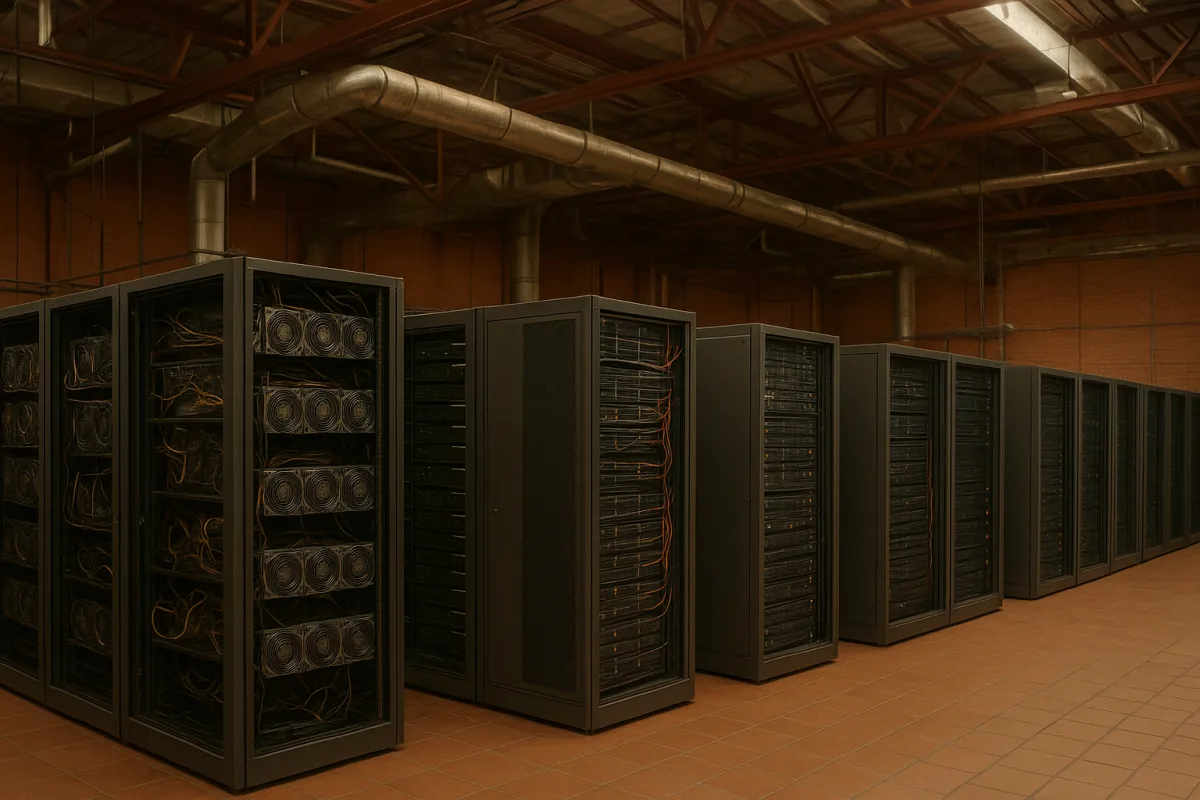
The important unit is not a bitcoin miner, it is a megawatt
The most consequential overlap between AI and crypto infrastructure is not an AI trading chatbot. It is the repricing of electrical capacity. Bitcoin miners built businesses around access to large quantities of power, and AI developers now need the same scarce input.
That shift has changed how markets assess former mining sites. A mine with a power interconnection, substations and operational land may be worth materially more to an AI operator than to a Bitcoin miner, but only if it can be rebuilt.
The risk is straightforward: a megawatt of mining capacity is not equivalent to a megawatt of AI capacity. Treating the two as interchangeable has allowed some companies to market a planned conversion as if it were completed revenue.
Genesis Digital Assets, the mining operator once heavily backed by FTX sister company Alameda Research, is now a useful case study. SWI Group has taken control of the business and plans to rename it SWI Digital as part of a push into AI and high-performance computing. [8]
The financial logic is easy to state. Bitcoin mining earns revenue by turning electricity into hash rate, then competing for block rewards. AI infrastructure instead rents power, cooling, network access and GPU computing capacity to customers running models and applications.
The operational reality is harder. Mining is tolerant of intermittent curtailment, relatively basic networking and equipment that can run in containerised installations. AI customers usually require highly reliable uptime, dense server racks, fast data transfer and much more sophisticated cooling.
That gap explains why the headline number that matters is cost per megawatt converted. CryptoSlate, citing CoinShares research, reported that AI-grade redevelopment can cost $8 million to $15 million per megawatt, compared with roughly $700,000 to $1 million per megawatt for mining infrastructure. [8]
Why AI needs a different kind of data center
A Bitcoin mining facility contains large numbers of specialised ASIC machines. Each machine performs one task, calculating hashes, and its output does not need to communicate continuously with the machine beside it.
An AI cluster is built differently. It commonly uses graphics processing units, or GPUs, that must exchange large volumes of data while training or serving models. That makes low-latency networking, storage and rack design central to the product.
Cooling is also a major cost. High-density GPU clusters produce concentrated heat loads that many mining facilities were not designed to handle. Air cooling can be insufficient, requiring liquid-cooling systems, redesigned racks and upgrades to electrical distribution.
The distinction matters because a mining operator can announce a large power portfolio without owning the infrastructure required to monetise it as AI capacity. A grid connection is valuable, but it is the first input, not a finished cloud service.
A customer contract changes the calculation again. A computing agreement can support financing because it indicates future revenue, yet lenders still need confidence that the site can be completed, powered, equipped and delivered by the contracted date.
Cointelegraph reported that BlocksBridge Consulting estimates publicly listed miners need roughly $50 billion to finish planned AI infrastructure projects. The identified gaps included $21.1 billion at IREN, $7.2 billion at Riot Platforms and $4.6 billion at HIVE Digital.
Those figures should not be treated as forecasts of successful build-outs. They are estimates of financing need, which is precisely the point. Announced capacity is a claim on future capital expenditure before it becomes operating capacity.
Borrowing costs can vary widely even for a single company. Cointelegraph reported that IREN secured a $3.65 billion GPU financing package at a blended 6% rate, followed by a separate $2.4 billion arrangement carrying a 9% fixed rate.
The projects differed, so the rates are not a clean comparison. Still, they show that funding conditions are part of the business model. A miner’s cost of capital can determine whether attractive AI revenue survives after interest, depreciation and build costs.
The SWI and Genesis conversion: what is actually being bought
SWI Group announced an €800 million capital increase, bringing its total equity raised since March above €1 billion, according to CryptoSlate. The Amsterdam-listed company said the funding would support data centers, power infrastructure and computing deployments in Europe and the United States. [8]
Its Genesis acquisition gives the strategy an existing footprint. Alameda Research invested approximately $1.15 billion in Genesis in 2021 and 2022, when the miner was valued around $5.5 billion, before FTX’s November 2022 collapse. [8]
That history is not merely background. The FTX Recovery Trust filed a September 2025 lawsuit seeking to claw back the $1.15 billion, according to the reporting brief. Genesis contests the action, leaving creditor outcomes and the legal treatment of the assets unresolved.
CryptoSlate reported that SWI acquired more than 70% of Genesis through purchases and restructuring in August. [8] But SWI has not identified which sites it will convert first, how much each conversion will cost, or when AI revenue will begin.
That limits what can be inferred from the €800 million raise. It provides financing capacity, not proof of AI utilisation. The company also did not disclose how much of the proceeds would be assigned specifically to Genesis facilities. [8]
The reported prize is substantial. CoinShares estimated that AI computing infrastructure could generate annualised profit of about $1.5 million per megawatt, against roughly $500,000 for Bitcoin mining. [8] That is an estimate, not a universal margin.
Profit per megawatt depends on customer pricing, GPU ownership, depreciation, electricity costs, uptime, construction overruns and financing. In Bitcoin mining, returns also depend directly on Bitcoin’s market price, network difficulty and the timing of the next halving.
The independent research brief places Bitcoin around $83,000 in its mining comparison and notes that top-tier hydro miners may achieve roughly 60% margins at $0.07 per kilowatt-hour. At residential power prices of $0.16 to $0.20, it says mining can run at a loss.
That comparison explains the strategic temptation. AI revenue may be contract-based and less exposed to Bitcoin’s daily price moves. Yet it substitutes a different set of exposures: customer concentration, hardware obsolescence, construction execution and debt service.
Contracts are more important than promotional capacity numbers
The conversion trade has been rewarded in public markets partly because AI infrastructure companies have received higher valuation multiples than mining-focused peers. CoinShares found AI-oriented miners traded at an average 19.4 times forward sales, versus 6.6 times for more mining-focused competitors. [8]
Such multiples are not cash flow. They are a market judgement about future revenue. The same CoinShares analysis found more than $100 billion in disclosed AI computing contracts across covered companies, but only about $1.1 billion in annualised revenue. [8]
It also found that around 550 megawatts were generating billings against more than four gigawatts of contracted capacity. [8] The difference illustrates the central execution problem: contracts may be signed years before facilities are ready to invoice.
This is why investors and counterparties should ask four mundane questions. Is the power fully contracted? Has the site received permits? Are the GPUs financed and deliverable? Is the customer obligated to pay if construction or energisation is late?
The Coin Bureau channel’s account of Oracle’s Project Jupiter in New Mexico offers a larger-scale version of this problem. A data center can have an anchor customer and extensive financing, yet still be constrained by fuel supply and regulatory approvals. [1]
The research brief says the Green Chile Project pipeline’s expected in-service date moved from August 15, 2026 to February 1, 2027, while an air-quality permit decision is pending by November 23. Oracle has maintained that it expects no delay. [1]
Whether Oracle meets the 2028 operating target remains uncertain. The point is not that a delay proves failure. It is that power infrastructure and approvals, rather than AI demand alone, determine when a computing asset can start earning revenue.
Binance AI is a different application of the same theme
Binance’s newly launched AI interface addresses a different bottleneck: trading workflow. The exchange rolled out Binance AI to English-language users after a beta involving about 150,000 users, according to The Block. [2]
The product uses a generative user interface, personalised market information, AI-created briefs and text or audio alerts. It is designed to adapt the exchange display to user behaviour and market events, rather than simply add a conventional chatbot. [2]
That can reduce the friction of locating information, comparing market data or setting alerts. It does not change the underlying economics of trading. It cannot turn uncertain market data into reliable forecasts, and Binance has not published performance evidence to suggest otherwise.
The second risk is automation bias. A polished interface that compresses news, price movements and account functions into one recommendation-like screen can make uncertain outputs appear more authoritative than they are, particularly during fast-moving markets.
There is also no post-launch evidence on whether the tool increases trading volume, retains users or generates incremental revenue. The 150,000 beta figure measures testing participation, not profitability, accuracy or whether users made better decisions. [2]
Robinhood’s launch of AI-enabled stock-trading and credit-card services in May shows that AI-led retail interfaces are becoming a competitive feature beyond crypto exchanges. [1] That is a distribution trend, not proof that AI has found an investing edge.
For crypto markets, the near-term impact may therefore be more structural than predictive. AI can reorganise research, alerting and order-entry interfaces. Meanwhile, the larger capital shift is occurring behind the screen, where miners seek to sell power and data-center capacity to AI customers.
What determines who captures the value
The strongest position belongs neither automatically to the miner nor the AI company. It belongs to the operator that can combine cheap, dependable power with permits, capital, hardware supply, cooling expertise and a customer contract that survives delays.
Election and policy risks are part of that equation. Morgan Stanley has highlighted that the US midterms could influence AI investment conditions, while the research brief notes at least 15 states have moratoriums or proposed restrictions affecting AI data centers. [4]
The eventual policy effects are speculative because election outcomes and subsequent rules remain unknown. But local zoning, tax incentives, transmission approvals and environmental reviews can alter project economics more directly than a company’s AI branding.
For former crypto mining assets, the market’s question is therefore practical. Can an operator spend the additional millions per megawatt, complete the physical upgrade and obtain paying customers before its financing costs overwhelm the expected AI premium?
SWI’s Genesis plans, Binance’s interface rollout and the broader mining-sector pivot all point to the same divide. AI can raise the value of crypto-linked infrastructure and trading software, but only measurable revenue, not an AI label, closes that gap.
Frequently Asked Questions
How does AI integration affect crypto mining infrastructure?
AI integration shifts the value of crypto mining infrastructure toward electrical capacity, but a megawatt of mining power is not equivalent to a megawatt of AI capacity. AI requires more sophisticated cooling, networking, and GPU financing, making the conversion of mining sites to AI data centers complex and costly. This changes how markets assess former mining sites, often increasing their potential value if properly rebuilt for AI use.
What are the costs of converting bitcoin mining sites to AI data centers?
Converting one megawatt of bitcoin mining capacity to AI-grade infrastructure can cost roughly $8 million to $15 million. In contrast, establishing mining capacity typically costs about $700,000 to $1 million per megawatt. This large cost difference reflects the need for advanced cooling, networking, and equipment upgrades in AI data centers.
Why is AI infrastructure different from bitcoin mining facilities?
Bitcoin mining facilities use specialized ASIC machines that perform a single task and do not require continuous communication between units. AI clusters use GPUs that must exchange large volumes of data with low latency, requiring advanced networking, storage, and rack design. Additionally, AI hardware produces concentrated heat loads that often necessitate liquid cooling and electrical upgrades, unlike the simpler cooling systems used in mining.
What challenges exist in repurposing crypto mining for AI computing?
Repurposing mining infrastructure for AI involves significant capital expenditure, complex upgrades to cooling and networking, and securing long-term customer contracts to support financing. There are also legal and operational risks, such as ongoing litigation and uncertainties about conversion schedules. Financing conditions and the ability to deliver functioning AI data centers on time are critical challenges.
How does AI impact the economics of crypto infrastructure?
The economic appeal of converting mining sites to AI data centers depends on contracted computing revenue rather than the AI label itself. Financing costs, equipment delivery, and power availability determine whether this revenue is realized. Borrowing rates and capital intensity heavily influence profitability, with some miners requiring billions in financing to complete AI infrastructure projects.
How we researched this
This article was assembled from 2 video sources across 2 channels, 8 published articles, 9 cited references.
Nothing here is based on hands-on testing. Where a figure or finding appears, it belongs to the source cited beside it, and the writing says so rather than implying otherwise. Every source is listed below so you can check it.
Sources
Oracle's $500 Billion AI Bet Is BREAKING — Coin Bureau
Alex Gladstein: How The Bitcoin-AI Convergence Impacts the Fight for Freedom — Bitcoin Magazine
Binance launches AI trading tool after 150,000-user beta — The Block
Meta's New Muse Wonder Finally Puts Zuckerberg in the Frontier AI Race — Decrypt
Crypto PACs report $2.7M spending blitz on House races as midterms loom — Cointelegraph
FTX’s former Bitcoin mining bet gets new life as parent raises €800 million for AI — CryptoSlate
Ledger Investigates Fund Losses Tied to Southeast Asian Reseller After Implant Found in Device — Bitcoin Magazine
StoneX raises Securitize price target 50% as tokenized stock platform opens new revenue stream — The Block
From GTA V on iPhone to Free Photoshop: This AI Tool Is Upending Software — Decrypt
Bitcoin miners face widening AI financing costs as lenders scrutinize deals — Cointelegraph
Binance launches AI trading tool after 150,000-user beta | The Block
AI infrastructure & semiconductors (AI & ML) | Flow Partners
AI Infrastructure Valuations: Q2 2026 | Windsor Drake Research
Binance launches AI trading assistant after 150,000-user beta — Geo News
SWI Turns FTX’s Former Bitcoin Mining Infrastructure Toward AI Boom
JPMorgan says a 2026 blue wave could slam AI data center stocks that now make up 45% of the S&P 500
Watch AI Integration and Impact on Crypto Trading and Infrastructure on Youtube
Also from the sources
Related Articles
AI Impact on Cryptocurrency Development and Market Dynamics
Explore how AI affects cryptocurrency development, mining, and market risks amid calls for slower AI progress in crypto infrastructure.
Crypto Market Infrastructure and New Financial Products
Explore crypto market infrastructure and new financial products like volatility futures and tokenized settlements with key risks and usage insights.
Institutional Crypto Infrastructure and Trading Expansions
Explore how institutional crypto infrastructure is expanding into derivatives, financing, and token products with key industry moves in 2026.

Mastering Day Trading: Craig Percoco's Live Session Strategies
Join Craig Percoco in a live trading session as he shares his strategies, indicators, and trade entries. Learn risk management and profit goals in day trading for a thrilling journey to hit that $10,000 mark.