
Crypto Wallet Vulnerabilities and Security Incidents Explained
Explore crypto wallet vulnerabilities, key security incidents, and how to protect your assets from hardware wallet exploits and private key risks.
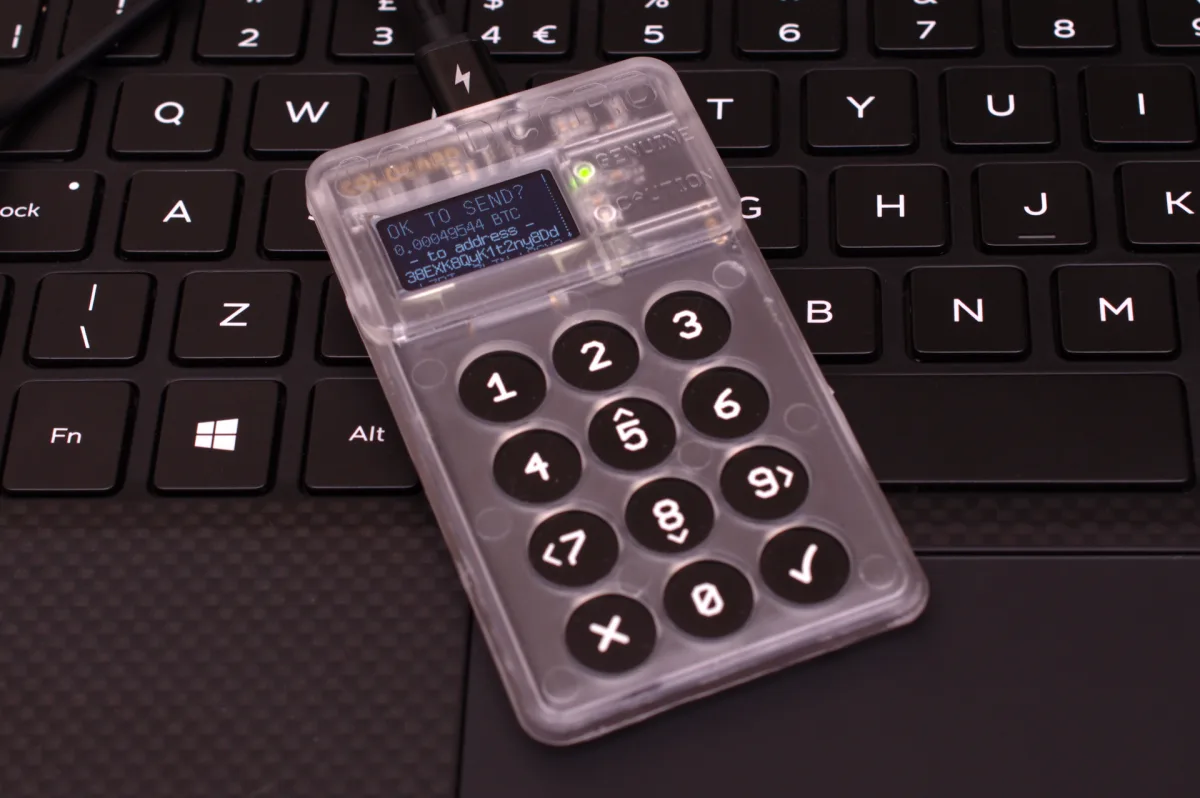
Photo: Gareth Halfacree from Bradford, UK, CC BY-SA 2.0, via Wikimedia Commons
A signature can be valid and still be theft
On Nov. 24, wallets associated with crypto trader Zion Thomas, known online as Ansem, rapidly sold meme coin positions and moved $2.57 million in proceeds to an Arbitrum address. The transfers looked valid on-chain because they were signed with keys able to control the wallets.
That is the recurring security problem behind the Coldcard flaw, the Bullpen incident and Europol’s piracy investigation. A blockchain can verify that a transaction came from the correct key. It cannot verify whether the person using that key was its rightful owner.
Ansem initially said an attacker may have accessed a Bullpen account connected to an imported Solana private key. Bullpen, the trading terminal Ansem cofounded, later confirmed unauthorized transfers involving 18 to 19 accounts created during its early beta period. Decrypt reported that the platform took the affected test service offline.
The Block reported that Ansem’s namesake Solana token, The Black Bull, fell 55% to below $0.02 amid the initial uncertainty. Decrypt put the intraday decline at roughly 60% in less than an hour, illustrating how quickly a wallet-security event can become a market event.
The private key is the control point
A private key is the secret credential that authorizes a crypto transaction. Wallet software uses it to create a digital signature, and every network participant can check that signature against the public address without seeing the private key itself.
Your recovery phrase, often 12 or 24 words, is a human-readable backup for that private key material. Anyone with the phrase can generally recreate the wallet on another device and sign transactions as though they owned the hardware wallet.
This setup removes the need for a bank to approve a transfer, but it also changes the failure mode. When a bank account is compromised, the bank may identify an unauthorized login or pause an unusual payment. A self-custody wallet sees a correctly signed transaction.
That means the chain records authority, not intent. If a thief obtains a seed phrase, extracts a private key from a compromised service, or manipulates a wallet into signing a malicious approval, the eventual transfer can be technically valid and economically catastrophic.
Coldcard’s flaw weakened the secret before users saw it
Coldcard is a Bitcoin hardware wallet made by Coinkite. Hardware wallets keep private keys away from internet-connected computers, but that protection depends on the recovery phrase being generated from sufficiently unpredictable random data.
Coinkite’s flaw was in the process that generated some recovery phrases. The wallets displayed phrases that appeared normal, and security checks confirmed that the intended secure generator existed, but the devices were using a weaker source of randomness in affected cases.
TRM Labs reported that the defect reduced seed entropy from the normal 128-bit level to as little as 40 to 72 bits. Entropy measures the number of plausible secret combinations, and lowering it sharply makes an offline brute-force search far more feasible. [1]
An attacker did not need to steal a user’s physical Coldcard device if the generated phrase was weak enough to reconstruct. They could test possible seed values offline, derive wallet addresses from each candidate, then identify the seed that controlled a funded address. [1]
The known thefts began July 30, 2026. Losses reached about 1,816 Bitcoin, valued at roughly $116 million by Aug. 5, according to TRM Labs. [1] CoinDesk reported that Coinkite urged customers to migrate funds, not merely install updated firmware. [2]
That distinction has a direct cost for affected holders. A firmware update can prevent a device from creating new weak phrases, but it cannot add randomness to a phrase that already exists. The Bitcoin must move to addresses generated from a new recovery phrase.
Coinkite’s Nov. 23 postmortem said at least 15 independent security reviews and research efforts failed to identify the defect. The company had received about 300 loss-related support tickets connected with 242 accounts by Nov. 18, according to Cointelegraph.
For you, the lesson is narrower than “hardware wallets are unsafe.” A hardware wallet protects a key after generation. It cannot protect a key whose creation process has already made it guessable.
Importing a key changes the risk boundary
The Bullpen incident centered on another way private-key control can expand. Bullpen lets traders import existing wallets, allowing its interface to submit transactions from addresses they already use. Bullpen’s documentation describes wallet-management functions for connected accounts. [7]
That can be convenient for rapid trading, but convenience brings a new dependency. Once a platform, browser session, application database or linked account can access signing material, a compromise of that system can become a compromise of the wallet.
Ansem said he believed unauthorized access to his Bullpen profile may have exposed the Solana private key he imported. He said his EVM-compatible Pump.fun wallets remained untouched, and Decrypt reported that a Hyperliquid account holding about $373,000 also remained intact.
Those untouched balances do not establish the route of the attack. They do show why wallet separation limits damage: an attacker who reaches one set of keys may not automatically reach balances held under different credentials, devices or account systems.
Bullpen has not disclosed the precise vulnerability, the total losses across all affected users or whether it will compensate them. The company said the affected accounts represented less than 0.005% of registered users, but percentage exposure does not reduce the loss for an affected account.
We would keep only an amount needed for active trading in a wallet imported into a trading terminal. Long-term assets belong in a separately generated wallet whose recovery phrase has never been entered into a browser, trading interface or online profile.
Public ledgers leave a financial trail
The same design that makes a theft difficult to reverse can make its proceeds visible. Europol said an operation from Nov. 16 through Nov. 20 traced more than 26 million euros, or $28.5 million, in crypto transactions connected to illegal streaming services. [8]
Authorities from 11 countries worked with Binance, Coinbase and blockchain analytics company Chainalysis. The operation disrupted 57 illegal streaming services and identified 321 websites offering infringing content, Europol said. [8]
The investigation followed transfers between wallets, clustered addresses believed to be controlled by the same operators, and connected those patterns to streaming businesses and individuals. Crypto can move across borders quickly, but the blockchain preserves a transaction history investigators can analyze. [8]
Europol said illegal IPTV operators often accept crypto subscriptions because payments can be sent internationally without the conventional payment networks used by card issuers. The agency’s focus was the financial infrastructure behind the services, not only the websites themselves. [8]
Tracing is not the same as recovery. Europol has not reported the percentage of implicated wallets that remain active, the amount seized, or whether victims and rights holders will recover funds. A visible address may still hold assets beyond an investigator’s immediate reach.
Crypto exchanges can become the key handoff point. When traced funds reach an exchange account, the exchange may hold identity records and can respond to valid legal requests. Funds kept in self-custody wallets require investigators to identify the controller through other evidence.
Regulators are targeting custody and identity records
Hong Kong’s proposed Virtual Asset Services Legislation Amendment Bill 2026 would require banks to obtain Securities and Futures Commission registration before providing covered crypto custody services. The proposal reflects a regulatory view that control of private keys is the central custody risk.
CryptoSlate reported that banks already supervised by the Hong Kong Monetary Authority would need additional registration, while independent providers would generally need a Securities and Futures Commission license. Hong Kong has not announced the legislation’s commencement date.
The proposed rules distinguish between a firm that can transfer client assets and software that leaves users independently in control of keys. Shared-key systems would be judged by who can actually move funds and whether customers can retain or restore access.
The CFTC is taking a parallel approach in prediction markets, though its focus is trading identity rather than wallet custody. Its new rule would require covered exchanges to collect names, contact information, occupations and employers for certain event-contract traders, CryptoSlate reported.
Public trade feeds can already show execution time, price and size. Adding retained identity data gives regulators a way to investigate suspicious trades placed shortly before market-moving announcements, although proving misuse of nonpublic information would still require evidence beyond timing.
Network security also has an operating cost
Not every security improvement concerns stolen keys. Solana validators, the computers that process transactions and maintain the chain, can waste computing resources when they execute a block that later loses to a competing version.
CoinDesk reported that Anza, developer of Solana’s main Agave validator client, proposed having validators abandon a losing block as soon as the network finalizes its rival. The change would stop machines from completing transaction checks whose results will never be used.
Solana’s Alpenglow upgrade reduced finality to roughly 150 milliseconds from about 12.8 seconds, according to the reported upgrade details. Faster agreement narrows the window in which validators may continue working on a block after the network has settled on another one.
Anza has not published figures for how frequently validators process losing blocks or how much computing power its proposed change would save. That makes any projected validator-cost reduction speculative for now, even if the mechanism is straightforward.
The wallet rule to keep
A wallet is not defined by the app icon on your phone or the device on your desk. It is defined by the keys, recovery phrase, approvals and account systems that can produce a valid transaction.
For Bitcoin held on potentially affected Coldcard firmware, we would create a new recovery phrase on updated software and move funds to addresses derived from it. CoinDesk reported that Coinkite’s warning was to migrate funds, because old phrases remained exposed after an update. [2]
For active trading, we would use isolated wallets with balances sized for the activity, then remove unused authorizations and avoid importing long-term-storage keys into web-connected services. The cost is added transaction management and potentially more network fees.
For platforms holding customer assets, the minimum question is who can sign, who can restore access, and what happens if either system fails. Hong Kong’s proposed framework and Europol’s exchange cooperation both point to the same reality: key control carries both operational responsibility and legal exposure.
Frequently Asked Questions
What caused the Coldcard hardware wallet vulnerability in 2026?
The Coldcard vulnerability was caused by a flaw in the wallet’s recovery phrase generation process that used weaker randomness than intended. This defect reduced the entropy of seed phrases from the normal 128 bits to as low as 40 to 72 bits, making offline brute-force attacks feasible without needing physical access to the device. As a result, attackers could reconstruct private keys and steal funds from affected wallets.
How can weak recovery phrases compromise crypto wallets?
Weak recovery phrases have lower entropy, meaning fewer possible combinations and easier guessing through brute-force methods. If an attacker reconstructs the seed phrase, they can recreate the wallet on another device and sign transactions, effectively controlling the funds. This risk exists even if the wallet hardware itself remains secure after key generation.
Why is importing private keys into platforms risky?
Importing private keys into trading platforms or applications expands the wallet’s attack surface because the platform gains access to signing material. If the platform is compromised, attackers can use the imported keys to authorize transactions and steal funds. Even platforms that call themselves noncustodial cannot fully eliminate this risk once private keys are imported.
What are best practices to separate trading and long-term crypto holdings?
It is advisable to keep trading balances separate from long-term holdings by using different wallets. This way, if a hot wallet used for trading is compromised, the attacker cannot access all assets. Long-term holdings should be stored in more secure environments, such as hardware wallets with strong recovery phrases, to minimize exposure.
How traceable are stolen crypto funds on public blockchains?
Stolen crypto funds are traceable on public blockchains because every transaction is recorded and visible. However, traceability does not guarantee that stolen funds will be frozen or returned. Blockchain records prove that a transaction was authorized by the key holder but cannot verify whether the transaction was legitimate or fraudulent.
How we researched this
This article was assembled from 8 published articles, 8 cited references.
Nothing here is based on hands-on testing. Where a figure or finding appears, it belongs to the source cited beside it, and the writing says so rather than implying otherwise. Every source is listed below so you can check it.
Sources
Solana developers move to stop validators finishing work on blocks that already lost, CoinDesk
Ansem denies involvement in $2.57 million wallet drain; Black Bull creator coin plummets 55%, The Block
Europol follows $28.5M crypto trail in streaming piracy crackdown, Cointelegraph
Ansem Meme Coin Crashes After $2.57 Million Wallet Drain, Bullpen Confirms Security Breach, Decrypt
Prediction market bets placed just before big news could soon be easier to trace, CryptoSlate
Coldcard reveals how Bitcoin wallet flaw went undetected for over 5 years, Cointelegraph
Hong Kong wants banks to secure new approval before holding customers’ crypto, CryptoSlate
BTC news: Coldcard urges users to move bitcoin as active wallet exploit continues
Private Key Management for Digital Asset Platforms | Guardian Resource Hub
Europol IPTV crypto trace: €26m, 57 services disrupted, Coindaro
Europol traces €26 million crypto trail in piracy crackdown | Grafa
Related Articles
Ledger Wallet Supply-Chain Breach Exposes Recovery Phrase
Learn how the Ledger wallet supply-chain breach compromised recovery phrases via reseller implants and what it means for hardware wallet security.

AI Impact on Crypto Security: Risks and Defenses Explained
Explore how AI affects crypto security, from autonomous exploits to defense challenges in blockchain and smart contracts.
DeFi Exploits September 2026
Detailed overview of major DeFi exploits in September 2026, including Payy, Duelbits, and Meter security incidents and their user impacts.
Cryptocurrency Exchange Security Risks
Explore cryptocurrency exchange security risks, including hacks, sanctions, and custody challenges, with actionable insights for traders and operators.