
Bitcoin Mining Attacks: Causes and Industry Challenges
Explore Bitcoin mining attacks, how hashrate hijacking works, and challenges miners face securing their operations.
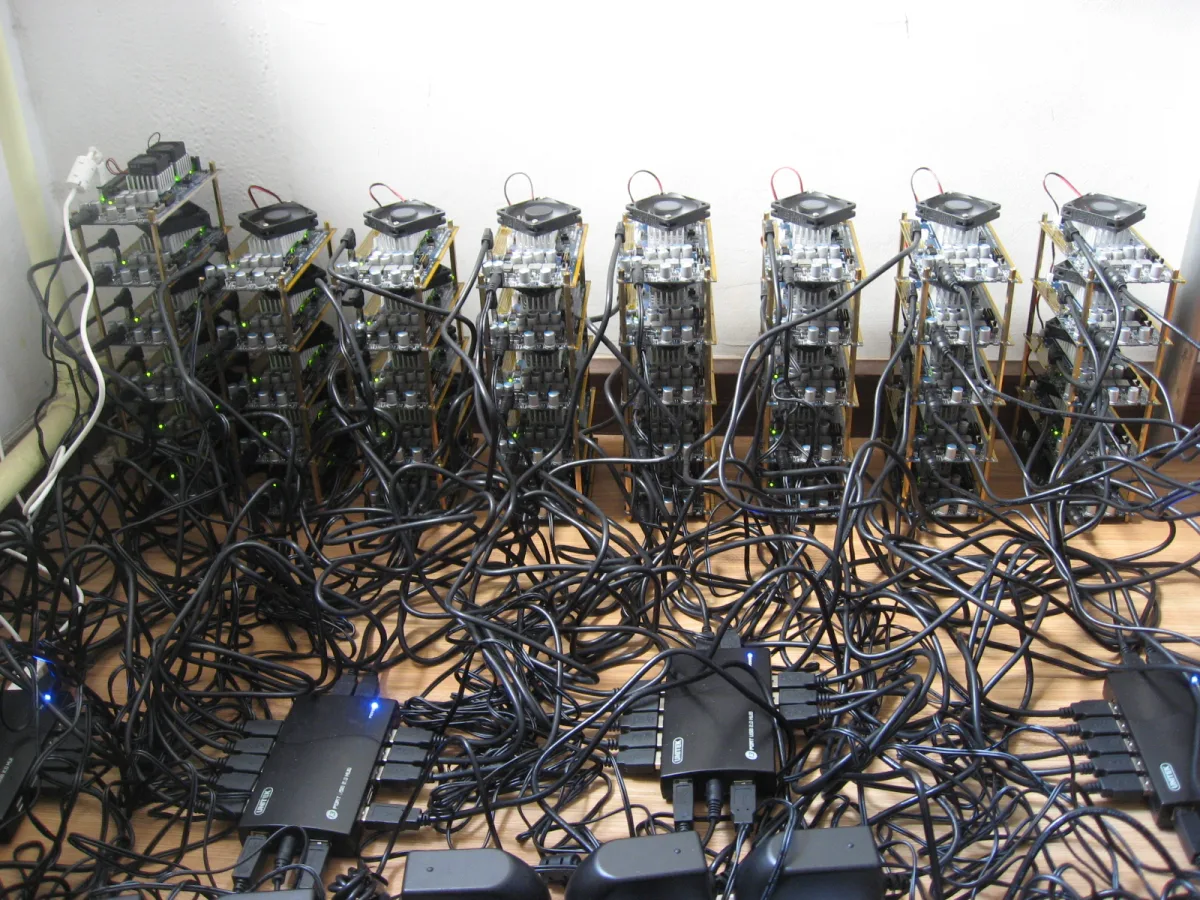
Photo: Xiangfu, CC BY-SA 4.0, via Openverse
A miner can be working, paying for power, and earning nothing
On Nov. 20, attackers diverted connections from more than 1,000 Bitcoin mining sites to an impostor pool, according to Coincu’s reporting on Braiins’ security alert. The reported scale was 1,050 to 1,600 sites and 0.6 to 1.9 exahashes per second of redirected hashrate. [1]
That is an expensive failure because the machines do not necessarily stop. They keep drawing electricity, fans keep spinning, and ASICs keep calculating hashes, but the pool dashboard can show zero hashrate while someone else receives credit for the work.
The risk sits below Bitcoin’s consensus system. Attackers have not rewritten the blockchain, forged coins, or broken into every affected miner. They have targeted the connection between a mining machine and the pool that records its submitted work and pays its operator. [2][5]
For a mining operator, this is closer to having a payment processor quietly redirect card receipts than suffering a broken drill rig. The facility’s central cost, electricity, continues to accrue, while the revenue attached to that electricity can disappear.
Hashrate is the input a pool turns into payouts
Hashrate measures how many hash attempts miners make each second. A Bitcoin ASIC is specialized equipment built to make those attempts at enormous volume, competing to find a block that meets Bitcoin’s difficulty target.
Most miners do not wait to win a block alone. They join pools, which combine the hashrate of many operators and distribute rewards based on each participant’s contribution. That arrangement converts an irregular block lottery into a steadier stream of pool payouts.
The pool measures contributions through shares. A share is proof that a miner performed work meeting a target set by the pool, even if that work was not sufficient to create a Bitcoin block for the network.
A machine submits shares over a mining protocol, traditionally Stratum V1. The pool sends a job, the miner computes hashes, and the miner returns shares. The pool’s accounting system then assigns the resulting payout to the miner’s account.
That chain creates the attacker’s opening. If an attacker can persuade a miner that an impostor server is its genuine pool, the impostor can send work, accept shares, and attribute those shares to its own account elsewhere.
The weakness is plain-text Stratum V1
Stratum V1 is the long-running language that connects a miner to a pool. It was widely adopted because it works across machines and pool systems, but its traditional form sends traffic without encryption or reliable server authentication. [2][4]
A miner using plain Stratum V1 may know it has reached an address configured as its pool endpoint, but it cannot reliably verify that the server answering is actually that pool. This leaves room for a convincing impostor.
Braiins, a mining software company and operator of Braiins Pool, said the November incidents exploited that weakness. Its account said attackers did not need to compromise miners or break into Braiins Pool’s internal systems. [5][10]
Instead, the attacker placed itself in the traffic path. It could then relay legitimate-looking jobs to miners and forward the productive work to a separate pool account controlled by the attacker, collecting the credit generated by victims’ machines. [2][5]
For the victim, the operational symptom can be confusing. Hardware telemetry may look normal, power consumption stays elevated, and machines can appear healthy on-site. The initial warning may be a pool dashboard that abruptly reports no active hashrate.
BGP decides where the miner’s traffic goes
The second component is the Border Gateway Protocol, or BGP. BGP is the internet’s route-announcement system, used by networks to tell one another how to reach blocks of IP addresses.
It was built around trust between networks. A malicious operator can announce a route that appears more specific than the legitimate route to a pool endpoint, and some networks may send their traffic toward that new route. [2][10]
This is known as a BGP hijack. The attacker does not need to enter the mining facility, install malicious firmware on every ASIC, or obtain the pool’s credentials. They need participating networks to accept and follow the false route.
Once that happens, Stratum V1’s lack of server verification becomes the decisive weakness. Routing alone can move traffic, but encryption and certificate checks can stop a miner from accepting the impostor as its pool.
The attack therefore has two distinct layers. BGP gets the attacker between the miner and the pool, while unencrypted Stratum V1 lets the attacker impersonate the destination without immediately being rejected.
November showed that the exposure is active
Early-November episodes reportedly hit 120 to 400 mining sites at a time, concentrated in Brazil and Argentina. Coincu reported that those incidents redirected between 36 and 174 petahashes per second. [1]
The Nov. 20 wave was substantially larger and affected mainly European sites, according to reports citing Braiins. At 0.6 to 1.9 exahashes per second, the diverted hashrate was several times larger than the earlier reported episodes. [1][11]
The figures are snapshots, not a published total of industry losses. No public accounting has established how long every diversion lasted, how many individual operators lost rewards, or the aggregate amount of Bitcoin paid to attackers.
That uncertainty affects how you interpret the headline numbers. A short diversion of 1 exahash per second can still be costly, but the ultimate loss depends on duration, the pool’s payout method, Bitcoin’s block production, and the allocation of shares.
Braiins characterized the escalating bursts as testing activity. The pattern suggests attackers were probing a large population of reachable endpoints, learning where route manipulation and unprotected Stratum connections could produce results. [5][10]
The network remains intact, but mining economics do not
Bitcoin’s consensus rules can continue operating through this kind of attack. Honest machines still perform real proof-of-work, blocks can still be found, and the blockchain does not automatically accept invalid transactions because a pool connection was hijacked.
The immediate damage lands on miners and pools. A miner pays the energy bill for work credited elsewhere, while pools face customer-service disputes, hashrate volatility, and questions about whether their endpoints and fallback configurations are protected.
Large sustained diversions could also affect pool concentration in the short term. The impostor can direct stolen work to an account at another pool, temporarily increasing the apparent hashrate of that pool without giving it control over the underlying machines.
That is different from an attacker owning or controlling the mining equipment. Still, a pool that cannot distinguish genuine customer traffic from rerouted work may have a distorted view of its own hashrate and payout obligations.
The key network-integrity issue is confidence in mining infrastructure. Bitcoin can survive a local routing theft, but operators will demand higher assurance that a machine’s work reaches the party contracted to account for it.
Stratum V2 changes the trust model
Stratum V2 is a newer mining protocol designed to encrypt communications and authenticate the pool endpoint. It also supports more advanced arrangements for block-template construction, giving miners and pools more flexibility over transaction selection. [3][4]
For the hijacking problem, encryption and authentication are the immediate features. A miner configured to verify a legitimate pool certificate can reject a server that merely appears at the expected network address.
Braiins has urged operators to migrate from plain Stratum V1 to Stratum V2, or use Stratum V1 over TLS with certificate verification where a full V2 upgrade is not available. It also released a proxy intended to help miners that cannot upgrade directly. [2][12]
The proxy approach matters because mining fleets are rarely uniform. A site may operate different ASIC generations, third-party firmware, custom monitoring equipment, and backup pool settings accumulated over years of expansion and equipment resale.
A secure primary connection does not fully solve the problem if a machine automatically falls back to an old plain-text endpoint when connectivity degrades. Braiins has specifically recommended removing or securing those backup connections. [2][10]
Adoption is meaningful, not complete
The industry has made progress, but an upgrade is not universal. CoinDesk reported that seven major pools representing 75% of global hashrate had joined the Stratum V2 Working Group by May 2026. [3]
Those participants included Foundry USA, AntPool, F2Pool, SpiderPool, MARA Pool, Block Inc., and DEMAND. Participation signals support for the standard, but it does not establish that every connected miner or every pool endpoint is running encrypted V2 traffic. [3]
Braiins Pool has supported Stratum V2 since around 2020, while DEMAND Pool launched as a V2-native pool in March 2025. Foundry USA began testing V2 in November, according to Spark’s protocol overview. [4]
Hardware support also shapes the migration. Spark reported V2-capable firmware and hardware support for Bitmain Antminer S19 and S21 machines and Auradine ASICs, though operators still need to deploy compatible configurations across their fleets. [4]
We would start by auditing every active endpoint and every failover setting, then move the fleet to authenticated encrypted connections where the pool and machine support them. The expensive mistake is assuming a modern primary connection protects an unsecured backup route.
AI raises the tempo, but its role here is unproven
Luxor tied a separate reward-redirection incident to AI-assisted attacks, while Braiins described the routing and protocol weakness behind its own alert. Public reporting has not established that the AI tool Artex was used in the reported Bitcoin mining attacks.
Artex is an agentic framework built for authorized penetration testing that can coordinate planning, assessment, and reporting tasks through underlying language models. Security reporting says it has been repurposed by criminals and has appeared across multiple sectors. [6][7]
The concern is speed and scale. Tools that automate scanning, reconnaissance, and workflow coordination can reduce the manual effort required to find exposed systems, though they still require targets with vulnerabilities or weak configurations. [6][8]
More than 1,600 publicly exposed Artex installations had reportedly been identified, but that count does not show how many were criminal operations. The tool’s availability does not establish a direct link to mining-pool intrusions. [7][9]
For miners, the immediate defense remains familiar: remove exposed weak points, authenticate systems, patch firmware and management software, and monitor for unexplained changes in pool-side hashrate. AI may accelerate attacks, but it does not eliminate the need for an exploitable path.
Mining has always carried demand and infrastructure risk
The current attacks arrive in an industry already shaped by volatile hardware economics. Nvidia has agreed to pay $290 million to settle a shareholder lawsuit over claims that it obscured how much 2017-2018 GPU revenue came from cryptocurrency mining demand, while denying liability.
That episode concerned GPU mining rather than today’s Bitcoin ASIC business, but it illustrates the broader problem. Mining can generate large equipment demand during a boom, then leave suppliers, operators, and investors exposed when revenue assumptions change.
Fidelity’s filing for a proposed spot Chainlink ETF is unrelated to Bitcoin mining security, but it reflects the continuing financialization of crypto assets. A mining operator’s revenue, however, still depends on physical machines, electricity, pools, and internet connections functioning as intended.
No industry-wide mandate or regulatory framework has been publicly reported for the November hashrate hijacking incidents. The response remains largely operational, driven by pools, firmware providers, network operators, and miners that can make their connections harder to impersonate.
Frequently Asked Questions
How do Bitcoin mining attacks exploit Stratum V1 protocol?
Bitcoin mining attacks exploit Stratum V1 by taking advantage of its lack of encryption and server authentication. Attackers can impersonate a mining pool server, redirecting miners’ work and rewards to their own accounts without the miners noticing. This is possible because Stratum V1 sends traffic in plain text, allowing attackers to insert themselves into the communication path.
What is hashrate hijacking in Bitcoin mining?
Hashrate hijacking occurs when attackers redirect the computational power of miners to a different pool account controlled by the attacker. Miners continue to operate and consume electricity, but their rewards are credited to the attacker instead of themselves. This type of attack exploits the connection between mining machines and pools rather than the Bitcoin network itself.
How does BGP hijacking affect Bitcoin miners?
BGP hijacking can enable attackers to intercept and redirect internet traffic between miners and pools. By manipulating internet routing, attackers can position themselves to impersonate mining pools and hijack miners’ hashrate. This allows them to collect mining rewards without controlling the miners or the blockchain.
What security measures can prevent Bitcoin mining attacks?
Using encrypted mining protocols like Stratum V2 or encrypted Stratum V1 with certificate verification can prevent pool impersonation attacks. These protocols provide authentication and encryption, blocking attackers from masquerading as legitimate pools. Maintaining secure pool connectivity is an important operational control alongside power management and hardware maintenance.
Why is encrypted Stratum V2 important for mining security?
Encrypted Stratum V2 addresses the vulnerabilities of Stratum V1 by adding encryption and reliable server authentication. This prevents attackers from intercepting or impersonating pool servers, protecting miners from hashrate hijacking. Although adoption is not yet complete, Stratum V2 significantly improves the security of mining communications.
How we researched this
This article was assembled from 4 published articles, 12 cited references.
Nothing here is based on hands-on testing. Where a figure or finding appears, it belongs to the source cited beside it, and the writing says so rather than implying otherwise. Every source is listed below so you can check it.
Sources
Fidelity files for spot Chainlink ETF with planned Nasdaq listing, The Block
Another Bitcoin Mining Firm Flags 'Hashrate Hijacking' Attacks That Reroute Rewards, Decrypt
What Is Artex? The AI Hacking Tool Linked to the US Spy Agency Breach, Decrypt
Nvidia to Pay $290 Million to Settle Long-Running Crypto Mining Revenue Lawsuit, Decrypt
Braiins Reports Bitcoin Hashrate Hijacking Attack Affecting Up to 1,600 Mining Sites, Coincu
Bitcoin miners hit by hashrate hijacking attack exploiting unencrypted connections | The Block
Bitcoin (BTC) mining pools with 75% of hashrate back open standard for block construction
Stratum V2: Next Generation Mining Protocol Explained | Spark
Braiins: hashrate hijacking attacks hit 1,000+ bitcoin mining
China-aligned hackers deploy AI agents in massive ConnectWise supply chain attack
Braiins Warns Bitcoin Miners of Ongoing Hashrate Hijacking Attacks
Braiins Warns of Widespread Bitcoin Hashrate Hijacking Attacks
Related Articles
Quantum-Resistant Bitcoin Upgrades: Costs and Challenges
Explore quantum-resistant Bitcoin upgrades, their costs, challenges, and how they protect Bitcoin transactions from future quantum threats.
Crypto Wallet Vulnerabilities and Security Incidents Explained
Explore crypto wallet vulnerabilities, key security incidents, and how to protect your assets from hardware wallet exploits and private key risks.

Bitcoin Corporate Treasury Management: Risks and Use Cases
Explore Bitcoin corporate treasury management, including sales, collateral risks, and funding strategies for institutional holders.

Bitcoin Mining Industry Changes and Innovations in 2026
Explore key Bitcoin mining industry changes in 2026, including pool shutdowns, heat reuse, and AI data center innovations.